
A crypto sign up bonus can depend on what happens after money arrives in an account. A deposit records an incoming transfer. A rewards programme may deduct withdrawals, exclude certain funding routes and require a qualifying balance to be maintained. The amount shown in a deposit history can therefore differ from the figure used to assess a reward.
BYDFi advertises welcome rewards of up to 8,100 USDT through its Rewards Hub. Understanding that offer requires looking at both the tasks and the rewards attached to them. The headline amount is not an automatic cash payment for opening an account or making a single deposit. Availability also depends on eligibility and local restrictions, particularly for rewards connected to derivatives trading.
What the 8,100 USDT welcome offer means
A crypto welcome bonus may involve several actions, each with its own requirements. BYDFi’s Rewards Hub brings together new-user tasks and shows reward types, task progress and deadlines. This gives eligible users a place to assess what an activity requires before committing funds.
When comparing a crypto exchange sign up bonus, the useful questions are specific: what action earns the reward, how much activity is required, and what can the reward actually be used for?
Registration, deposit and trading requirements should be assessed separately. A trading-volume target measures trading activity; it does not mean the same amount must be deposited. Equally, depositing funds does not automatically complete a trading task.
The advertised maximum should therefore be read alongside the individual task cards. A reward’s face value also needs to be distinguished from money that can be withdrawn.
 BYDFi
How BYDFi calculates net deposits
BYDFi publishes a net-deposit formula in its Rewards Hub terms. It lists the following additions and deductions:
| Added to the calculation | Deducted from the calculation |
| On-chain deposits, excluding internal transfers | On-chain withdrawals, including internal transfers |
| P2P and fiat purchases | P2P and fiat sales |
| Airdrops | Transfers out and gifts sent |
These are the platform’s stated accounting categories. They explain why simply adding up incoming transfers may produce a different result from the rewards calculation. An excluded internal transfer does not increase qualifying deposits, while an outgoing transaction covered by the formula reduces them.
Consider a hypothetical example involving only qualifying on-chain transactions within the relevant task period. A user deposits 1,000 USDT and later withdraws 300 USDT. With no other counted transactions, the net deposit is 700 USDT.
The deposit history still records an incoming 1,000 USDT. The rewards calculation also accounts for the 300 USDT leaving the account. If the user withdraws the full 1,000 USDT instead, the net deposit becomes zero under those assumptions.
BYDFi also states that deposits are valued in USDT using its prevailing rates at the time of the transaction. For deposits made in another asset, the recorded value may differ from that asset’s market value later.
Why an account balance can tell a different story
An account balance and a net-deposit figure answer different questions. The balance reflects assets held in the account and can change through trading gains, losses and fees. Net deposits follow the programme’s rules for counted inflows and outflows.
For a crypto deposit bonus, this means a balance screenshot alone may not establish that a task has been completed. Funds already held before the relevant period, or transactions excluded by the task, should not automatically be treated as qualifying new deposits.
Holding requirements introduce a separate consideration. BYDFi’s terms state that the holding-period countdown begins when the requirements are met and stops when the balance falls below the qualifying threshold.
Reaching a threshold once is therefore different from maintaining it for the required period. A withdrawal can affect the net-deposit calculation, while a reduction in the relevant balance can also affect the holding requirement. The task’s progress display is more useful than assuming that the original transfer amount remains sufficient.
What BYDFi’s rewards can actually do
 BYDFi
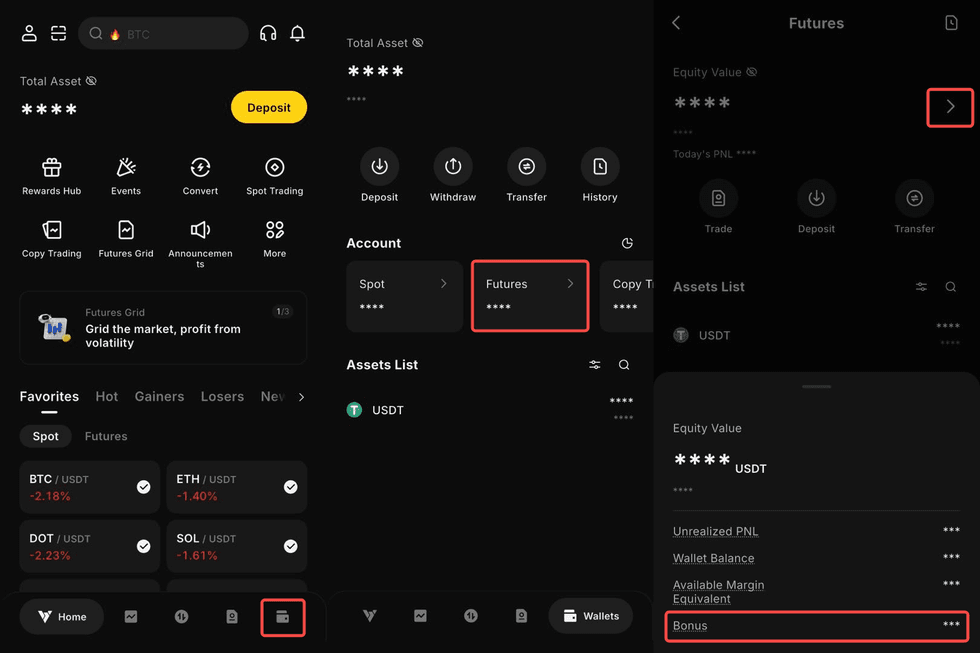
The practical value of a crypto bonus depends on its permitted use. BYDFi’s Futures Bonus, for example, applies to USDT-M futures, which are futures contracts margined in USDT.
According to BYDFi’s usage instructions, the bonus can cover trading fees, funding fees and realised losses. It can also serve as margin when the account’s USDT balance is insufficient. For an eligible user already trading that product, these are specific uses beyond the headline reward amount.
The bonus itself cannot be withdrawn, although profits earned using it can be withdrawn. There is an important consequence to moving funds out: withdrawing assets from the Futures Wallet before the bonus is fully used causes the remaining bonus to be forfeited. Unused bonuses are also reclaimed at expiry.
Other rewards have different functions. A fee voucher offsets eligible futures trading fees but cannot be used as margin or withdrawn. Readers should therefore identify the reward type before treating its stated value as a cash benefit.
How to buy USDT without confusing a purchase with a deposit
For readers considering how to buy USDT, the funding source matters as much as the purchase itself. BYDFi provides a Buy Crypto page, but the payment methods available and the requirements attached to a transaction should be checked before proceeding.
The Rewards Hub formula lists P2P and fiat purchases among its additions. That gives readers more useful information than a blanket assumption that every purchase is excluded. However, a particular route still needs to match the applicable task’s conditions.
Exchanging crypto already held in an account is a different action from bringing in new funds. It changes the assets held without necessarily increasing qualifying net deposits. Similarly, using an existing fiat balance should not be assumed to create a second qualifying deposit merely because a purchase has taken place.
Following a task through to a claimed reward
After registering for an account to participate in BYDFi’s new-user reward tasks, eligible users should visit Rewards Hub before completing any qualifying activity. BYDFi’s terms identify that visit as the participation-registration step.
A practical review follows the task from entry to payment:
- Check the required action, accepted funding methods and any deposit or trading threshold.
- Note the completion deadline and any holding period. Some tasks also require identity verification before a reward can be claimed.
- Check recorded progress rather than relying solely on a transfer receipt. BYDFi says progress updates may take up to 30 minutes.
- Claim the completed reward manually within its designated claim period.
- Check My Rewards after approval. Rewards undergo a risk review that BYDFi says typically takes up to seven calendar days.
Keeping tasks and reward records in the same hub makes these stages easier to follow. It also helps separate completing an activity from receiving a reward that is ready to use.
Before choosing a task, compare the usable reward with any fees, funding charges and trading risk involved. Trading solely to reach a target can cost more than the reward provides. The relevant figure is the reward available for an activity that suits the user’s circumstances, with its funding and usage conditions understood.