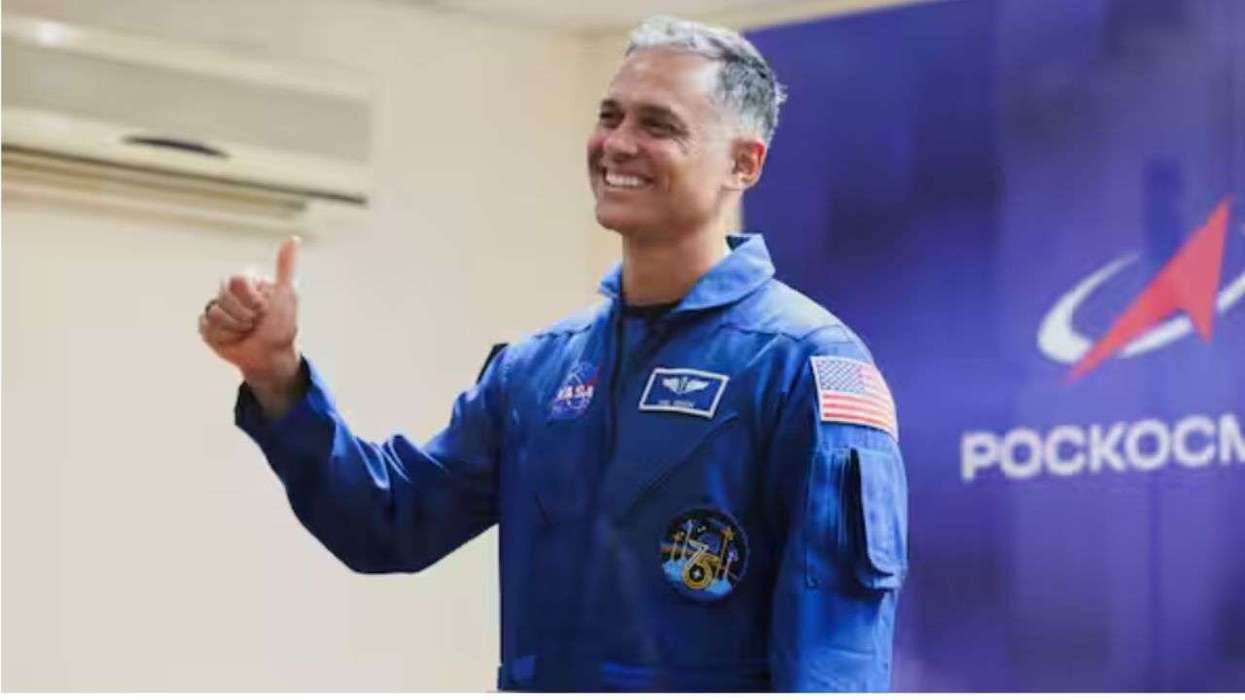

- Anil Menon reached the International Space Station on his first space mission.
- The eight-month expedition will focus on AI, medical research and semiconductor technology.
- Menon travelled aboard Russia's Soyuz spacecraft under the long-running US-Russia seat exchange programme.
NASA astronaut Anil Menon has arrived at the International Space Station (ISS) for his first space mission, beginning an eight-month expedition that will focus on artificial intelligence, medical technology and space-based manufacturing.
Menon travelled to the orbiting laboratory aboard Russia's Soyuz MS-29 spacecraft alongside Russian cosmonauts Pyotr Dubrov and Anna Kikina. The spacecraft lifted off from the Baikonur Cosmodrome in Kazakhstan on Tuesday (14), completing the journey to the ISS in about three hours.
The mission is part of the long-standing US-Russia seat exchange programme, under which astronauts from both countries fly on each other's spacecraft to ensure continuous joint operations aboard the ISS. Despite ongoing geopolitical tensions, the arrangement has remained in place as the multinational space station continues to operate ahead of its planned retirement in 2031.
A mission centred on science and future space travel
Over the next eight months, Menon will lead and support a series of scientific experiments aimed at preparing astronauts for longer missions beyond Earth's orbit.
According to NASA, one project will study how semiconductor crystals can be manufactured in microgravity, research that could improve the production of components used in high-performance computing, artificial intelligence systems and advanced medical devices.
Menon will also carry out ultrasound procedures using augmented reality and AI-assisted techniques that could reduce the need for medical support from Earth during future deep-space missions. Another experiment will focus on bioprinting vascular tissue in microgravity to help scientists better understand ageing and support the development of new medical treatments.
Menon, a physician and US Space Force colonel, joined NASA as a flight surgeon in 2014 before being selected as an astronaut in 2021.
In addition to conducting research, he will also participate as a test subject in a study examining how blood circulation changes in space. Researchers hope the findings will help develop measures to protect astronauts during extended missions.
For the next two weeks, the International Space Station will host a crew of 10, comprising four Americans, one European astronaut and five Russian cosmonauts.
NASA Administrator Jared Isaacman congratulated the crew after their arrival, reportedly saying their mission was only just beginning and wishing them success in advancing scientific research while inspiring people back on Earth.

 Nathan FielderGetty Images
 A poster of the documentaryA24