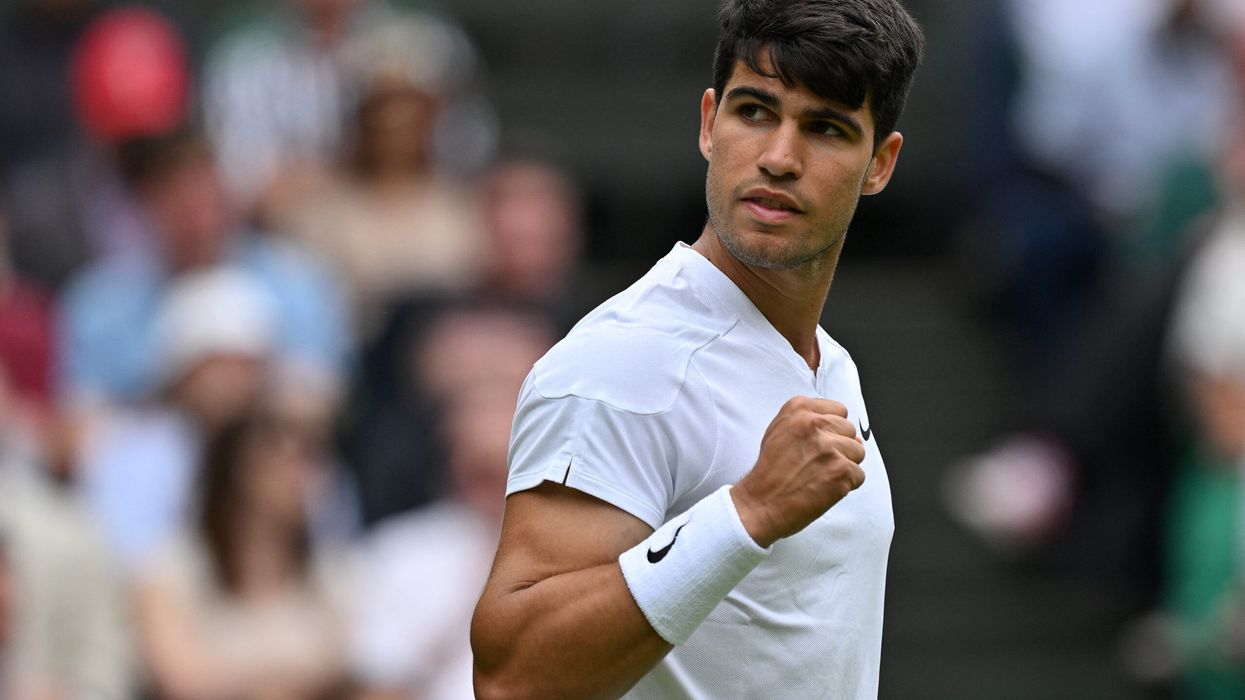

Carlos Alcaraz, the defending champion, overcame a spirited challenge from Estonian qualifier Mark Lajal, securing a 7-6(3), 7-5, 6-2 victory to move into the second round at Wimbledon on Monday.
The 21-year-old Spaniard, fresh from his maiden French Open victory last month, faced a tough test in his opening match at the All England Club before getting the better of Lajal after a two-hour, 22-minute battle.
Alcaraz, who had become the youngest player in history to win a major on all three surfaces – clay, hard, and grass – with his triumph at the French Open last month, played some powerful groundstrokes, and his drop shots were effective.
In the first set, the third seed Alcaraz dropped serve midway through but battled back to win it in a tiebreak. Lajal, ranked 269th in the world, broke Alcaraz again early in the second set. However, the Spaniard quickly responded by breaking back to love and then took the lead in the 11th game. With momentum on his side, Alcaraz dominated the third set, finishing the match with a brilliant backhand crosscourt winner.
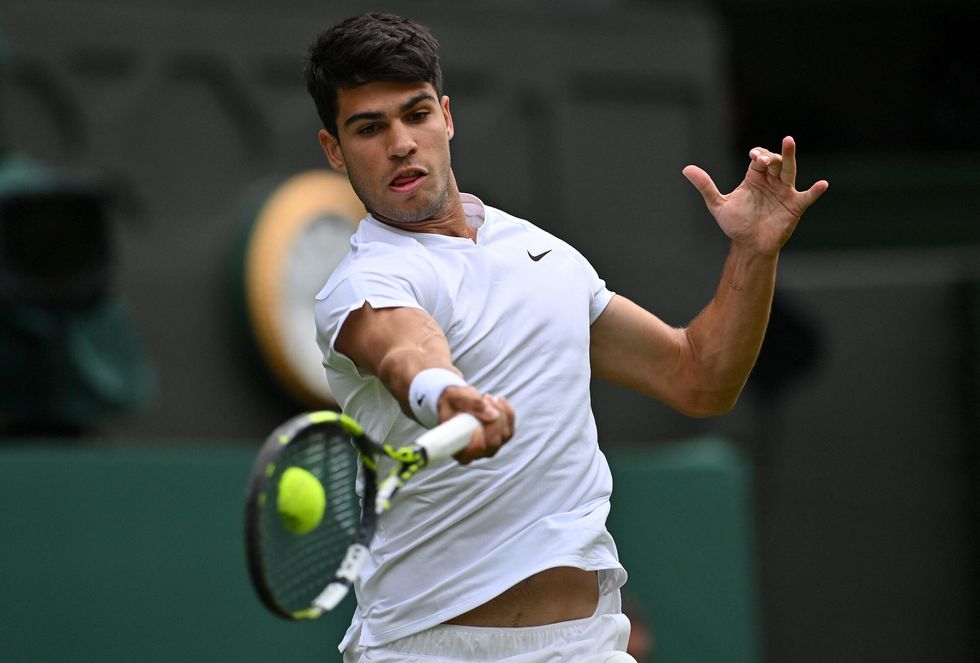 Alcaraz is vying to become the third player in the Open Era to win multiple Wimbledon men's singles titles aged 21 or under. (Photo: Getty Images)
"He played a good match, obviously surprised me a little bit because I didn't have the chance to see him play a lot. He has a great level, he's really young, my age," Alcaraz said after the match. "I'm sure I will play against him even more on the tour and I'm really happy to get my first win on Centre Court this year."
The lowest-ranked player to defeat Alcaraz at a Grand Slam was 95th seed Mikael Ymer in the second round of the Australian Open in 2021.
Alcaraz, who became the first player outside of the Big Four of Roger Federer, Rafael Nadal, Novak Djokovic, and Andy Murray to win Wimbledon since 2002 last year, admitted to feeling nervous on Wimbledon's Centre Court, despite his previous successes there.
"Stepping on this court, it's the most beautiful court I've played on. I still get nerves when I'm playing here," he said. "I played for 45 minutes here on Thursday and it's the first time I get nervous practising. I'm glad and I'm a privileged guy to play on this court."
Lajal, also 21, was making his Grand Slam debut. Despite his limited experience, he managed to break Alcaraz's serve first in both the opening and the second sets but could not sustain the advantage. His performance, however, was commendable given his ranking and experience level.
Before the match, Lajal had never won a Grand Slam qualifying match and had only two wins on the ATP Tour. His run at Wimbledon, though brief, showcased his potential. Lajal's highest-ranked victory came against number 78 James Duckworth in the final round of Wimbledon qualifying.
 Lajal, the 21-year-old Estonian, was making his Grand Slam debut. (Photo: Getty Images)
Alcaraz's victory continues his perfect record against qualifiers at Grand Slams, extending it to 7-0. The Spaniard is aiming to join an elite group of men, including Rod Laver, Bjorn Borg, Roger Federer, Rafael Nadal, and Novak Djokovic, who have won the French Open and Wimbledon back-to-back.
Alcaraz is also vying to become the third player in the Open Era to win multiple Wimbledon men's singles titles aged 21 or under.
Alcaraz's next match will be against either Australia's Aleksandar Vukic or Austria's Sebastian Ofner. With his confidence bolstered by the first-round win, Alcaraz will look to build on his performance as he aims for another deep run at Wimbledon.
Lajal, despite the loss, leaves Wimbledon with valuable experience and the knowledge that he can compete with top-tier players.
(With inputs from AFP and Reuters)