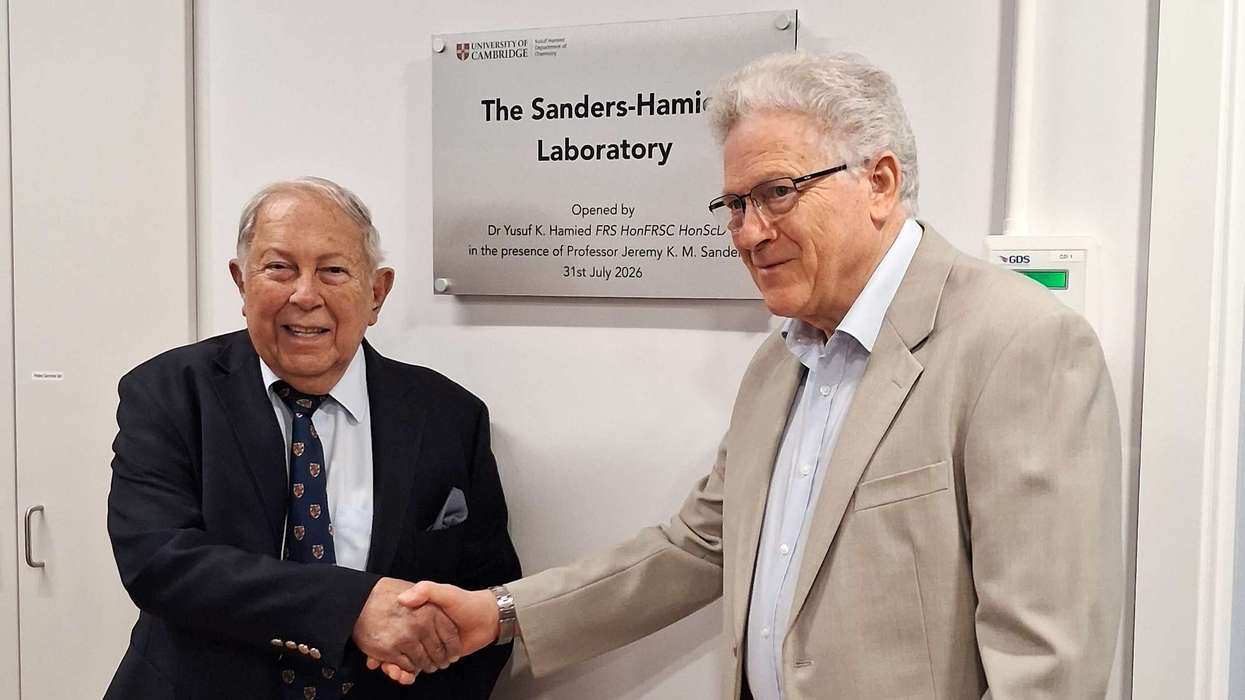

Dr Yusuf Hamied was in a nostalgic mood at the formal inauguration of two laboratories in the department of chemistry at Cambridge University which have been completely refurbished and modernised with his financial help.
“I’m just happy to be here,” said the head of Cipla, the Indian pharma giant, at the function which took place on Friday (31).
Hamied, who celebrated his 90th birthday on 25 July, 2026, added: “I wish I was a student again.”
The vice chancellor of Cambridge University, Prof Deborah Prentice, described the wider impact of the “extraordinary generosity” shown by the Yusuf and Farida Hamied Foundation (which has also supported Eastern Eye’s Arts, Culture & Theatre Awards).
She said: “The impact of Yusuf and Farida’s gift will be felt far beyond Cambridge. The research generated by these laboratories will contribute to addressing global challenges from health to sustainability to technology and fundamental science. This will reinforce Cambridge’s role in generating knowledge for the public good. So the gift is an investment, not just in in buildings, but in people and in ideas yet to come.”
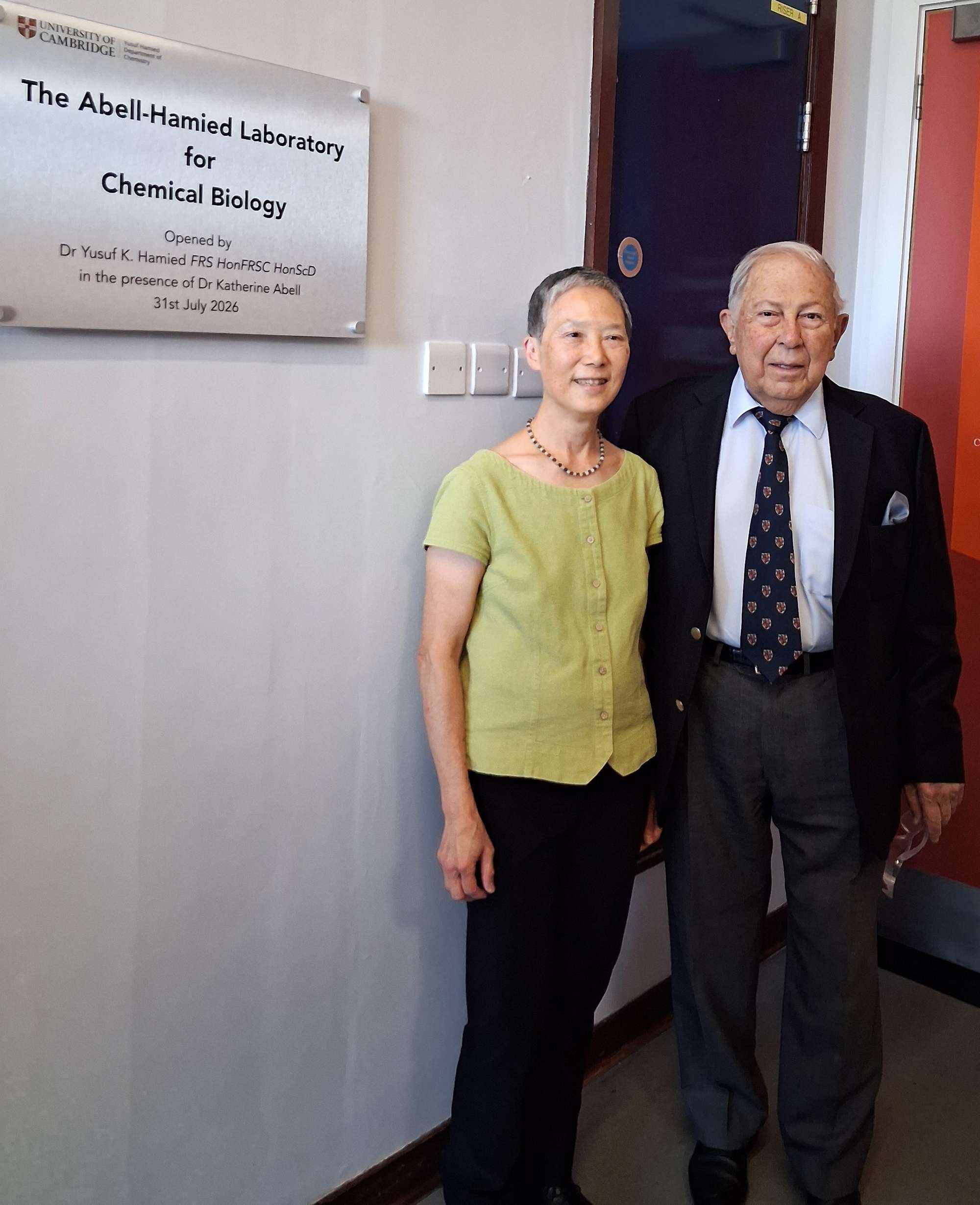 Katherine Abell and Yusuf Hamied Amit Roy
The university’s chemistry department – renamed the “Yusuf Hamied Department of Chemistry” in 2020 – has been at Lensfield Road in Cambridge since 1957. There is a plaque at the entrance to the building, stating the building was formally opened by Princess Margaret, then Queen Elizabeth’s 28-year-old younger sister, on 11 November 1958.
But Hamied started using the building in 1957 as a PhD student when it was first put up. He had read chemistry as an undergraduate at Christ’s College, Cambridge, from 1954-1957 and obtained a First, qualifying him to begin his PhD.
He recalled he was admitted to Cambridge by Sir (later Lord) Alexander Todd, Professor of Organic Chemistry at Cambridge. Todd was also a Professorial Fellow at Christ’s and had the authority to admit Hamied to the College as an undergraduate.
On a visit to Bombay in 1953, Hamied’s father, Khwaja Abdul Hamied – he had established Cipla in 1935 to make medicines for India – asked Todd: “How do you admit students to Cambridge?”
Todd replied: “If we like the student, we take him.”
Hamied said: “That’s how I got in with only ‘O’ levels, and came up the ladder until 1957 when this lab department at Lensfield Road opened for the first time for PhD students. So my association with this department goes back a long time.”
The department contains the “Todd-Hamied (seminar) Room”, opened in 2004; plus, there is now a generous fund Hamied has set up for talented students.
He told the assembled dons and students: “I was glad to see a number of your students who are recipients of the Yusuf Hamied Chemistry Fund, and that is something I’m very proud of. My association with the department of chemistry here is till the end of time because this is a grant given forever.”
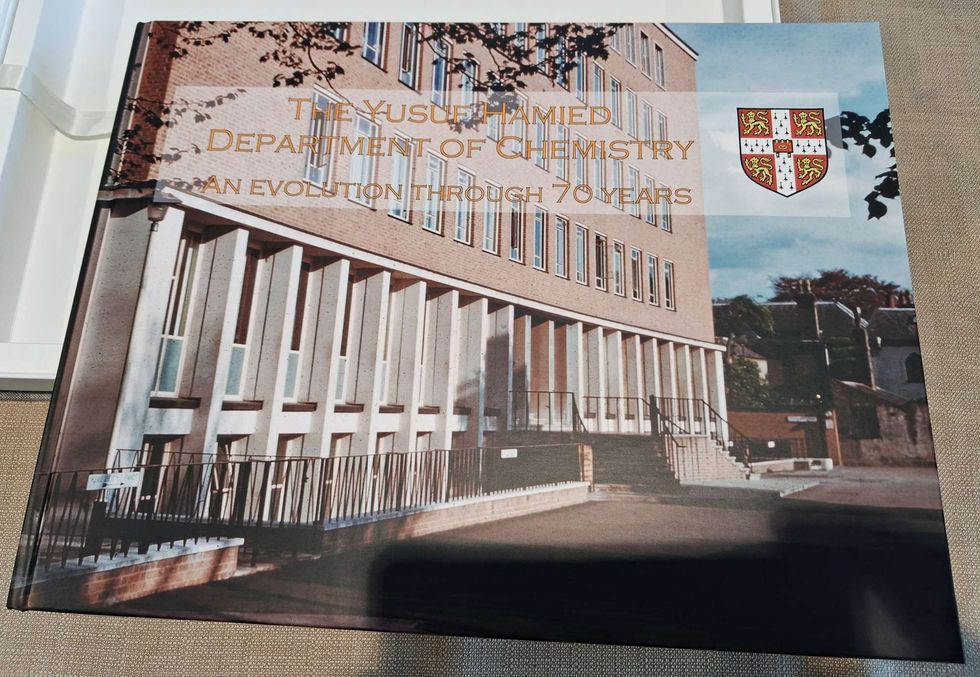 The album gifted to Yusuf Hamied Amit Roy
The first plaque he unveiled was for “The Abell-Hamied Laboratory for Chemical Biology”, in memory of Prof Chris Abell, whose sudden death at the age of 62 on 26 October 2020 caused widespread shock across the academic community.
He was a professor of biological chemistry at the chemistry department, and also the Todd-Hamied Fellow at Christ’s College. On his 2016 election to the Royal Society, Abell’s research was described as having “changed the face of drug discovery”.
With Hamied standing next to her, his widow, Katherine Abell (she told Eastern Eye she met her husband when they were both PhD students at Cambridge), spoke of her husband’s legacy: “Chris was a son of the University of Cambridge, and also of this department.”
She sketched out his academic work: “From a rural village up in Yorkshire, he came to Cambridge to do his undergraduate (degree), and then stayed on to do his PhD with Professor Jim Staunton. After a very brief period of postdocing in the States, he came back to this department where he built his life’s work. And in the last few years of his life, he took on the senior leadership role in the university – as pro- vice chancellor of research.”
She said: “He was a visionary who knew that the future may be shaped and influenced by the actions you take today in the present. So he went about his life and his work with purpose, always striving for excellence and reaching for the stars. His achievements and his contributions were acknowledged and recognised by his peers and the scientific community.
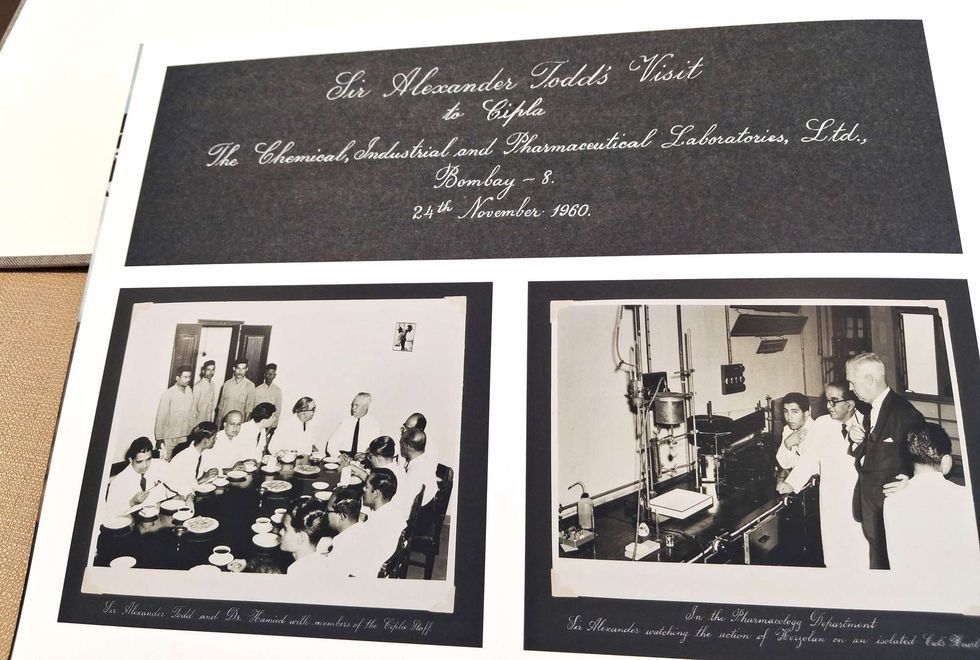 Todd visit to Cipla in Bombay in 1960 (from the album) Amit Roy
“He was elected fellow of the Royal Academy of Medical Sciences. He was elected fellow of the Royal Society, and the Royal Society of Chemistry awarded him the interdisciplinary prize for his pioneering work across boundaries of the fields of chemistry, biology, physics, and engineering.
“But for those of us who travelled with him a long way, we remember a force of nature, full of energy. He was also warm, kind, open, and when you had a conversation with him, you knew he paid you 100 per cent attention, and you came away with feeling a little lighter, a little brighter, with a bit more hope, because the world was definitely much better for having someone like Chris Abell among us.”
She added: “I’m humbled and honoured to be here to stand amongst giants, that of the past and those of the present. I thank Yusuf for your continued generous support to the department, and I thank the collective decision to remember Chris in this way.
“I’m sure that the improved facility will immediately have an impact on the current cohort of researchers, and also for many generations to come. May some of them be curious enough to ask, ‘Who are these people? Who is Abell? Who is Hamied?’ And in discovering their histories, I hope that some of them will be inspired to become leaders in their generation, to strive for the excellence that they are capable of, and to reach for the stars.”
She and Hamied were applauded by students as they entered the lab which now bears Abell’s name.
Explaining the wider significance of the work being done at Cambridge, Prof James Keeler, head of the chemistry department, told Eastern Eye: “This is the Abell-Hamied Laboratory. This is chemical biology. We think of biological problems, but from a very chemical point of view. That’s really the distinctive thing, as opposed to classical biochemistry.
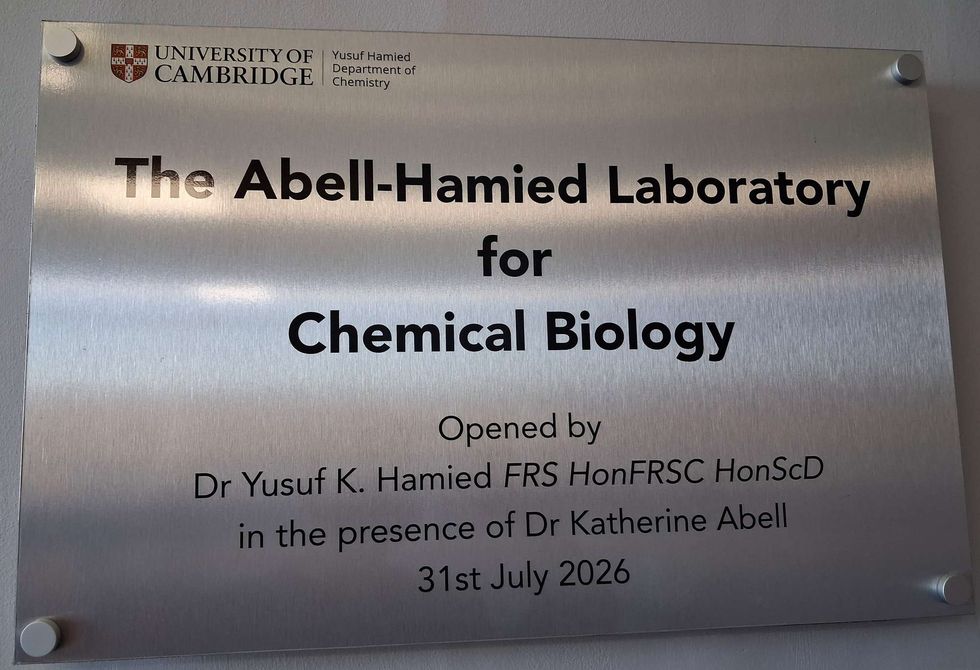 Abell-Hamied plaqueAmit Roy
“Part of this lab has got Jenny Zhang’s group in it, and they are pushing this even further because they’re looking at how you can change the mechanism of photosynthesis and adapt that for energy capture and do solar-driven chemistry.”
Asked about the importance of the work that had been done by Abell, Keeler replied: “The thing about Chris Abell was he came here to really reinforce the chemical biology that was his speciality. Chris developed the whole kind of chemical biology thing to a much higher level than it had been done before. But he also developed work on microfluidics as well. It has biological applications. It’s one of those things that just kind of came out of his work. So when Katherine (Abell) said he was a visionary, this is actually very true because not only was he a visionary in chemical biology, he suddenly thought, ‘Oh, there is something else I could do with this,’ and set off on that way.”
Keeler commented on the new labs: “These are the sorts of labs that he (Abell) would have liked to have had. The basic envelope is the same, but what has changed was that this lab (previously) didn’t have a separated area for offices, so the students had to sit at the experimental areas. We have redeveloped the cold room and things here that they use for the biological preparations to keep them separate. And we’ve taken the opportunity to put in all sorts of facilities that you need for biological work that they didn't have before, like tissue culture.”
Asked about the relative values of pure research versus research done with a practical application in mind, he replied: “I think it’s a bit of a combination of both. The ultimate driver is inquiry about what what’s going on. How do we understand this? But, of course, people always have an eye on whether there are applications and as to whether there’s a possibility of translation. But that’s not the primary driver. We are about fundamental research here. History shows that fundamental research leads to innovation.”
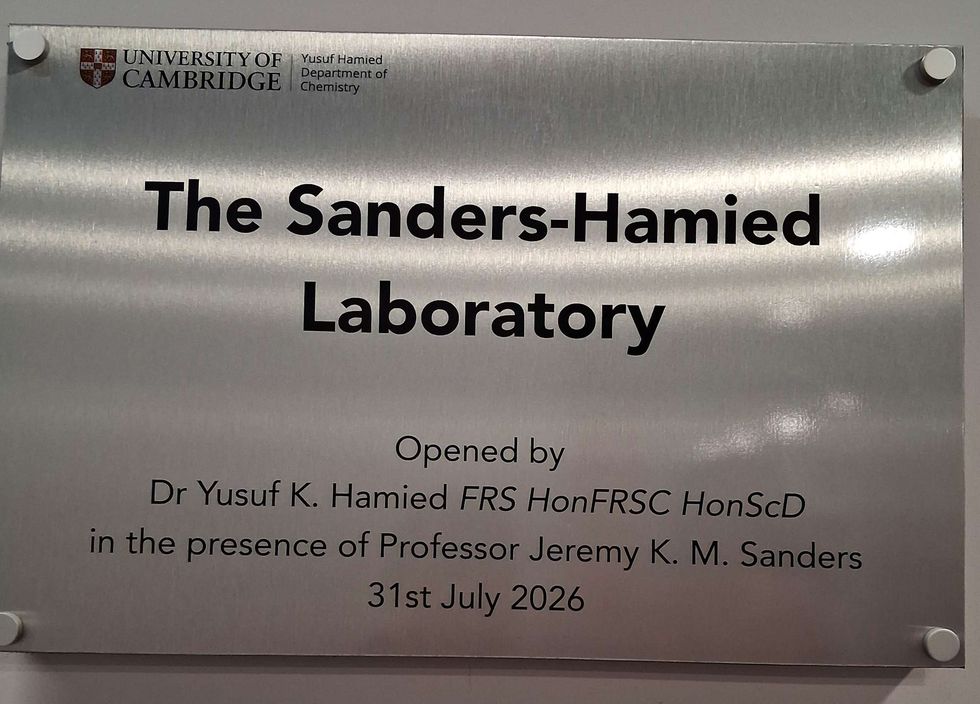 Sanders-Hamied plaque Amit Roy
He spoke of the work being done one floor up in the Sanders-Hamied Laboratory, which had also been modernised with Hamied’s help.
“There are two other groups up there,” said Keeler. “There’s Jonathan Nitschke Group – and they’re doing macromolecular chemistry, which is about assembling very large molecules from pieces that have particular properties. You might use them for storing hydrogen, you might use them as catalysts and that sort of thing. And then the other group that’s upstairs is (led by) Matteo Sanchez. He’s a Wellcome research fellow, and he’s got again a very hybrid outfit. Some of it is very biological, looking at how neurons work in vision. Some of it is very chemical, synthesising the various molecules they need for their work.”
Those working in the labs were “a mixture of PhD students and postdocs”.
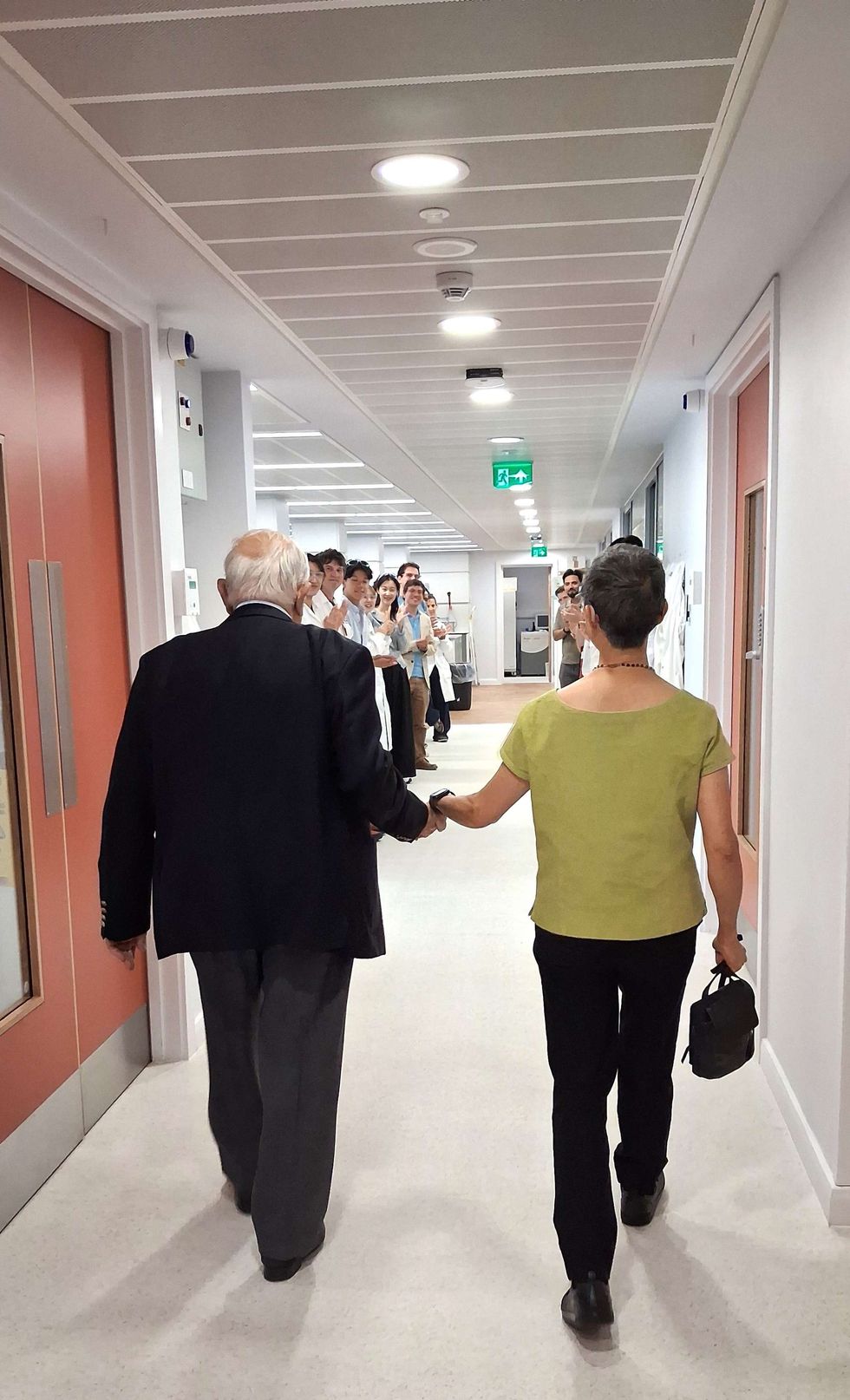 Yusuf Hamied & Katherine Abell meet students Amit Roy
Asked whether they represented “the best of the best”, Keeler said: “We would like to think so. It’s our brand. The excellence of the science attracts the excellent students, attracts the excellent postdocs, attracts the excellent new members of academic staff, so it’s very important for us to maintain this high profile.
“When it comes to research, is it still important for Cambridge to do pure research without being forced to do something that will have an application that might come later. Pure research is always important – the whole point about research is you don’t know where it’s going. If you only say I’m going to do this because it’s going to have this outcome, you’ve automatically limited yourself to essentially a predetermined path.
“The trouble with a lot of government funding, I have to say, is that because they’re always looking at the outputs, they will only basically fund very conservative, very incremental research. You need to have good people, who are free to think, ‘What if I tried this? What if I did that? How about this completely different way of thinking about things, and then see what comes of that?’ You really need both. But if you only have applied research, you’re not going to find out anything fundamental.”
Talking about Hamied, he said: “Obviously, Yusuf and Cipla are all about applying science, but he has always understood, through his support for us, that that’s only possible if you have this underpinning, not only the people who we train here, who might go on to work in industry, but also the ideas that come up through here.”
In the world ranking, the chemistry department at Cambridge, he said, was generally ranked third after Stanford and the Massachusetts Institute of Technology (MIT).
He acknowledged the American universities had a lot more money but their prestige drew in the best talent. He was in favour of having open borders for scientists without imposing immigration hurdles.
“Absolutely, yes,” he declared. “The academic staff here are from all over the world, literally, and the research students and postdocs also literally from all over the world. That mobility, bringing in new ideas, new perspectives, is really important.”
Unlike other science departments, which have moved to new campuses outside the city, the chemistry department would stay put in Lensfield Road.
Keeler confirmed: “We have decided very firmly we’re planting our flag here. The building is 70 years old, but it’s basically in a very good state. This refurbishment is basically possible because the structure is sound.”
The Sanders-Hamied plaque was unveiled jointly by Prof Jeremy Sanders and Hamied.
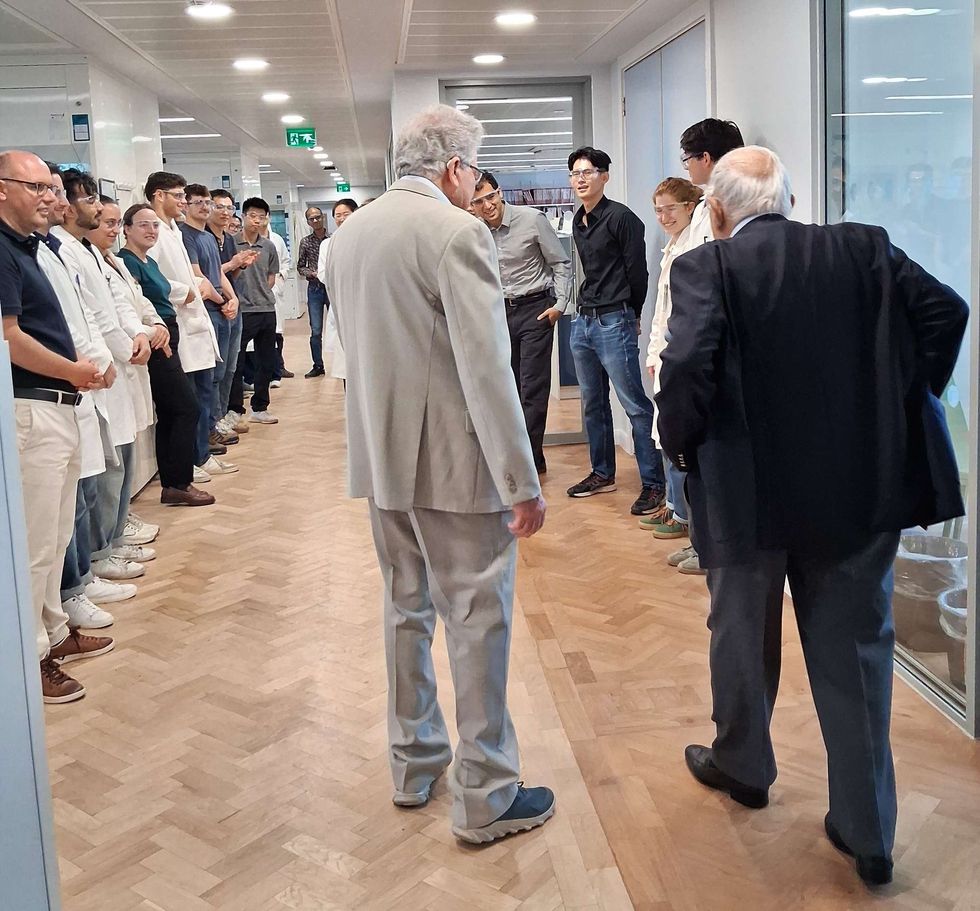 Yusuf Hamied and Jeremy Sanders meet studentsAmit Roy
Sanders said: “More than 20 years ago, I was head of chemistry (from 2000-2006), and Yusuf came to see me. As a result of several conversations, he gave us our first big donation, which was for the Todd-Hamied (seminar) Room.
“The room previously was a cold, drafty, dark, miserable room called G19. Yusuf, you transformed the Todd-Hamied room, and over the last 20 years, you have transformed chemistry in Cambridge, and transformed the way that we all were able to live as chemists here.
“Thirty years ago, when I was promoted to professor, I had the opportunity to redesign this lab. I had wonderful students and postdocs who produced great science, but 30 years on, it was time to reinvent it, reimagine it, revive it, and that’s what you’ve enabled us to do. The students and postdocs I had were brilliant people doing wonderful science. The next generation and the next one after that will benefit from what you’ve done here, and, of course, through the whole department.”
In an interview with Eastern Eye, Sanders said that to mark the founding of Cambridge University in 1209, “there was an 800th anniversary fundraising campaign, which I was marginally involved in. But separate from that was an 800th year celebration, and I was in charge of the celebration, a year-long party. Cambridge was given a royal charter around 1245, and the first college was Peterhouse in 1280.”
Asked about the big breakthroughs in the chemistry department that he could remember, he said: “Professor Steve Ley – he is here - came to Cambridge in 1992. This great synthetic chemist developed new ways of making molecules, which were very important, very influential in the pharmaceutical industry.
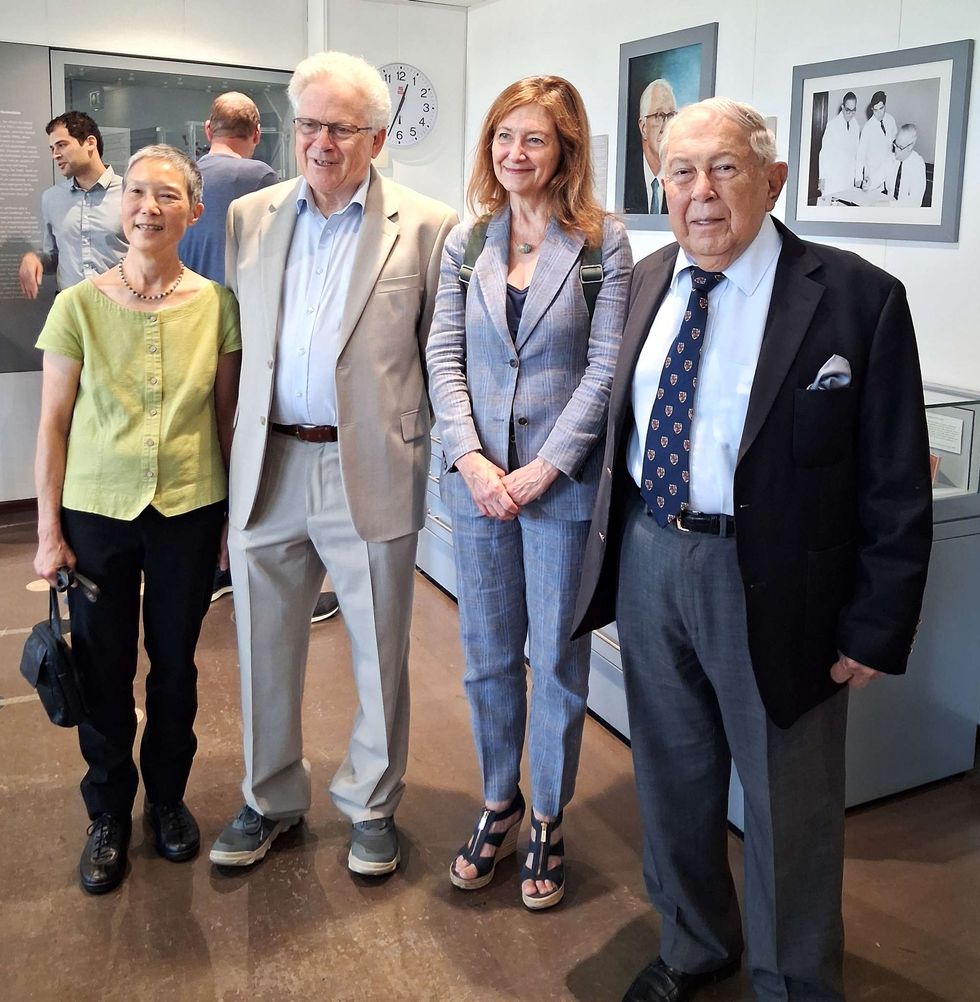 (From left) Katherine Abell, Jeremy Sanders, Deborah Prentice and Yusuf Hamied Amit Roy
“My research group was involved in developing new ways of making molecules that were inspired by evolution in nature. In nature you see evolution. Successive generations of animals or plants mutate slightly to optimise their performance, optimise their chance of being successful, and we invented a way of doing the same thing in this laboratory in the 1990s and the 2000s.
“But, you know, science advances through many small steps. But the other big step was by Shankar Balasubramanian. So, in 1997, he and David Klenerman, who is also here, invented rapid DNA sequencing. And that has transformed the way we do medicine, the way we do biology.
“Now, many children have their DNA completely sequenced when they’re born, and you can then very rapidly see if they are susceptible to particular kinds of illnesses and deal with it.
“During COVID, we knew about the mutations. Different versions of COVID came along. The only reason we could follow those and track those was because of the invention of superfast DNA sequencing here in this department and in the pub at the Panton Arms next door.
“The Panton Arms, a pub just around the corner, is the chemistry pub. That’s where they had the first idea for next-generation DNA sequencing. And I think that’s probably the most important thing that’s come out of this department in the last 50 years.
“A lot of important science has come out of this building. Just as important as the discoveries I can tell you about is that every year these young people learn how to be independent scientists, and they go off into academia, into industry, into government. They use what they’ve learned here about how to be great scientists for the benefit of everybody, so that’s what I’m most proud of. It’s not only the discoverers, but the wonderful young people that we train and create.
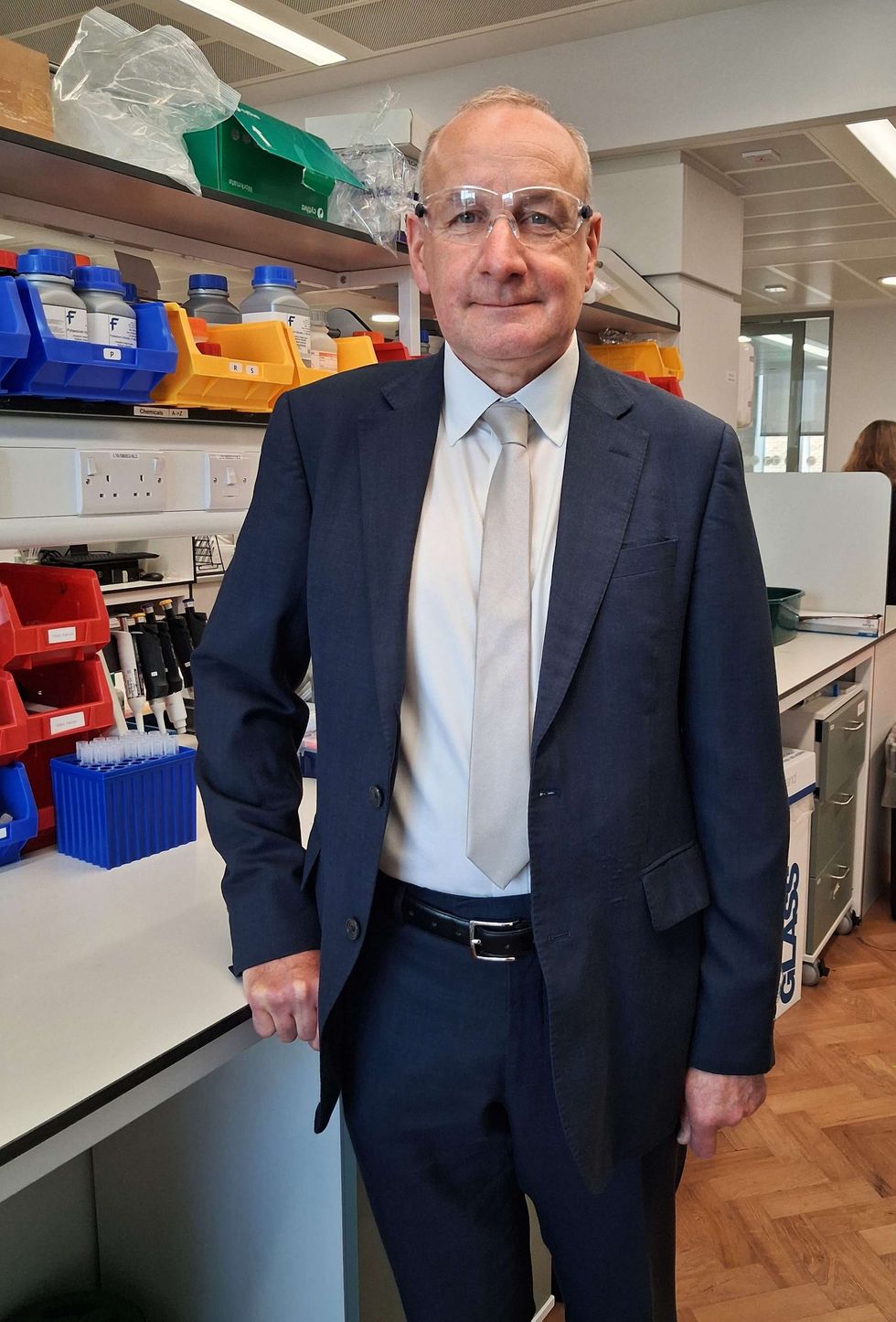 James Keeler Amit Roy
“James Keeler has been a brilliant head of department. I recruited him to this department in 1983 when he was a student. He retires from being head of department in September. So yes, we invest in people, but in order to invest in people, we need facilities like this (refurbished lab) for them to come here, to be attracted here, and to do great things.”
Speaking in the Todd-Hamied Room, the vice chancellor of Cambridge University, Prof Prentice, said: “Yusuf, of course, has a deep and enduring connection with the department of chemistry, beginning in his years as a student here, and extending through decades of engagement, partnership, and support,” she began.
She confided: “You have no idea how difficult it is to find support to refurbish existing laboratories, and it’s in so many ways the support we need the most because it very directly enables the science and education and innovation and impact that we’re all about. And yet very few donors understand the impact that this kind of funding can have. Yusuf understands, and we’re so grateful for it.”
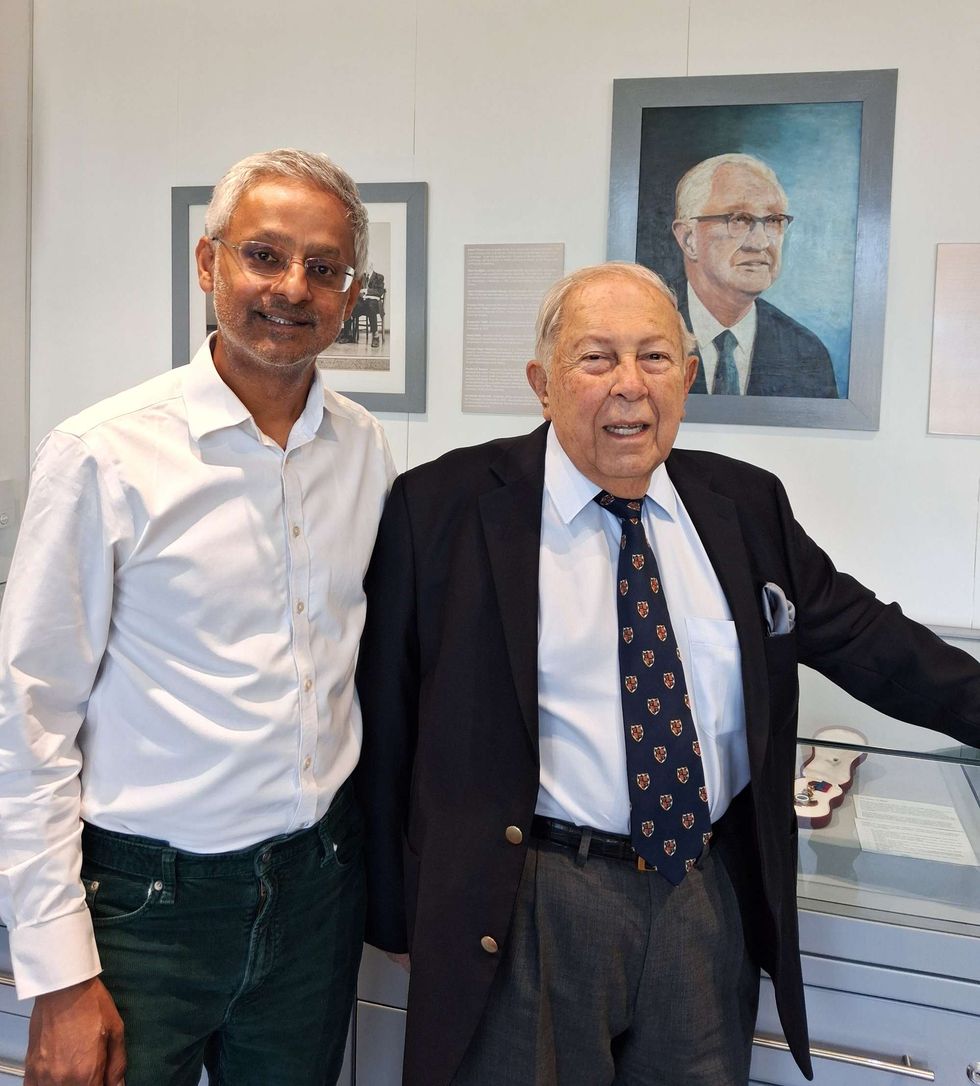 Shankar Balasubramanian with Yusuf Hamied Amit Roy
She spoke of the wider impact of Hamied’s decision to help the chemistry department: “It’s funded the creation of state-of-the-art safe and sustainable laboratory spaces, facilities designed to enable the discovery of new science. These are environments that encourage curiosity, collaboration, and discovery. They are 21st-century science spaces. They will serve generations of Cambridge scholars. They will be fantastic for students, providing inspiring spaces to learn and train scientists. They will be fantastic for researchers, providing them with tools and settings to pursue ambitious questions, and they will be fantastic for staff – the staff who run these laboratories – supporting excellence over the long term.
“Yusuf’s philanthropy reflects a commitment to access, impact, and social responsibility – a belief that science should improve lives far beyond the university. That’s a belief that we across the university wholeheartedly share, and we’re so grateful that Yusuf’s generosity enables us to realise it. Indeed, it’s our partnership around this shared endeavour that we celebrate today.”