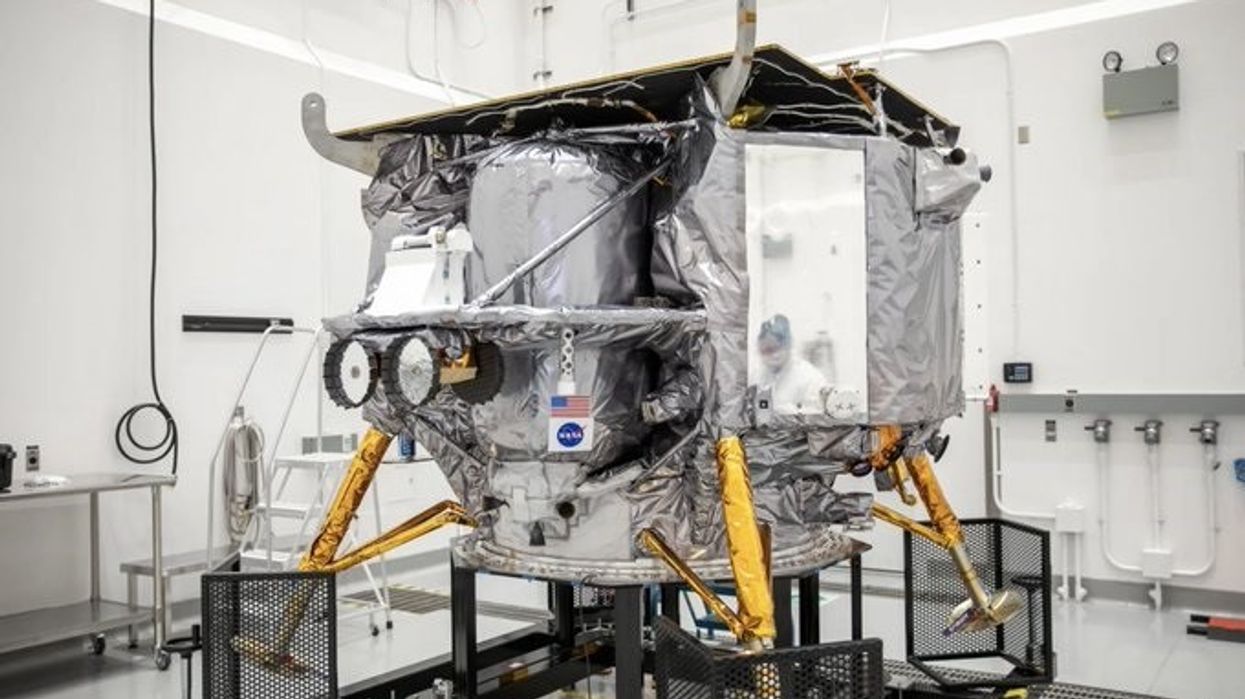

The head of a potentially pioneering private company has revealed that, more than 50 years after the final Apollo mission, the United States will endeavour to land a spacecraft on the Moon again on January 25.
The lander, named Peregrine, will have no one on board. It was developed by American company Astrobotic, whose CEO John Thornton said it will carry NASA instruments to study the lunar environment in anticipation of NASA's Artemis manned missions.
Several years ago, NASA opted to commission US companies to send scientific experiments and technologies to the Moon -- a programme called CLPS.
These fixed-price contracts should make it possible to develop a lunar economy, and provide transport services at a lower cost.
"One of the big challenges of what we're attempting here is attempting a launch and landing on the surface Moon for a fraction of what it would otherwise cost," said Thornton Wednesday (29) at a press briefing at his company's base in in Pittsburgh.
"Only about half of the missions that have gone to the surface of the Moon have been successful," he said.
"So, it's certainly a daunting challenge. I'm going to be terrified and thrilled all at once at every stage of this."
Takeoff is scheduled for December 24 from Florida aboard the inaugural flight of the new rocket from the ULA industrial group, named Vulcan Centaur.
The probe will then take "a few days" to reach lunar orbit, but will have to wait until January 25 before attempting landing, so that light conditions at the target location are right, Thornton said.
The descent will be carried out autonomously, without human intervention, but will be monitored from the company's control center.
In the spring, the Japanese start-up ispace had already attempted to become the first private company to land on the Moon, but the mission ended in a crash. Israel also suffered a setback in 2019.
Only four countries have successfully landed on the Moon: The United States, Russia, China and, most recently, India.
In addition to Astrobotic, NASA has signed contracts with other companies, such as Firefly Aerospace, Draper and Intuitive Machines.
The latter is due to take off aboard a SpaceX rocket in January.
"NASA leadership is aware of the risks and has accepted that some of these missions might not succeed," said Chris Culbert, the CLPS programme manager.
"But even if every landing isn't successful, CLPS already had an impact on the commercial infrastructure needed to establish a lunar economy," he said.
With its Artemis programme, NASA wants to establish a base on the surface of the Moon.
(AFP)