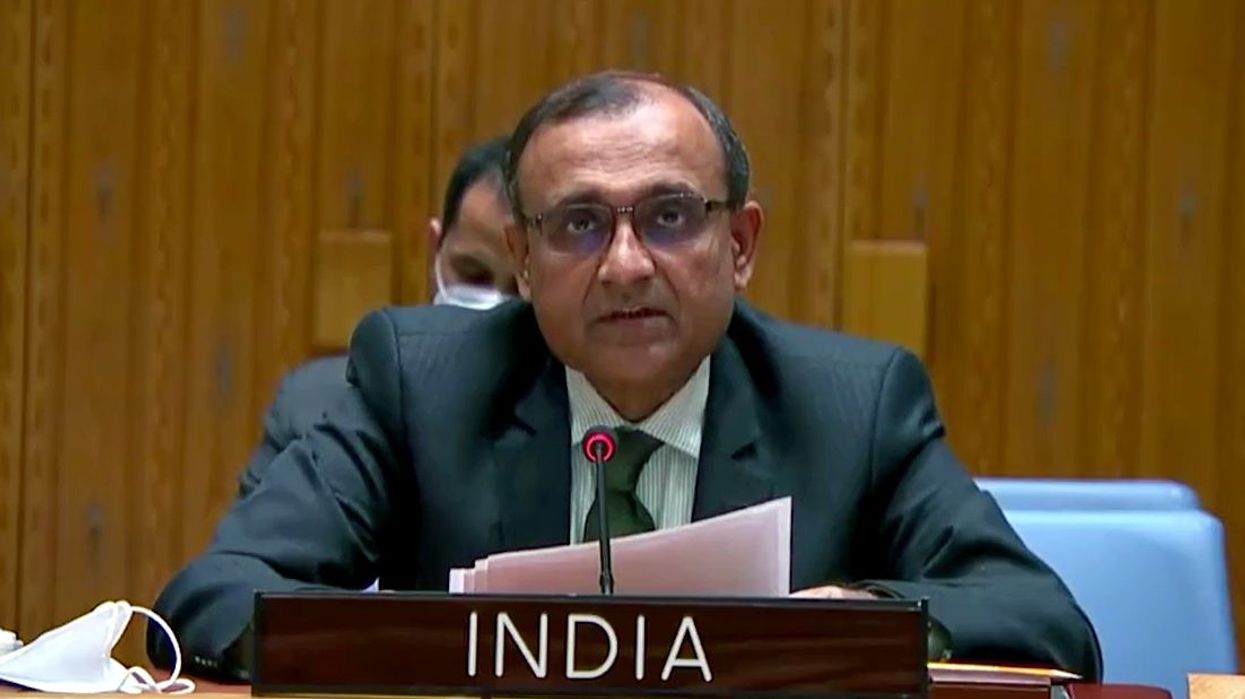

There cannot be 'double standards' on 'relegiophobia' and combating the issue should not be a "selective exercise" involving only one or two religions but apply equally to phobias against non-Abrahamic religions, India said at the United Nations.
Addressing the UN, Ambassador TS Tirumurti said, "As we have emphasized, combating religiophobia should not be a selective exercise involving only one or two religions but should apply equally to phobias against non-Abrahamic religions as well. Till this is done, such international days will never achieve their objectives. There cannot be double standards on religiophobia."
While addressing the UN to mark the first anniversary of the International Day on countering hate speech, the Indian envoy said, "Aberrations are dealt with within our legal framework and we do not need selective outrage from outsiders, especially when they are self-serving - even communal in nature, and pursuing a divisive agenda."
Undermining the importance of education, Tirumurti said that education plays an important role in combating radicalization, violent extremism, and terrorism.
He further said, "We call on countries to develop an education system that truly contributes to combating them by promoting the principles of pluralism and democracy."
Indian Ambassador to UN said that the society should be built on the pluralism where every society is respected. He further added that pluralistic tradition is recognized in the resolution piloted by the United Arab Emirates and Egypt on the International Day of Human Fraternity.
"India has embraced both these principles - democracy and pluralism. And we call on all countries to adhere to these principles to ensure that intolerance is addressed within a Constitutional framework," the Indian envoy said.
Earlier, on Wednesday, TS Tirumurti met with UN Ambassadors from the Quad (Australia, India, Japan & the United States), in New York.
Tirumurti met US Ambassador Linda Thomas-Greenfield, Australian Ambassador Mitch Fifield, and Japanese Ambassador Kimihiro Ishikane.
"Following the Quad Leaders' Summit in Tokyo, @UN Ambassadors from the Quad (Australia, India, Japan & the United States) met again in New York today. We discussed ways to strengthen the rules-based international order and reinforce efforts at the UN to tackle global challenges," tweeted Tirumurti.
All four nations find a common ground of being democratic nations and common interests of unhindered maritime trade and security.
Amid reports of China and Russia coming closer, the US has planned to "enhance cooperation, engagement, strategic and economic ties" with its Quad partners. As competition continues between China and members of the Quad, it will be critical to find ways to creatively engage in ways that mitigate risk.
(ANI)