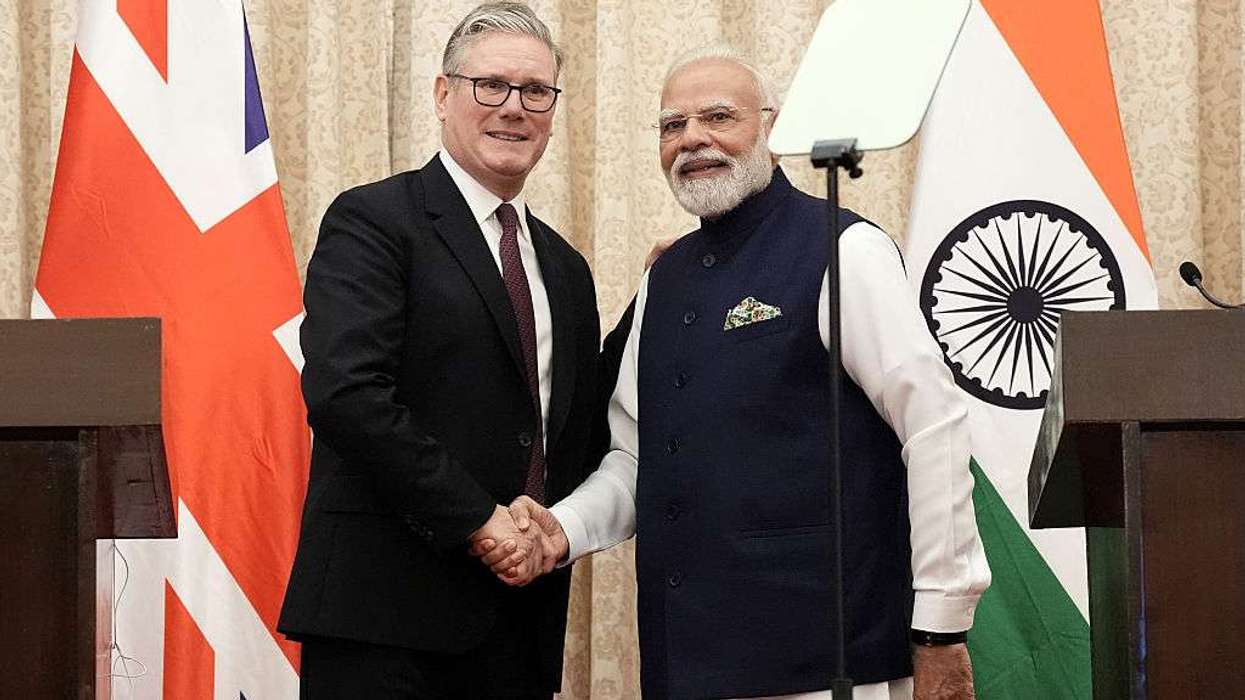

Keir Starmer is traveling to Washington this week for his first international engagement since becoming the UK prime minister. This visit comes shortly after his recent election victory.
Starmer, 61, will attend NATO's 75th anniversary summit in Washington. This is his first foreign trip since assuming office last Friday. He aims to reaffirm Britain's support for NATO and Ukraine in its conflict with Russia.
This visit is part of a series of diplomatic engagements for Starmer, with the UK set to host a European leaders' conference next week.
"It will be an opportunity for him to learn and get to know other leaders as much as to communicate any particular messages," foreign policy expert James Strong told AFP.
The previous Conservative government was a strong supporter of Ukraine, providing financial and military assistance. Starmer has pledged continued support for Ukraine and is expected to convey this commitment to Ukrainian president Volodymyr Zelensky at the NATO meeting.
Starmer's defence secretary John Healey has already visited Ukraine since last Thursday's election, and foreign secretary David Lammy has been meeting with European NATO members.
Labour is committed to the NATO alliance and plans to maintain the Conservative promise to increase defence spending to 2.5 per cent of GDP, above the NATO target of two per cent.
"We can expect lots of talk about 'business as usual'," said Strong, a lecturer at Queen Mary University of London.
Starmer will also focus on improving relations with European allies strained by Brexit. Labour has promised closer cooperation with European countries, including bilateral deals with France and Germany, as well as agreements with the EU.
"We can expect to hear a lot of talk about improving relations, about being a more reliable partner, and above all about being more stable and predictable," said Strong.
Starmer's visit is also an early chance to build a relationship with US President Joe Biden and reinforce the UK-US special relationship. Starmer's Labour Party is more aligned with Biden's Democratic Party, which could aid in this effort, though the timing is sensitive as Biden faces pressure regarding the upcoming presidential election.
Starmer is aware that he may need to interact with a potentially isolationist Trump administration from January next year.
"He will want to demonstrate his rock-solid commitment to the UK's alliance with America, and to send a strong signal about the resilience of the 'special relationship', whatever lies ahead," Sophia Gaston, head of foreign policy at the Policy Exchange think-tank, told AFP.
A potential point of contention could be the Israel-Hamas conflict in Gaza, with Labour perceived as more pro-Palestinian compared to Washington. The leaders are also likely to discuss China, covering trade, commerce, and technology.
Following his US trip, Starmer will host the European Political Community summit at Blenheim Palace on July 18, with leaders from France and Germany expected to attend. Labour seeks "an ambitious" security pact with the EU.
Olivia O'Sullivan, director of the UK in the World program at Chatham House, stated that the summits provide a chance to elaborate on Labour's proposals. Starmer may also outline post-Brexit trade deals following his introduction to the global stage in Washington.
(With inputs from AFP)