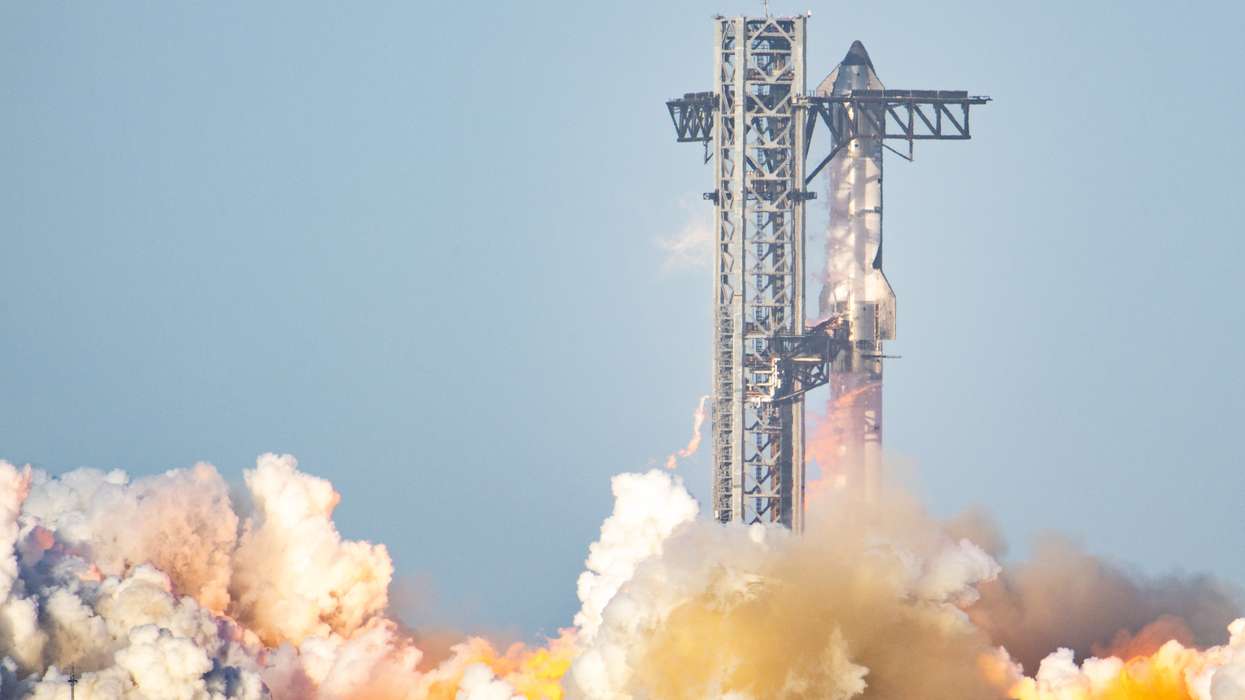

- Starship reached Earth orbit for the first time after 13 suborbital test flights.
- One of its engines shut down earlier than planned during the flight.
- The spacecraft deployed 26 next-generation Starlink satellites.
SpaceX’s Starship has reached Earth orbit for the first time, marking a major milestone for the giant rocket after an engine problem briefly threatened to derail its most ambitious test flight yet.
The uncrewed spacecraft lifted off from SpaceX’s Starbase facility in Texas on Monday (28), with one of its three main engines shutting down earlier than planned after it reached space. Mission controllers initially said the vehicle would not attempt the orbital insertion, before engineers determined it could safely continue. Starship then completed the engine burn needed to enter orbit.
The achievement came on Starship’s 14th test flight. All 13 previous flights since 2023 had remained on suborbital trajectories, meaning the spacecraft reached space but did not achieve the speed and trajectory needed to circle Earth.
The latest flight therefore represents an important shift in the programme. Rather than simply testing whether Starship can survive a launch and reach space, SpaceX is now testing its ability to operate as an orbital vehicle capable of carrying useful payloads.
From test rocket to commercial vehicle
Starship was carrying 26 next-generation Starlink V3 satellites, making this its first orbital mission with an operational payload. The satellites were deployed one by one at an altitude of roughly 269km.
The V3 satellites are designed to carry significantly more data than the previous generation, and SpaceX hopes eventually to launch them in much larger batches using Starship. The company has said it wants Starship to enter routine service later this year.
That commercial role is important because Starship is being developed as a fully reusable launch system that could eventually carry far more cargo per flight than SpaceX’s existing Falcon 9 rockets.
The rocket is also central to Elon Musk’s plans for expanding the Starlink network and reducing the cost of putting large payloads into space.
Why the Moon and Mars are watching
The orbital milestone also matters beyond Starlink.
Starship is being developed to carry crew and cargo to the Moon and, eventually, Mars. Nasa plans to use a version of Starship as part of its Artemis programme to support future lunar missions.
For now, however, the spacecraft still has to demonstrate that it can safely complete the other half of the journey.
Following its orbital mission, Starship is due to perform a deorbit burn and re-enter Earth’s atmosphere before a controlled splashdown in the Pacific Ocean west of Chile. No recovery of the spacecraft is planned on this flight.
The Super Heavy booster has already returned separately, completing an engine-controlled splashdown in the Gulf of Mexico.
The next challenge is therefore not simply getting Starship into orbit. SpaceX must show that the vehicle can repeatedly launch, operate in space, survive re-entry and eventually be recovered and flown again.
That is the step needed if Starship is to move from an experimental rocket into the high-frequency launch system Musk envisages.