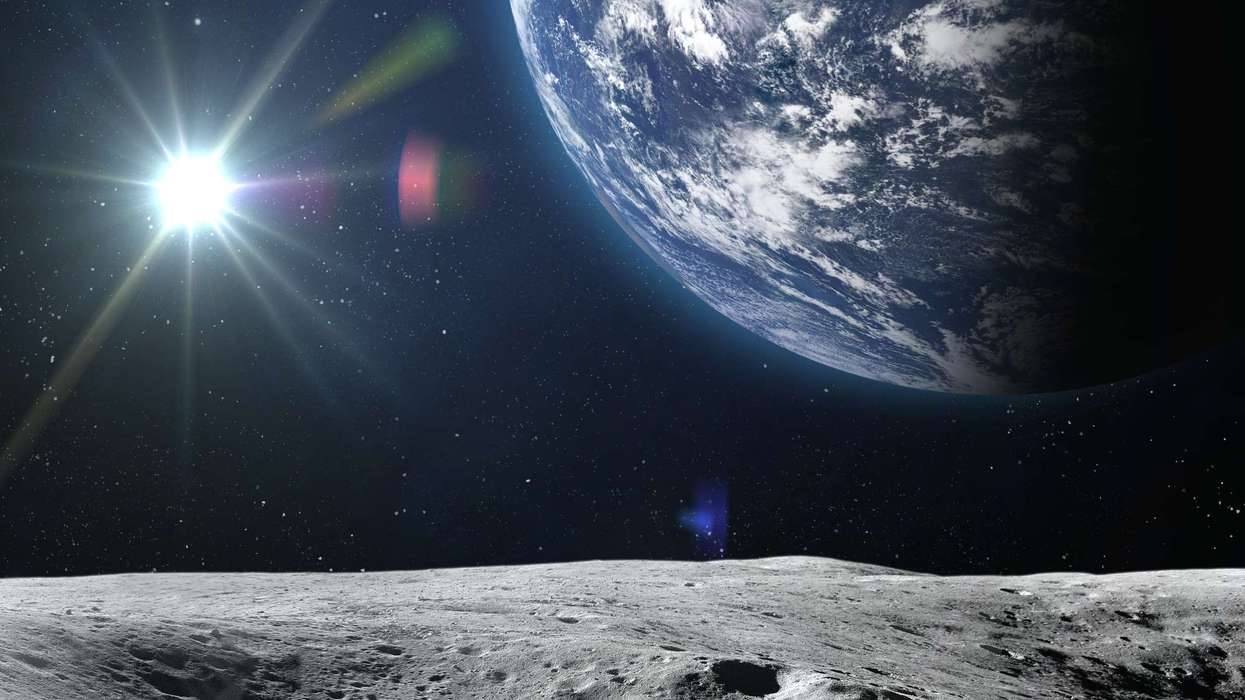

- A discarded four-tonne SpaceX Falcon 9 rocket stage is believed to have crashed into the Moon.
- Scientists say the impact poses no risk to Earth but could leave a crater around 18 metres wide.
- The accidental collision may help researchers better understand lunar impacts and space debris.
A discarded SpaceX Falcon 9 rocket stage is believed to have crashed into the Moon after spending more than a year drifting through space, raising questions about how the impact happened and why scientists are paying close attention to it.
The roughly four-tonne rocket stage was part of the Falcon 9 mission that launched Firefly Aerospace's lunar lander in January 2025. It was expected to strike the Moon at around 8,690 km/h, creating a fresh crater and sending dust and rocks across the lunar surface. While astronomers were unable to immediately confirm the impact, Nasa said it expected the collision to leave a crater about 18 metres wide and four metres deep.
Why did the rocket hit the Moon?
Unlike rockets launching satellites into Earth orbit, lunar missions require much more energy to escape Earth's gravity. After placing Firefly's spacecraft on its path to the Moon, the Falcon 9's second stage had completed its job.
Normally, rocket stages either burn up in Earth's atmosphere or fall into the ocean. In this case, however, the upper stage remained in deep space because it had travelled too far from Earth to follow those usual disposal paths.
The rocket had already used its remaining fuel and could no longer be controlled. Over time, the combined effects of the Moon's gravity, Earth's gravity and solar activity gradually altered its orbit.
Julianna Scheiman, SpaceX's director of Nasa science and Dragon programmes, reportedly said the rocket's path towards the Moon resulted from a combination of solar activity and gravitational forces rather than a planned manoeuvre.
Astronomers only determined earlier this year that the abandoned rocket stage was on a collision course with the Moon.
Why are scientists interested if it was accidental?
Although the impact is not expected to affect Earth in any way, scientists believe it could provide valuable information about the Moon's surface and improve the way space agencies track objects travelling beyond Earth's orbit.
Nasa said it plans to compare images of the impact site taken before and after the collision to better understand how artificial impacts disturb lunar soil and scatter dust and rocks. The findings could also help improve techniques for monitoring large pieces of space debris travelling through deep space.
Jimi Russell, a Nasa spokesperson, reportedly said the event poses no danger to Earth and offers an opportunity to collect lunar data while refining methods for tracking objects in space.
Experts also say the incident highlights the growing challenge of managing space debris. Bill Gray, creator of widely used astronomy software that helped predict the impact, reportedly said the collision may offer some scientific value but also reflects the need for greater care in disposing of large pieces of space hardware after missions.
Accidental impacts of this kind remain uncommon. A Chinese rocket stage struck the Moon in 2022, while Nasa deliberately crashed a rocket stage into the lunar surface in 2009 to study the material thrown up by the impact. More recently, several spacecraft attempting controlled Moon landings, including Russia's Luna-25, India's Chandrayaan-2 and Israel's Beresheet, have instead ended in crashes.
Following the latest incident, SpaceX and Nasa are reportedly discussing ways to reduce the chances of similar unintended lunar impacts during future missions.






 The September 11 Memorial and Museum stands on the site of the former World Trade Centre in New York, where the twin towers were destroyed in the 2001 attacks Spencer Platt/Getty Images