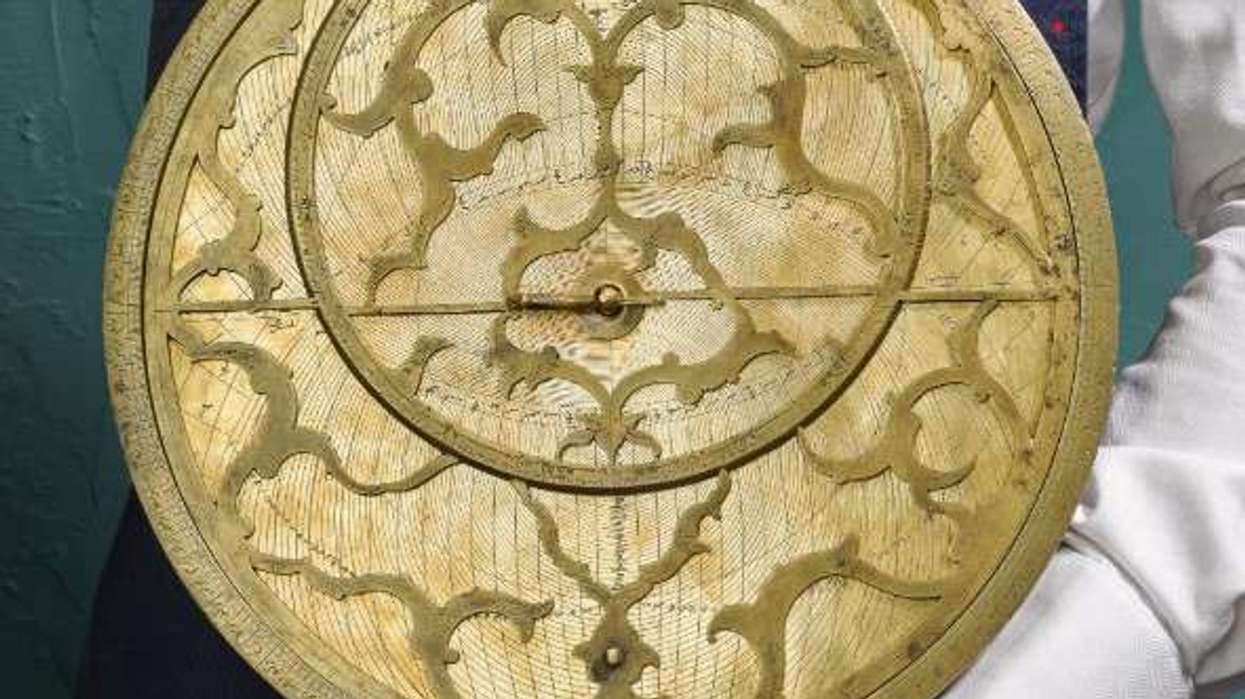

A RARE 17th century brass astrolabe from the collection of Maharani Gayatri Devi is set to be auctioned in London next week.
The instrument will be part of Sotheby's ‘Arts of the Islamic World and India’ sale on Wednesday. It went on display over the weekend and is estimated to fetch between 1.5 and 2.5 million pounds.
Dating to 1612, the astrolabe is believed to be the largest of its kind. It was created by two brothers in Lahore for a Mughal nobleman.
The device was part of the collection of Maharaja Sawai Man Singh II and later passed to Gayatri Devi, Rajmata of Jaipur, before entering a private collection.
“It was commissioned by Aqa Afzal, a really powerful Mughal nobleman who at the time was overseeing the administration of Lahore under Emperor Jahangir, and the object was clearly conceived as something befitting a man of his considerable standing,” the auction notes said.
"The craftsmanship is quite staggering: 94 cities catalogued inside with their longitudes and latitudes, 38 star pointers connected by floral tracery, five precision-calibrated plates, and degree divisions so fine they are subdivided down to a third of a degree.
"The inscription describes it as an 'asturlab-e tam’, a complete astrolabe, referring to the fact that its plates carry a full 90 altitude circles," it added.
The astrolabe carries Persian names of stars and Sanskrit names in Devanagari script. Its plates include locations such as Mecca, Bijapur, Ajmer, Kashmir and Lahore.
The brass device could be used to tell time, map stars, calculate the position of the sun, find the direction of Mecca and navigate.
Sotheby’s said such astrolabes are both instruments and objects of craft, and are sometimes described as old devices similar to smartphones.
According to the auction material, Lahore in the early 17th century was a centre for astrolabe-making in the Mughal period. The craft, known as the “Lahore School”, was passed through generations within a single family.
The instrument was made by brothers Qa'im Muhammad and Muhammad Muqim, who worked together on only two astrolabes. The one being auctioned in London is one of them.
The other example, now held at the National Museum of Iraq, measures 12 cm in diameter. The one set for auction measures 29.5 cm in diameter and nearly 50 cm in height.
Other items in the sale include a Mughal painting of Jahangir estimated at between 150,000 and 200,000 pounds, and 19th century paintings from India expected to sell for around 80,000 pounds.
(With inputs from agencies)