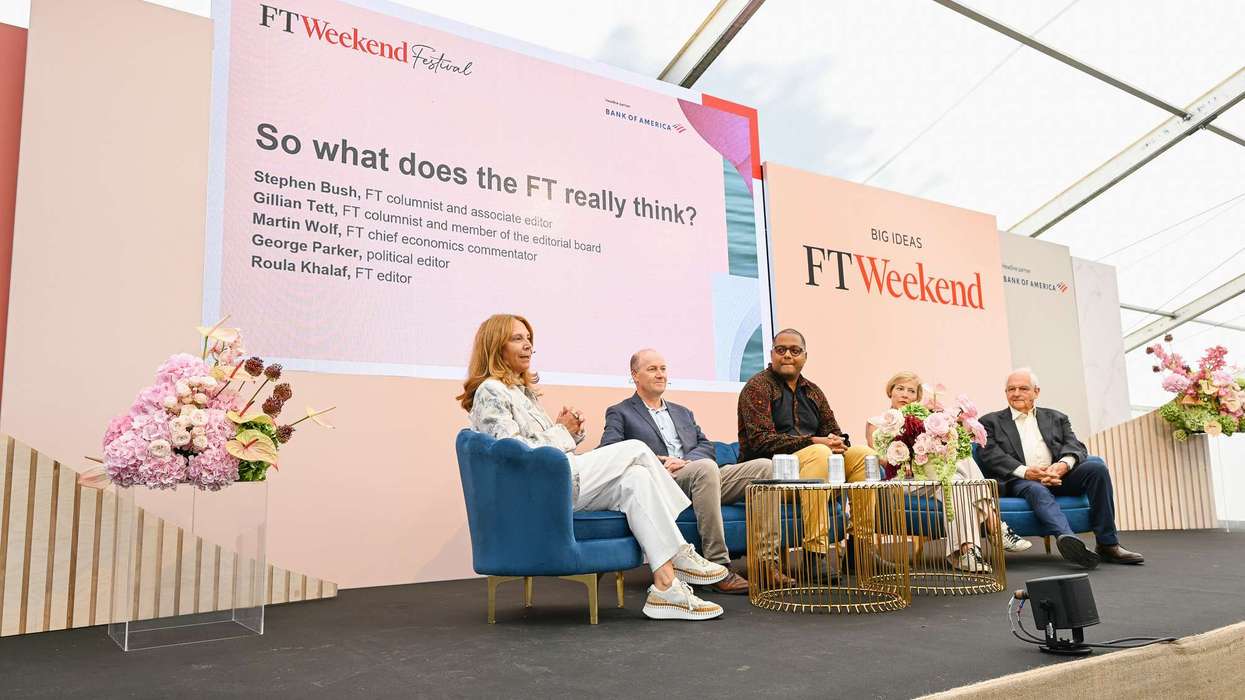

ONE of the biggest cheers at this year’s FT Weekend Festival came when George Parker, political editor of the Financial Times since 2007, predicted Reform leader Nigel Farage would not become Britain’s prime minister after the next general election.
His comment came during a session, “So what does the FT really think?”, which sought to recreate the typical daily “editorial board tussle over the FT’s view of the big issues”.
Parker declared: “I don’t think there’s any prospect of Nigel Farage being the next British prime minister.”
The tent, labelled “Big Ideas” and pitched in the grounds of Kenwood House in Hampstead Heath, was packed. The rousing cheers suggested Reform supporters were thin on the ground, if not totally absent.
Parker explained: “There would be massive tactical voting if there was any chance he could become prime minister – he’s such a divisive figure.”
He added: “I think that Nigel Farage is running a party which doesn’t have solid foundations. It’s based on nitroglycerine of eccentric politics.”
Another remark from Stephen Bush, the FT’s associate editor, appeared to suggest that many voters still had high regard for Rishi Sunak and that the current Tory leader, Kemi Badenoch, would do well to follow some of the economic policies of her predecessor.
He argued that Badenoch was not doing what she should be doing, “which is focusing overwhelmingly on the economy with an argument against Labour on the left and Reform on the right. There is a real risk for the Conservatives that people are starting to listen to them a bit more. But the more you listen to them, the harder it becomes to squint and go, ‘Oh yeah, that looks a bit like Rishi Sunak.’”
The chances are Rishi will stand down as the MP for Richmond in Yorkshire at the next election unless Badenoch can persuade him to be the shadow chancellor (a job he has already done) or foreign secretary.
This year’s FT Weekend Festival last Saturday (5) was blessed with perfect weather for late summer and early autumn. Copies of the weekend FT were liberally distributed across the grounds. Along with the tent labelled “Big Ideas”, there were others covering a wide range of subjects – “Literature & Life”, “Arts”, “Travel”, “FT Money”, “Tech”, “House and Home”, “HTSI” (How to Spend It), “Food & Drink”, “FT Future” and “Book Signings”.
According to Janine Gibson, editor of FT Weekend, “4,000 of you have come to Kenwood”. All this makes the FT Weekend Festival by far the best of its kind. The paper still retains a large pool of experienced journalists.
At the editorial board meeting, the FT’s editor, Roula Khalaf, who was in the chair, turned to the audience and posed the question: “So, before we start, how many of you are pleased with the performance of Andy Burnham so far?”
A sufficient number of hands went up for her to murmur: “Okay, okay, this isn’t bad.”
She turned to Martin Wolf, the FT’s chief economics commentator and one of the most respected voices in financial journalism: “It’s 45 days, but we’re getting closer to the end of his honeymoon. What’s your assessment? What should we be saying?”
Wolf began: “Well, he’s clearly a very, very talented and natural politician, and we haven’t seen that that often.
“But it’s certainly not sufficient. And he’s got objectively a very difficult situation, and it’s going to be extremely hard for him, even if he makes all the right decisions. And it’s pretty clear to me he won’t, because some of them are so difficult, (and) because some of them he doesn’t fully understand. It’s not at all clear he’s going to make enough difference to enough people to convince people.
“And just one final point: he’s not going to transform the economy in three years. Impossible. The biggest thing he must do is he must avoid really big mistakes, and there are some pretty obvious big mistakes he can make, because we are operating in a world of pretty big shocks.
“The biggest risk to him, I think, is a bond yield blowout, not because it’s his fault, but because bond markets are really fragile worldwide, and we’re at the top of that tree. So, avoid big mistakes. First rule for him.
“So, good news and bad news. Obviously, we have seen since the global financial crisis, which was nearly 20 years ago, an extraordinarily long period of stagnation or near stagnation in real household disposable incomes and GDP per head. If you allow yourselves to get into the sort of stagnation you got into, it gets embedded in everybody’s decision making. Every decision maker becomes defensive, and that then starts shaping the whole economy. This doesn’t get changed overnight without a catastrophe. We need a crisis because nothing otherwise is going to change, and we’ll live with stagnation.”
He talked of “almost the impossibility of doing any investment because regulation prevents just about everything. The tax system is a total mess.
“What depresses me about Mr Burnham, as a policymaker, is he seems to think he’s going to create a better ’70s. Now, first of all, we are not in the 1970s. That’s half a century ago. We still had an industrial economy. And secondly, the institutions he seems to think will deliver it – British Rail and all the rest – won’t work. What’s depressing about the next three years to me is it’s going to be a failure, a serious failure, and that is really awful.”
Adding her voice to the meeting was Gillian Tett, a columnist and member of the editorial board, who said that Burnham “needs three things. He needs a way to unleash animal spirits, to cite John Maynard Keynes, through his charisma. He needs solid policies that will actually tackle the growth problem and reassure the bond markets, and he also needs a lot of luck. Now, on the luck, he’s not had the luck so far.”
She said: “The phrase inside the Bank of England sometimes is that Britain’s gilt market is tethered to the tail of a drunken dragon.”
Asked about Britain’s current prime minister, Parker said: “I’ve known him since the 1990s when he was a floppyhaired special adviser to Tessa Jowell, and he’s got great human skills. He projects optimism. What you see is what you get with him. I mean, he is a genuinely engaging person.
“He talks a good game on reindustrialisation, but look at what he actually did in Manchester. You know, look at the skyline. It’s property speculation. It’s the knowledge economy. It’s MediaCity in Salford. He talks about something totally different to what he actually did.”
The festival began, as is customary, in the “Big Ideas” tent, with Tim Harford, who presents the BBC’s More or Less, talking about “Data: servant or master?”
After the editorial board, there was a session in “Big Ideas” on “The world at war”.
Moderated by FT chief foreign affairs columnist Gideon Rachman, speakers included Tom Tugendhat, the Tory former security minister who has just been appointed shadow foreign secretary; John Sawers, former chief of MI6; and Kim Ghattas, author, journalist and FT contributing editor.
Sawers said: “Trump himself is viscerally dismissive of Ukraine and is rather beholden and admiring of Putin.”
Since all sessions go online for 90 days, it is an excellent way to catch up with sessions people have missed. Mine is a long list. It may not be a bad idea for the FT to devote a session next year to UK-India relations in the light of the Free Trade Agreement. That was one of Sir Keir Starmer’s solid achievements.