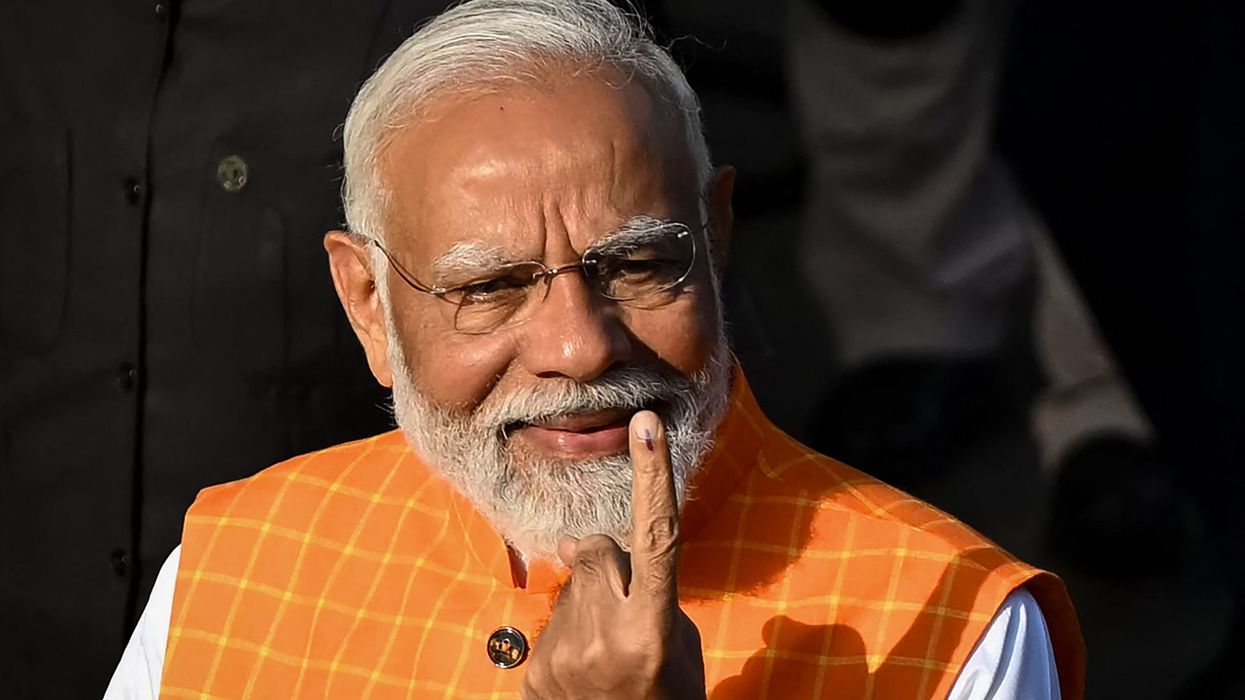
In the third phase of India's general election, prime minister Narendra Modi cast his vote early on Tuesday, urging for a strong turnout despite the summer heat.
The voting process that began on April 19 will span seven phases till June 1, with nearly a billion eligible voters. The counting of votes will happen on June 4.
"I urge all citizens to vote in large numbers and celebrate the festival of democracy... To all those working in the heat, I urge you to take care of your health and drink adequate water," he said after voting in Gujarat.
Modi voted in the Gandhinagar constituency where home minister Amit Shah, the BJP candidate, is contesting. Surrounded by supporters and party members, Modi engaged with the crowd before casting his ballot.
The campaign initially focused on Modi's economic achievements and welfare measures but shifted to energising the BJP's Hindu base.
In an interview with TV news channel Times Now, Modi said he does not oppose Islam or Muslims and wants the community to think about their future growth as they vote.
The third phase of voting covers 93 seats in 11 states and territories, including Gujarat, Maharashtra, and Karnataka, completing the voting process for 283 parliamentary seats. In the previous election, the BJP secured over 70 of the 93 seats up for grabs in this phase.
Voter turnout of 66.14 per cent and 66.71 per cent respectively in the first two phases has been marginally lower than corresponding phases five years back, with analysts blaming the summer heat and the lack of a single strong issue to motivate voters.
Despite slightly lower voter turnout compared to previous phases, the Election Commission is intensifying efforts to encourage voting, considering factors like summer heat.
"Weather conditions are predicted to be within normal ranges," it said in a statement on the eve of the vote, calling on voters to "turn out in greater numbers at polling stations and vote with responsibility and pride".
Various strategies, including voter awareness campaigns during cricket matches, social media alerts, and celebrity endorsements, aim to boost participation in the democratic process.
Over 1300 candidates, including around 120 women, are in the fray. Among the bigwigs are Union ministers Amit Shah (Gandhinagar), Jyotiraditya Scindia (Guna), Mansukh Mandaviya (Porbandar), Parshottam Rupala (Rajkot), Pralhad Joshi (Dharwad) and SP Singh Baghel (Agra).
Former Madhya Pradesh chief ministers Shivraj Singh Chouhan (Vidisha) and Digvijaya Singh (Rajgarh) have also returned to the Lok Sabha electoral fray this time.
The fate of former Karnataka chief minister Basavaraj Bommai (Haveri) and Badruddin Ajmal (Dhubri) will also be decided today.
(Agencies)






 Curator Emma Slocombe with ikat robes and arabachi coats in the Peter the Great Room in Blickling Hall Amit Roy
 View of the entrance to Blickling Hall on a rainy autumn dayAmit Roy
 Kente cloth from Ghana in the Long Gallery in Blickling Hall
 Decoration in the Great Hall at Blickling Hall Amit Roy
 Palampore fragment made in coastal south-east India in the Brown Room in Blickling Hall Amit Roy
 Bed valance dating from early 1700s in the Italian Print Room at Blickling Hall Amit Roy
 Indian inspired fabric draped on sofas in the South Drawing Room in Blickling Hall Amit Roy
 Indian inspired fabric draped on sofas in the South Drawing Room with Indian carpet in Blickling Hall Amit Roy
 Karun Thakar has picked out the geometric patterns in the bookcase and the Kente cloth in the Long Gallery in Blickling Hall Amit Roy
 Large tapestry depicting Peter the Great defeating the Swedish army at the Battle of Poltava in 1709 Amit Roy
 ikat robes and arabachi coats in the Peter the Great Room in Blickling Hall Amit Roy
 Baghs and kanthas made by women provide contrast to the men only portraits in the Great Hall at Blickling Hall Amit Roy
 Baghs and kanthas in the entrance Great Hall at Blickling Hall Amit Roy
 Baghs and Kanthas in the Great Hall in harmony with stained glass window at Blickling Hall Amit Roy
 Kimonos reflect Japanese influence in Upper Ante Room in Blickling Hall Amit Roy
 Kimono in Upper Ante Room in Blickling Hall
 A view of the Palace and fort at Agra shows romantic side of India Amit Roy
 Blickling Hall Amit Roy
 Table carpet, European 1670-1680 Amit Roy
 Unfinished 17th century Italian embroidery in the Print Room at Blickling Hall Amit Roy
 Picture of Kashmir shows a romantic view of India Amit Roy
 A panel of Ashburnham bed hangings made in Gujarat for sale in Europe in the Brown Room in Blickling Hall Amit Roy
 Colcha made in the 1600s by women in Bengal for the Portuguese market in the Long Gallery at Blickling Hall Amit Roy




