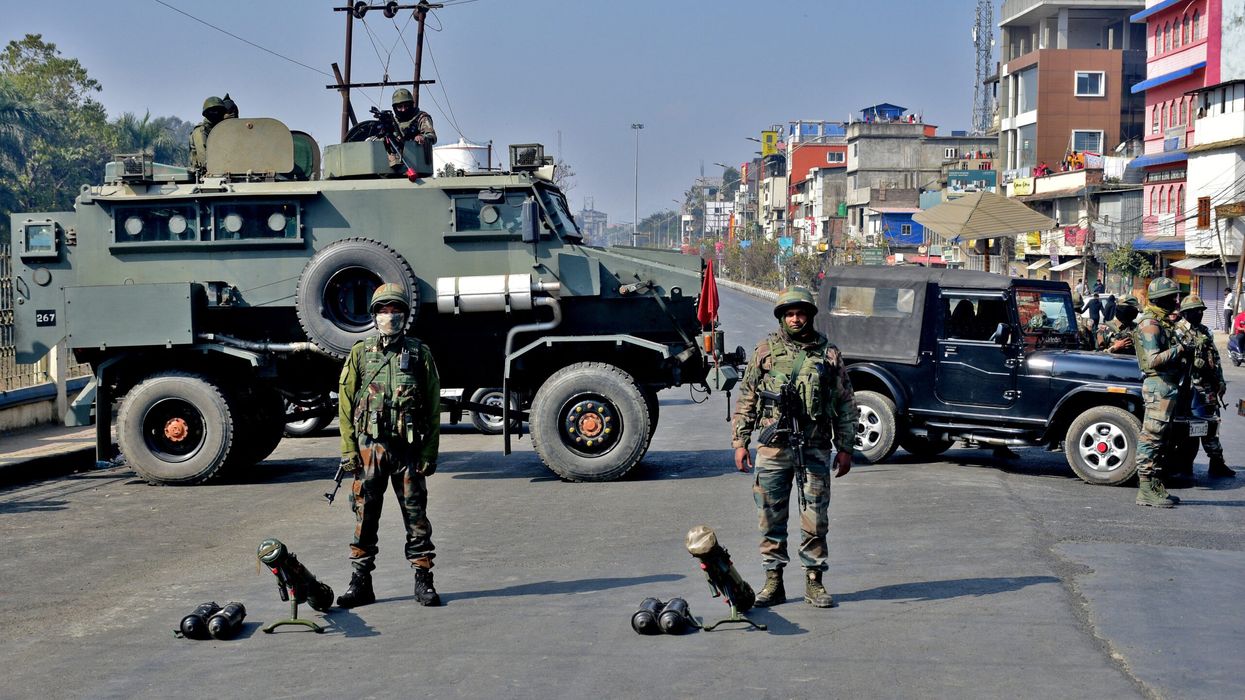

AT LEAST two people were killed and scores injured in India's northeastern Manipur state after security forces opened fire at a mob in Churachandpur district late on Thursday (15), a police official said, as sporadic violence continued in the region.
Close to 200 people have died since fierce fighting broke out last May between members of the majority Meitei and minority Kuki communities in the state bordering Myanmar over sharing economic benefits and quotas given to the tribes. Thousands remain displaced in relief camps.
Churachandpur, home to the Kuki-Zo community, was among the first areas in the state to witness ethnic clashes when violence first erupted in May.
Thursday's violence broke out after the district police ordered the suspension of a Kuki constable after purported images of him with armed men surfaced on social media.
About 400 people stormed the district police chief's office at around 7.30pm. (1400 GMT), demanding the order be revoked.
The mob attacked the complex which houses the offices of the police chief as well as the district administration, in the heart of the town.
"They climbed the gates and scaled the walls of the complex. Several vehicles were burnt, and later at night, the official residence of the deputy commissioner was torched," a senior police official said by phone.
Security forces lobbed tear gas at first in an attempt to disperse the mob and then "resorted to shooting", the official said, requesting anonymity as the person was not authorised to speak to the media.
The official said about 25 people were injured, and were being treated in hospital.
Authorities have suspended mobile internet services in Churachandpur for the next five days.
The Indigenous Tribal Leaders' Forum (ITLF), an apex tribal body, warned district police chief Shivanand Surve, who had issued the suspension order, to leave Churachandpur within the next 24 hours.
(Reuters)










English questioning rose from 20 per cent to 31 per cent, and racist jokes from 36 per cent to 41 per cent
Workplace violence against Black and ethnic minority employees rises to 26 per cent
Highlights
The Trades Union Congress surveyed 1,044 Black, Asian and ethnic minority employees. The results show clear increases in racist behaviour between 2020 and 2026.
Workers having their English questioned rose from 20 per cent to 31 per cent. Those hearing racist jokes went up from 36 per cent to 41 per cent.
Racist comments made to workers or around them increased from 31 per cent to 36 per cent.
Violence and threats
The most worrying finding involves physical threats and violence, which jumped from 19 per cent to 26 per cent.
Racist posts shared on workplace social media grew from 22 per cent to 28 per cent. Racist materials being passed around increased from 19 per cent to 25 per cent.
Beyond direct racism, many workers face unfair treatment. Nearly half (45 per cent) said they get harder or less popular jobs.
Over two in five (43 per cent) receive unfair criticism. The same number (41 per cent) stay stuck on temporary contracts.
Work conditions got worse too. Those not getting enough hours rose from 30 per cent to 40 per cent.
Workers denied overtime went from 30 per cent to 37 per cent. Being kept on short-term contracts increased from 33 per cent to 41 per cent.
Direct managers cause most unfair treatment (35 per cent), followed by other managers (19 per cent).
Bullying mainly comes from direct managers (30 per cent) and colleagues (28 per cent). Racist behaviour mostly comes from colleagues (33 per cent) and customers or clients (22 per cent).
Paul Nowak, TUC general secretary, said: "Black and ethnic minority workers are facing appalling and growing levels of racism and unfair treatment in Britain. This racism is plaguing the labour market – and it's getting worse."
The TUC is calling for urgent government action to tackle the problem. The union wants ring-fenced funding for the Equality and Human Rights Commission to enforce workplace protections.
It is pushing for mandatory ethnicity pay gap reporting for companies with over 50 employees.
The TUC says the Employment Rights Act, which makes employers responsible for protecting workers from harassment by customers and clients, will be an important step forward.
The union also wants employers to treat racial harassment as a health and safety issue and monitor ethnicity data across recruitment, pay and promotions.