
- The Defender Dakar gets a 626bhp twin-turbo V8.
- Its 35-inch all-terrain tyres are fitted to forged 20-inch wheels.
- Reservations are expected to open early next year.
Land Rover is taking one of its most extreme off-road machines out of the desert and onto the road, with the Defender Dakar turning technology developed for the Dakar Rally into a limited-run road-legal model.
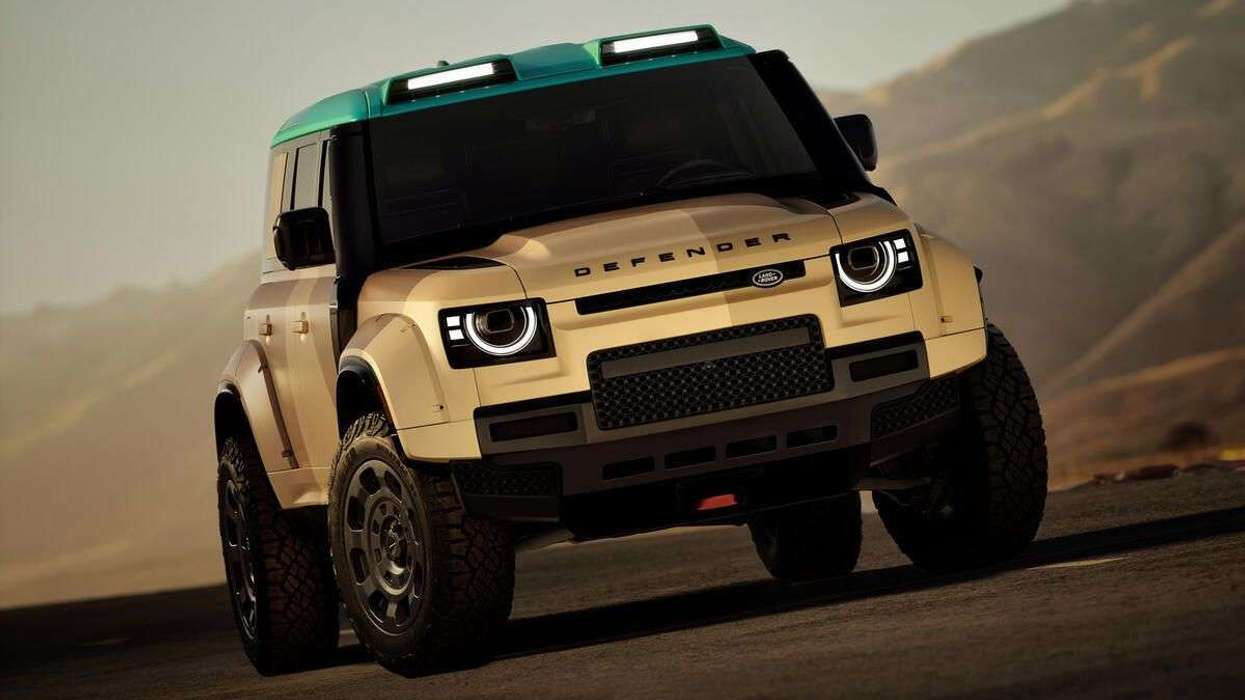
Revealed at Monterey Car Week, the new Defender is based on the Defender Octa but incorporates a series of upgrades developed for JLR's works Dakar racer. It gets a 4.4-litre twin-turbocharged V8 producing 626bhp and 553lb ft of torque, with power sent to all four wheels through an eight-speed automatic gearbox.
The interesting part is how much of the rally car's hardware has made the jump to the road.
The Defender Dakar gets bespoke springs, motorsport-developed Bilstein Advanced dampers and 35-inch all-terrain tyres wrapped around forged 20-inch wheels. Underneath, there is additional protection running from the front to the rear, including a tougher metal front undershield designed for serious off-road use.
Land Rover has also added three dedicated driving modes: Dunes, Gravel and Flight. The last is designed to help the vehicle manage landings after being driven over particularly rough or uneven terrain.
That sounds excessive for something carrying numberplates, but that is essentially the point of this Defender.
The Dakar hardware has not been left behind
The road car takes its basic architecture from the D7X platform used by JLR's Dakar competitors, while the body has been given its own rally-inspired treatment.
There are roof-mounted light pods, carbon-fibre air intakes and bonnet, extended wheel arches with exposed rivets, chunky mud flaps and a Dakar-style rear treatment. Buyers will also be offered race-inspired paint schemes, including a beige and turquoise combination based on the Defender that won the 2025 Dakar Stock category.
The original competition car's focus on surviving extreme terrain has also shaped the road version's underbody protection.
Inside, Land Rover has not yet shown the production cabin. It has confirmed that the layout will be more focused than the standard Defender, with four individual seats, optional racing harnesses and dedicated space for items such as helmets and the spare wheel. An onboard compressor will also be available.
There is a practical reason for much of this equipment. The Defender Dakar is not simply a styling exercise based on a rally car. It is intended to bring some of the hardware used in competition into a vehicle that can legally be driven away from a race stage.
The car's 626bhp output is also higher than that of the current Defender Octa, which has been slightly detuned for emissions reasons. Because the Dakar will be sold in Britain through the Individual Vehicle Approval route, it is understood to be able to retain the full output.
Land Rover has not yet announced the price or production numbers, although the model is expected to cost considerably more than the £147,000 Defender Octa.
Reservations are expected to open early next year, with production scheduled as a highly exclusive run.
That leaves the Defender Dakar in a rather unusual position. It has been developed from a vehicle designed to spend its days attacking dunes, gravel and jumps, yet its next destination could be a British road.
Whether owners actually take advantage of all that Dakar hardware is another matter. But unlike the competition car, this one comes with the one piece of equipment the rally version never needed: a numberplate.