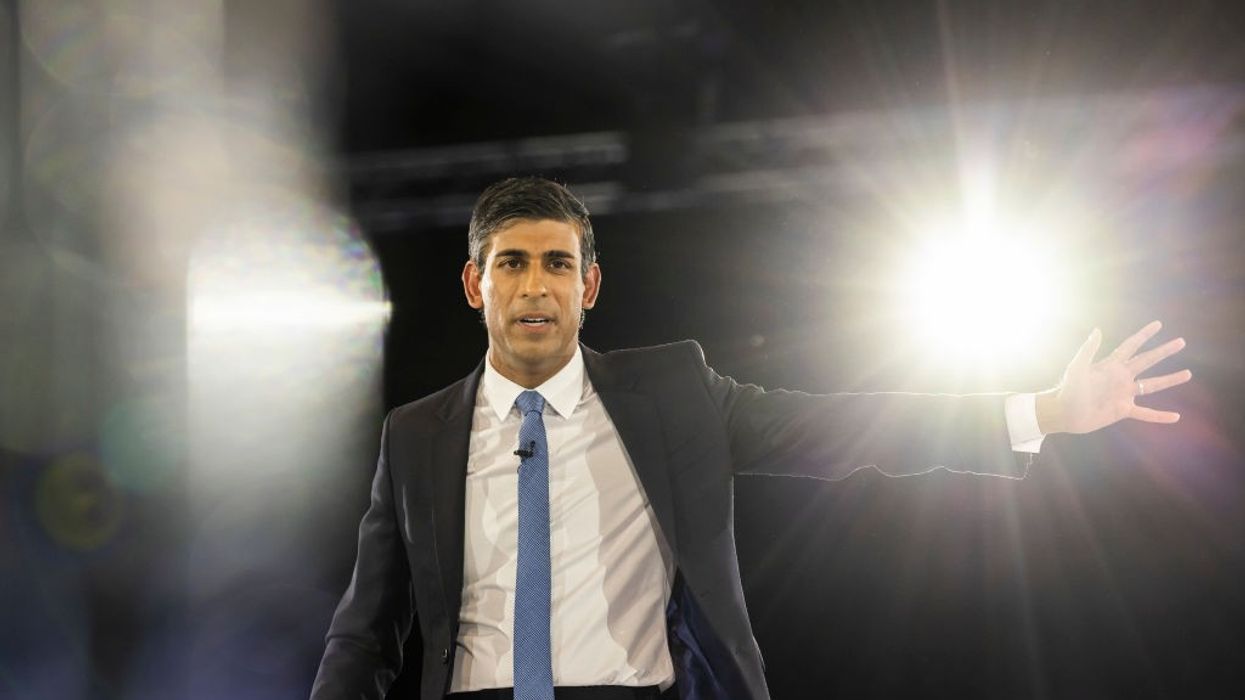

With Rishi Sunak on the threshold of becoming the first non-white prime minister of Britain, arch-rivals India and Pakistan are on the cusp of history to share a pride, though none of them played a role in it.
Sunak’s grandparents originated from British India but their birthplace Gujranwala lies in modern day Pakistan's Punjab province. Thus, in an odd way, the new British leader is both an Indian and a Pakistani.
So far, the scanty details about his ancestry are available only on social media and that is where both Indian and Pakistanis are expressing their views about his rise to power amidst bitter political wrangling in the UK.
''The Sunaks are a Punjabi Khatri family from Gujranwala, now in Pakistan,” tweeted one Queen Lioness 86, adding: ''Ramdas Sunak, Rishi’s paternal grandfather, left Gujranwala to work as a clerk in Nairobi in 1935.''
Ramdas' wife, Suhag Rani Sunak, moved to Delhi first from Gujranwala, along with her mother-in-law, before travelling to Kenya in 1937, according to Queen Lioness 86, who has provided all details about the family, including the migration of UL and the birth of Rishi in 1980 in Southampton.
Though officially nothing has been said in Pakistan about 42-year-old Sunak, some on social media have suggested the government to lay its claim on him.
''I think Pakistan should also lay claim on Rishi Sunak because his paternal grandparents were from Gujranwala who from there migrated to Kenya and then to Britain,” one Shafat Shah tweeted.
Someone with a Twitter handle as Grand Finale wrote: “Wow! What a tremendous achievement. A Pakistani has now ascended to the highest office in England. Anything is possible if you believe.''
But others suggested that both Pakistan and India should be proud of the new British leader. ''Going to bed in the US with hopes that a #Punjabi from #Gujranwala will be the #PrimeMinister of the #UK in the morning! Both #Pakistan and #India should be jointly proud of this moment!” tweeted Yaqoob Bangash.
There are also fears that the two countries may live up to their reputation of animosity and even try to cross lines while laying claim that Sunak is the son of their respective lands, said 35-year-old Zulfiqar Jatt.
''Since Gujranwala is in Pakistan, anyone who belonged to this city even a 100 years ago is a Pakistani today,” Jatt told PTI.
Others like Akhtar Saleem are more down to earth and want Sunak to address the longstanding issue of the Kohinoor diamond.
''Since he is becoming prime minister, I think Pakistan should ask him to return the Kohinoor diamond which was stolen from Lahore,” Saleem said.
(PTI)