
Highlights
- World's 39 hottest cities all in India on April 29.
- Banda hit 46.2°C, highest temperature globally on April 27.
- Uttar Pradesh has 21 of 50 hottest cities.
The pattern continued on April 29, with the world’s top 39 hottest cities all located in Indian states. Sasaram in Bihar led at 45°C, followed by Varanasi and Balangir at the same temperature.
Mirzapur and Ghazipur in Uttar Pradesh also recorded 45°C, while Buxar in Bihar matched this temperature.
Prayagraj came seventh at 45°C, with Bilaspur in Chhattisgarh, Jaunpur in Uttar Pradesh, and Chandrapur in Maharashtra all recording 44°C.
The data shows India is facing an April heatwave unlike anything seen before.
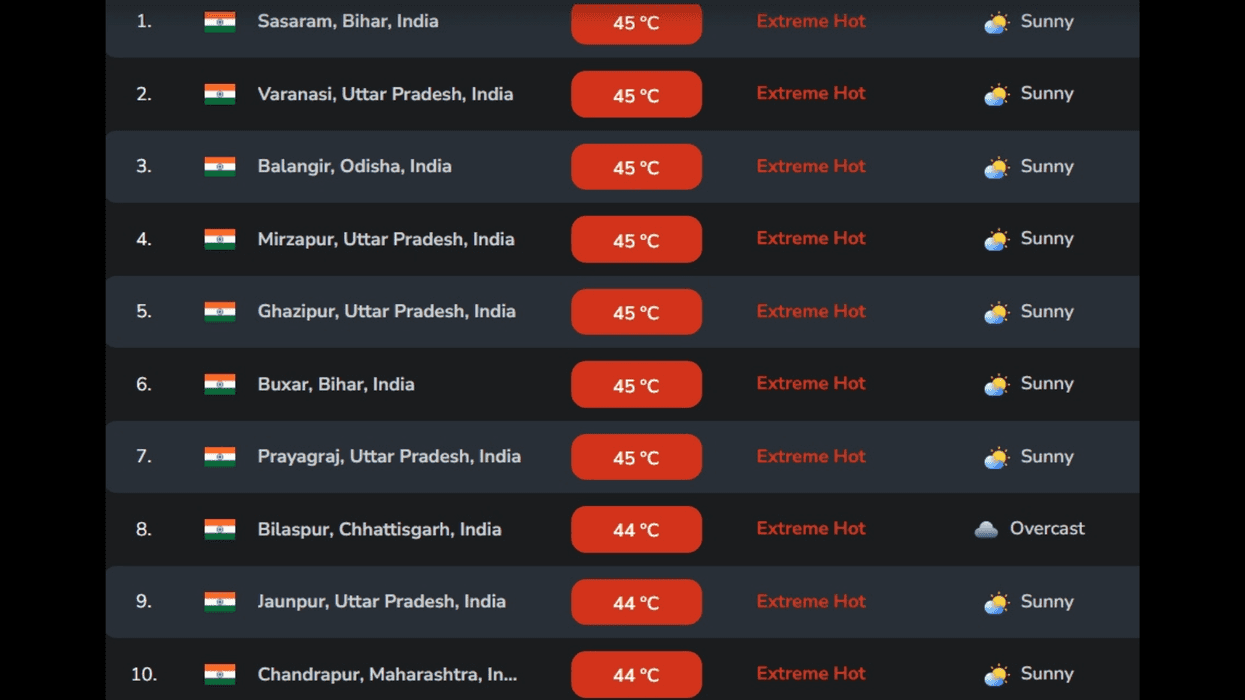 Real-time data as of April 29 showing India’s top 10 cities among the world’s hottest citiesAQI.in
The unprecedented scale
Banda, a city in Uttar Pradesh's Bundelkhand region, recorded the planet's highest average temperature on April 27 at 40.5°C.
Its peak reached 46.2°C, while its overnight low stayed at 34.7°C.
Even at its coolest hour after midnight, Banda was hotter than what most European countries call a dangerous summer heatwave.
Uttar Pradesh led the rankings with 21 cities in the top 50. Maharashtra followed with 10 cities, all from the Vidarbha region. Madhya Pradesh, Rajasthan, and Haryana made up most of the remaining entries.
The data tracked six things across the full day: lowest temperature, highest temperature, average temperature, UV index, wind speed, and humidity.
Average temperature decided the rankings because it shows the constant heat people live through across 24 hours.
Across all 50 cities, the average peak temperature on April 27 was 44.7°C.
The coolest maximum on the list was Solapur at 41.9°C, a reading that would cause public health emergencies in most countries.
Health and climate impact
Akola in Maharashtra recorded the highest UV index at 10.7, just below the World Health Organization's "extreme" level of 11. At 10.7, skin without protection can burn within 15 minutes at midday.
The city also had 13 per cent humidity, the driest conditions among the top 10.
Etawah recorded wind speeds of 59.8 kilometres per hour, the strongest on the entire global list. At 46°C air temperature, such winds do not cool the body but speed up water loss instead.
Prayagraj showed the widest temperature change, from 45.7°C during the day to 29.1°C overnight, a 16.6°C gap.
It also had the highest humidity at 21 per cent, meaning the heat stress on the body was worse despite similar temperatures elsewhere.
Climate experts say that while India has always had hot summers, the wide spread and strength of extreme temperatures happening at the same time across many regions shows a change.
The data shows almost no rain across all cities, with Agra recording the highest at just 0.5 millimetres.
Public health officials warn that when temperatures go above normal body temperature of 37°C, outdoor workers, elderly people, and those with heart problems face serious danger from heat-related illness