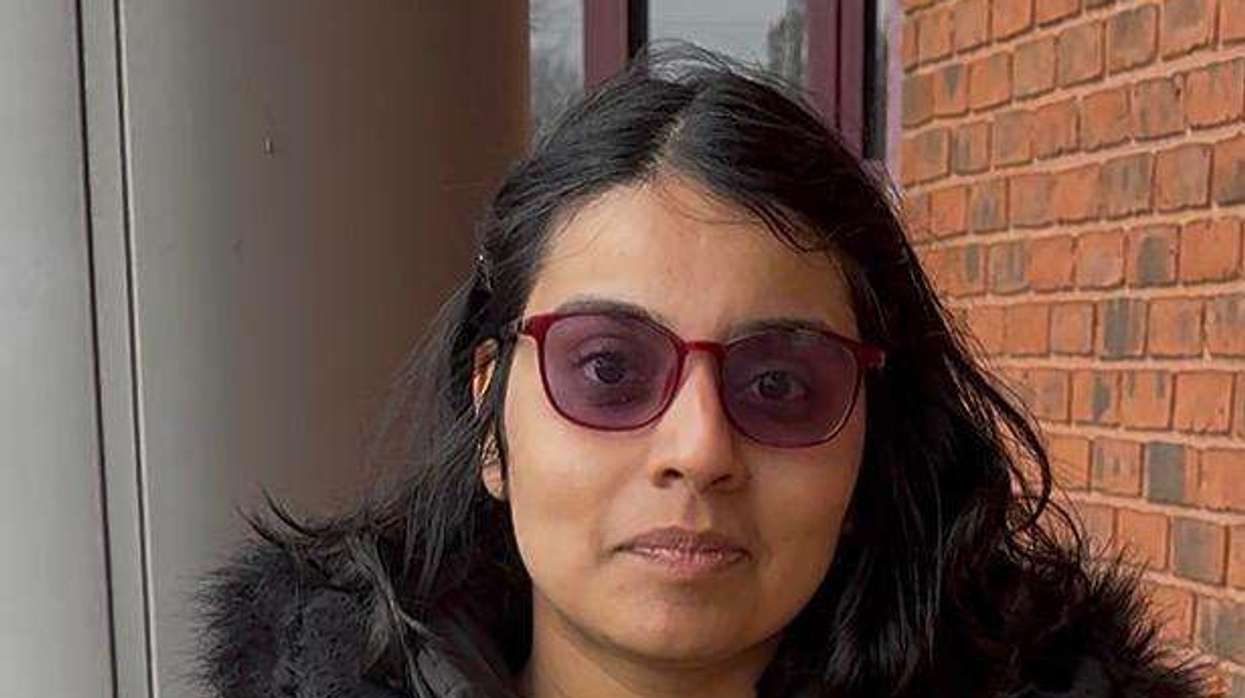

A SOUTH ASIAN disabled woman, who has spent over fifteen years championing marginalised communities, is now standing as an independent candidate in the Wednesbury ward in next week’s Sandwell Borough local elections.
Gina Patel lives with cerebral palsy, epilepsy and anxiety, and sometimes uses a wheelchair. She is standing for public office for the first time, driven by a conviction that “local politics does not reflect people like her”.
In an interview with Eastern Eye, Patel said, "I believe that politics is not what it should be. It is not accessible, it is not inclusive, and people like me are not being heard. Too much of politics is being talked at you — it is not really a co-production approach. When politics affects everyone's lives, decisions should be made by those it affects."
She is not aware of any sitting councillor across the borough who shares all three of her identities - south Asian, disabled and female. "I know that some have one or two, but I don't know of anyone who has all three. Representation in local politics is low for people like me, and I want to show that people from my communities can have a seat at the table."
Accessibility tops her priority list
Her priorities are rooted firmly in everyday life. Accessibility is at the top of her list — she points to the absence of dropped kerbs in parts of the town centre as a practical example of how public spaces continue to fail disabled people. A community survey she ran on social media before declaring her candidacy revealed that residents also wanted free parking and a more diverse high street.
She added, "In Wednesbury, there are a lot of hair salons and barbers, and I feel we could use more variety in our town centre to bring it back to life. Our town was just brilliant once, and I wish we could make it better again”. The survey also flagged anti-social behaviour and a perceived lack of health and wellbeing services.
If elected, she wants to use her lived experience to offer direct support to constituents navigating complex systems, particularly around special educational needs. "I would like them to see me as someone who is there for them — not just a one-off person to help them with their issues. I wouldn't describe myself as your typical politician, and I don't want to be."
Patel has deliberately chosen not to knock on doors during her campaign, describing cold-calling as intrusive. Instead, she is engaging with residents through a leaflet and social media, where a series of videos sharing her lived experience has attracted around 14,000 views on Facebook.
 Gina PatelPhoto: Facebook
Her approach to winning votes is equally unconventional. "If people want to vote for me, that is great, but if they think somebody else is better, they should do what is best for them and their family. I don't believe in putting pressure on people,” Patel added.
She is standing with no party affiliation, something she regards as a point of principle. "I'm not from a political party, so I would make decisions based on the interests of my community and the people who really need to be heard. It would be a privilege to be in those chambers."
Asked whether her lack of a political background is a weakness, she noted, "I think it's a strength. There is no one quite like me now who really engages with people in a way that does not talk at them. I want people to see me as just a neighbour, not Gina the councillor. I want people to feel engaged with politics again, because sometimes people don't vote because they don't see much change."
'Not afraid of challenges'
A WeAreTheCity Rising Star for Diversity Award winner, TEDx speaker and three-time participant in the UN Women UK CSW Conferences, Patel was also a member of the first ever West Midlands Young Combined Authority. She has served as co-chair of her organisation's Disability Network for four years and presented a petition at Downing Street on Changing Places facilities. She also ran a social media campaign called CP Everyday Life to raise awareness of cerebral palsy.
She said, "I've achieved so much in my career that I now want to take the next step and broaden my horizons to something on a much bigger scale. I'm not doing it for the career - I'm doing it because I want to make a difference to people's lives, and not only those from marginalised communities. I want to be out there representing all kinds of people."
She is clear-eyed about the challenges of entering an arena that has historically been neither welcoming nor representative.
"I do worry, but if I don't give this a chance then I'm going to let people win who say that I can't do this. If I can be the first step towards seeing the next Gina in politics - whether that is another councillor, an MP, or any other kind of politician — then that means something, regardless of whether I get elected or not,” she concluded.




 Curator Emma Slocombe with ikat robes and arabachi coats in the Peter the Great Room in Blickling Hall Amit Roy
 View of the entrance to Blickling Hall on a rainy autumn dayAmit Roy
 Kente cloth from Ghana in the Long Gallery in Blickling Hall
 Decoration in the Great Hall at Blickling Hall Amit Roy
 Palampore fragment made in coastal south-east India in the Brown Room in Blickling Hall Amit Roy
 Bed valance dating from early 1700s in the Italian Print Room at Blickling Hall Amit Roy
 Indian inspired fabric draped on sofas in the South Drawing Room in Blickling Hall Amit Roy
 Indian inspired fabric draped on sofas in the South Drawing Room with Indian carpet in Blickling Hall Amit Roy
 Karun Thakar has picked out the geometric patterns in the bookcase and the Kente cloth in the Long Gallery in Blickling Hall Amit Roy
 Large tapestry depicting Peter the Great defeating the Swedish army at the Battle of Poltava in 1709 Amit Roy
 ikat robes and arabachi coats in the Peter the Great Room in Blickling Hall Amit Roy
 Baghs and kanthas made by women provide contrast to the men only portraits in the Great Hall at Blickling Hall Amit Roy
 Baghs and kanthas in the entrance Great Hall at Blickling Hall Amit Roy
 Baghs and Kanthas in the Great Hall in harmony with stained glass window at Blickling Hall Amit Roy
 Kimonos reflect Japanese influence in Upper Ante Room in Blickling Hall Amit Roy
 Kimono in Upper Ante Room in Blickling Hall
 A view of the Palace and fort at Agra shows romantic side of India Amit Roy
 Blickling Hall Amit Roy
 Table carpet, European 1670-1680 Amit Roy
 Unfinished 17th century Italian embroidery in the Print Room at Blickling Hall Amit Roy
 Picture of Kashmir shows a romantic view of India Amit Roy
 A panel of Ashburnham bed hangings made in Gujarat for sale in Europe in the Brown Room in Blickling Hall Amit Roy
 Colcha made in the 1600s by women in Bengal for the Portuguese market in the Long Gallery at Blickling Hall Amit Roy




