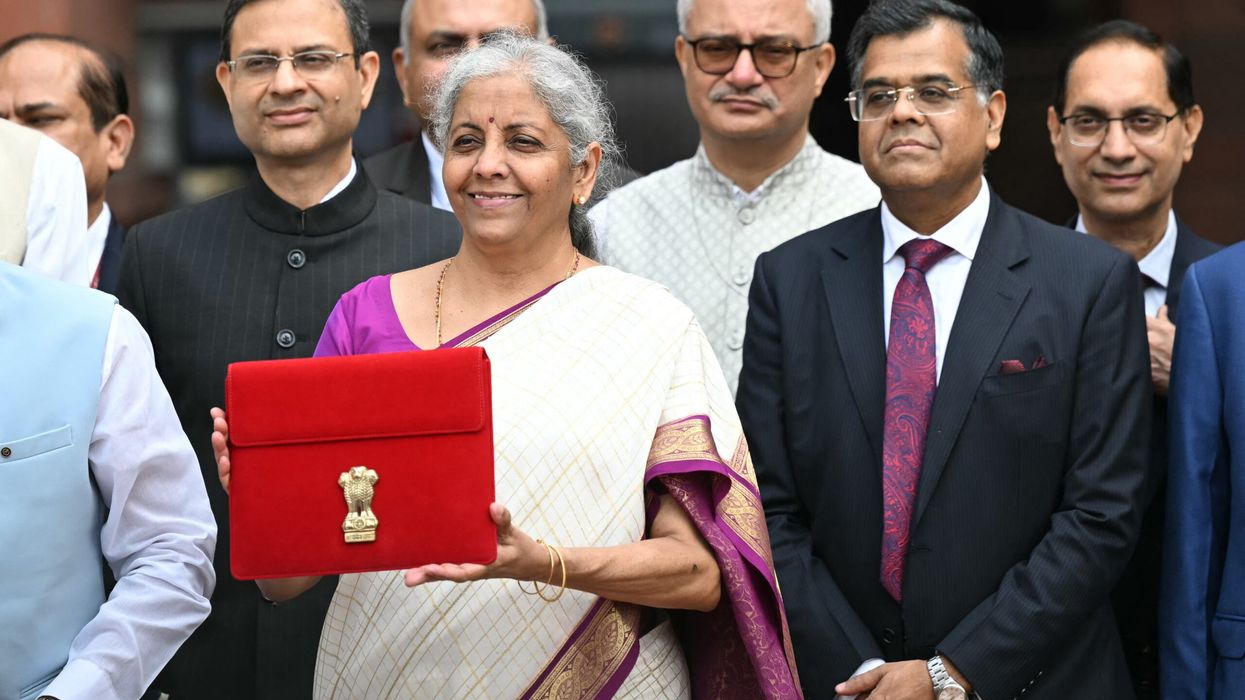

India will spend £18.6 billion on job-spurring efforts over the next five years and boost rural spending, the country's finance minister Nirmala Sitharaman said on Tuesday in the 2024/25 budget, unveiled after last month's election setback for the government.
Narendra Modi's Bharatiya Janata Party (BJP) failed to secure an outright majority in the general election last month, making it dependent on allies to form a government for the first time since he came to power a decade ago.
The government will spend £24.6 billion on rural development, Sitharaman said, while unveiling new schemes for states led by two key allies.
To spur employment, it will roll out incentives for companies, including those in manufacturing, along with programmes to improve skills and provide subsidised loans for higher education, Sitharaman added.
India's official unemployment rate in urban areas is 6.7 per cent, but private agency the Centre For Monitoring Indian Economy estimates it higher, at 8.4 per cent.
Government data this month showed 20 million new job opportunities generated each year since fiscal 2017-18, but private economists said self-employment and temporary farm hiring accounted for much of the figure.
India's consumer stocks rose 1.5 per cent to a record high.
The government will also maintain spending on long-term infrastructure projects at £102.8 billion, offering long-term loans of £13.9 billion to states to fund such expenditure. The spending plan was unchanged from the interim budget presented in February before the national elections.
Some of these loans will be linked to milestones reached in reform, covering areas such as land and labour, which Sitharaman said the government intended to push in its third term. In a concession to the government's allies, Sitharaman said it would hasten loans from multilateral agencies for the eastern state of Bihar and the southern state of Andhra Pradesh.
The government plans to cut its fiscal deficit to 4.9 per cent of gross domestic product in 2024-25, below the 5.1 per cent figure in February's interim budget. It reduced its gross market borrowing marginally to £129.7 billion.
Highlights of the budget:
Job creation
- Budget proposes to allocate £18.5 billion for job creation over 5 years.
- Allocates £14.1 billion for agriculture and allied sectors.
- To launch 3 schemes for employment-linked incentives.
Inflation
- Finance minister says inflation remains low, moving toward a 4 per cent target.
- Proposes to take supply-side measures to contain food inflation.
- Minister says global economy still in the grip of policy uncertainties.
Economic growth
- To allocate £1.4 billion as special financial support through multilateral development agencies to Andhra Pradesh state, ruled by Modi's biggest ally TDP.
- Credit support to small and medium businesses during the stress period.
- Proposes to support setting up of 12 industrial parks.
- Proposes to enhance small loans to £18,500 for small and medium businesses.
- To set up a venture capital fund of £92.5 million for space.
Rural development
- Provision of £24.6 billion for rural development.
- Proposes state aid for 30 million affordable housing units in urban and rural areas.
Urban development
- Proposes £20.4 billion federal government assistance for affordable urban housing over the next five years.
- Government will partner with private players for developing small nuclear reactors.
Infrastructure investments
- Capex outlay for infrastructure retained at interim budget target of £102.8 billion.
- Proposes £13.9 billion for long-term loans to states for infrastructure investments.