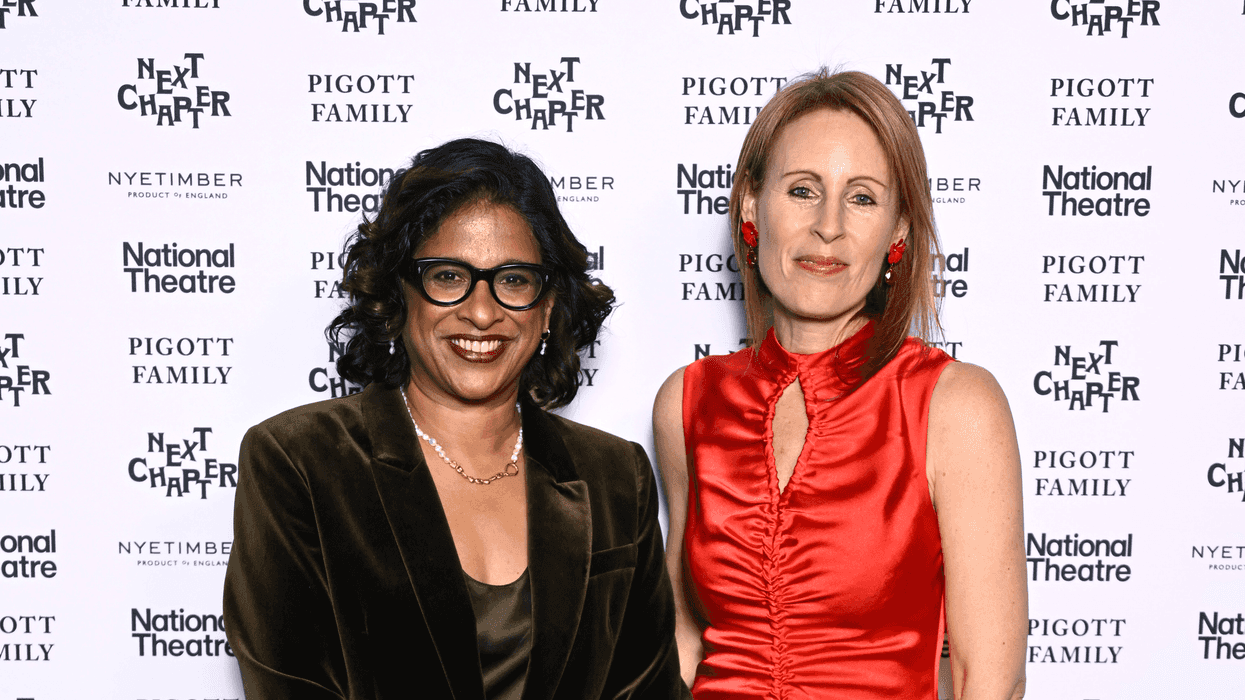

Indhu Rubasingham, artistic director of the National Theatre, now has thick, lustrous hair which wouldn’t look out of place in a shampoo ad.
This is not a sexist comment because she herself once made a point of stating: “I remember cutting my hair. I had long, curly hair and, in my twenties, I decided that if I wanted to be taken seriously as a director, I would have to cut it, so I had a pixie cut.”
She said she did not feel any undue pressure, which is reassuring considering she is following in the footsteps of some of the most illustrious figures in British theatre. Laurence Olivier was in charge of the National from 1962–1973. He was followed as director by Peter Hall (1973–1988); Richard Eyre (1988–1997); Trevor Nunn (1997–2003); Nicholas Hytner (2003–2015); and most recently, Rufus Norris (2015-2025).
Rubasingham, who was artistic director of the Kiln in north London, was appointed to the National in December 2023 and worked alongside Norris for a year. Now, she is monarch of all she surveys.
The difference between the Kiln and National “is the scale of it. The principles are the same in terms of fundraising and programming. The scale is the main difference. Kiln times 100.”
She added: “I don’t feel confined. What I feel is a responsibility to give as much choice as possible, and as much variety and different voices and as many different perspectives as possible. I feel the responsibility but I don’t feel constrained in any way. I’ve worked very hard to get here, and it’s great I have been given the opportunity to be here.”
Rubasingham was born in Sheffield in 1970 to Tamil parents who came to the UK from Sri Lanka. She graduated from Hull University with a BA Hons in drama. She has previously held associate director positions at the Gate Theatre, Birmingham Rep and the Young Vic.
When she occupied the Lunch with the FT slot over a meal at Rambutan, a Sri Lankan restaurant in London’s Borough Market, the Financial Times summed up the importance of her job: “The appointment puts her in charge of the flagship venue — a beacon of the industry with a workforce that stretches to 1,900, a national voice and a global reputation — and pitches her into the top tier of influence in the arts. It also makes her the first woman, and the first person of colour, to hold that post in the National Theatre’s 60-year history. That’s a landmark in itself: she’s already attracted headlines describing her as ‘the most powerful woman in British theatre’.”
When it comes to deciding what to put on, “the constraints are always budgetary,” she pointed out. “Can you afford to do it? But other than that, it’s totally my choice.”
She does not think hers will be a distinct vision, “different to that of my predecessors. It’s now the broadest possible church from classics to new writing. When I first started, I talked about bringing the world to the National, and taking the National to the world.
“We tour work around the country. We take work physically to America and other countries. More importantly, our digital work is in 184 countries – in cinemas, streaming at home. The digital output is taking the output to the world.”
One play, Inter Alia, was seen by 100,000 people on a single day in China.
Digital does make Rubasingham an important figure in world theatre. She was included in Sir Keir Starmer’s delegation when the British prime minister went to Mumbai on an official visit in October last year.
“I’ve come away with renewed excitement about what the possibilities could be between the two countries,” she said.
One play that attracted British Asian audiences was The Father and the Assassin, which she directed. Written by Anupama Chandrasekhar, it looked at Mahatma Gandhi’s assassination from the point of view of his killer, Nathuram Godse. Chandrasekhar has also adapted Kipling’s The Jungle Book which will be staged later this year.
“There are a couple of playwrights that are under commission that might be specifically targeted (to British Asian audiences) with British Asian stories,” Rubasingham revealed.
“I’m really interested in family shows – War Horse, Ballet Shoes, The Jungle Book – because the family show is what makes people get engaged with theatre. Also music and musical theatre will get in younger people.”
And she is committed to discovering new writing: “I love new play writing. Most of my career has been working on new plays with living playwrights. It’s the lifeblood of theatre.”
In a function jointly hosted by Rubasingham and the Indian High Commissioner Vikram Doraiswami in March, it was stated that the National Theatre’s vision of artistic collaboration “aligns closely with that of the government of India to position India not only as a global cultural force, but as one of the world’s most dynamic creative markets, an opportunity made even more compelling in the context of the recently signed India-UK trade deal”.
Rubasingham laughed as she said: “My work is my life. My diary is absolutely jam packed. I probably have 10 meetings a day. I’m meeting artists, working on productions, I’m programming, having internal meetings with different teams. I’ve just had a meeting with a playwright. And this evening I’m going to make a speech about the National Theatre.”
She does now receive quite a few invitations to deliver keynote addresses. At the end of February, she gave the Jennie Lee Lecture, named after Britain’s first arts minister (1964-70). In 1969, Lee took part in a ceremony marking the start of building work for the National Theatre.
Rubasingham reminded her audience at the National Theatre: “Her striving also left its mark on this building. On our stage, she appeared in our 2024 production of Tim Price’s new play about Nye Bevan, in which she was brought to life so brilliantly by Sharon Small.”
She added: “Without concerted intervention to protect the resources and pathways for our playwrights and theatre-makers, particularly at the start of their careers, we risk losing writers who want to and can write for our country’s biggest stages.
“We risk losing the future generation-leading playwrights, to take up the baton of the finest our country has produced, such as Tom Stoppard, Caryl Churchill, David Hare, Alan Bennett, Roy Williams, David Edgar, Moira Buffini, Beth Steel, Natasha Gordon, Jack Thorne, Rebecca Lenkiewicz, James Graham, Winsome Pinnock – to name a few.”
It’s possible that one day, long after she is gone, there will be a play about how Indhu Rubasingham got to the National Theatre and what she did as its artistic director.
ENDS