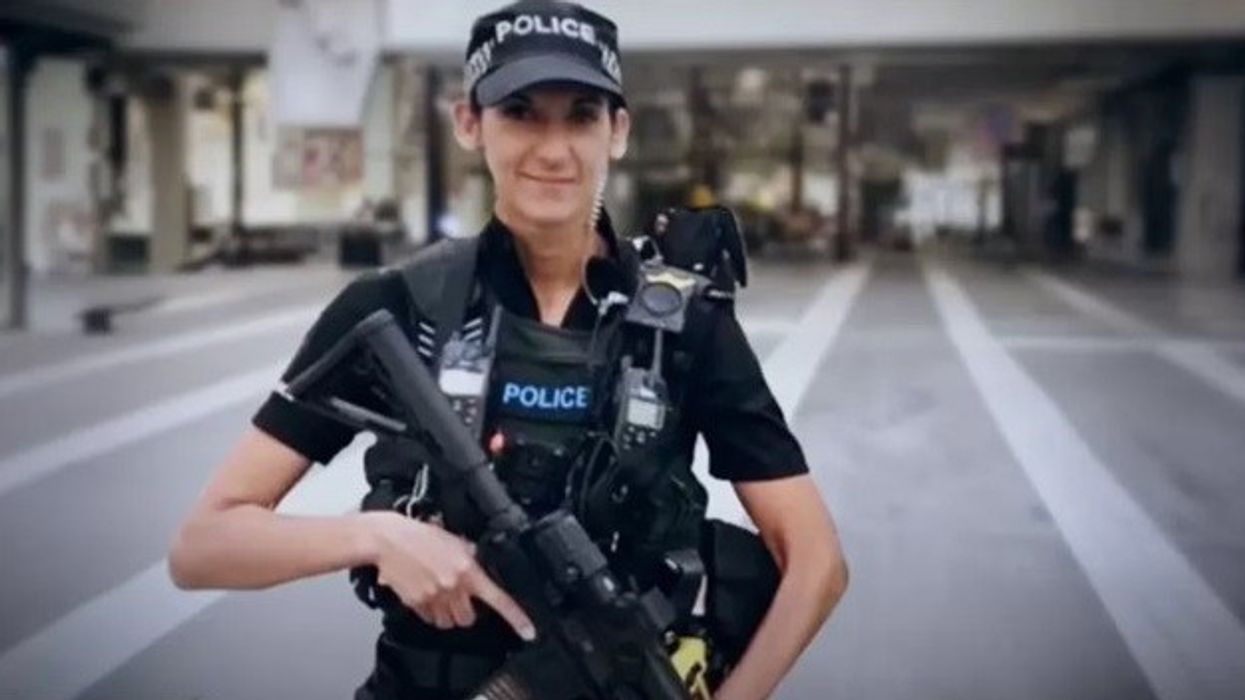

A former firearms officer who was stripped down to her underwear during a training exercise has been awarded £30,000 by an employment tribunal.
Rebecca Kalam said she felt "vindicated" by the decision, which found she had been subjected to sexist and derogatory language and harassment, sex discrimination, and victimisation at West Midlands Police, the BBC reported.
The police force said it was considering the tribunal's findings, and a further claim for future lost earnings and pensions will be decided in January. Kalam said she was "saddened" that her experience was not an isolated case.
"Only now have West Midlands Police accepted full liability for their many, many failures, yet there remains no clear cultural change or protection for its female officers," she said.
Kalam, a former detective inspector who worked at West Midlands Police from 2008 to 2023, was medically retired in July 2023 after joining the Firearms Operation Unit in 2012.
At a tribunal in Birmingham, it was revealed that in March 2012, Kalam was required to act as a "stooge" in a mock training exercise, where her clothes were cut off so that first aid could be administered.
Kalam said that she felt "extremely uncomfortable" during the exercise which involved a bullet wound to her left breast which the officers would need to treat.
Kalam alleged that on another occasion, a male officer shoved her to the ground with his foot on her neck while she was doing push-ups, and then told her that having breasts does not prevent her from doing push-ups.
The tribunal learned that the police force failed to provide her with appropriate personal protective equipment (PPE), such as ballistic body armor or a handgun with a light trigger pull, like male officers.
The tribunal also heard that the officer was made the "poster girl" for the firearms unit and was required to undergo a photo shoot when she was five months pregnant in April 2016.
In a ruling issued last week, employment judge Christopher Camp stated that Kalam had also sustained "significant psychiatric injury" that made her unable to work.
Judge Camp said that the police force's admitted wrongdoing had resulted in a "relatively young" and "ambitious" woman being "unable to work for the police again in the foreseeable future."
Kalam said that "extraordinary people" had been failed by their managers, senior leaders, and a string of faulty disciplinary procedures. She also urged officers to challenge the behaviour of their colleagues."
She added that she was sincerely grateful to her witnesses and supporters for their bravery which they demonstrated at great personal risk to their careers.
It has also been alleged that Kalam, whose husband is a detective sergeant in the same police force, would have been promoted to superintendent if she had not been discriminated against and victimised.
Her claim for aggravated damages was denied, but she was awarded £30,000 in compensation for emotional distress.
She had previously been awarded £3,000 for physical injuries she sustained due to inadequate personal protective equipment (PPE), including two second-degree burns.
At the time, she was one of only seven female firearms officers in the unit, which had up to 250 male officers.
Former West Midlands Police superintendent Karen Geddes said, “I feel sorry for Rebecca and the experience she had, I had the privilege of knowing her, and knew how much she enjoyed her role."
Some of the tribunal's findings were not unexpected, Geddes added, as firearms departments have traditionally been male-dominated.
According to her, it doesn't matter what kind of uniform you have, if you don't have women to wear it, it will just sit in a closet.
She added, for me, the question is what cultural change has the department made to ensure that someone will want to follow in Rebecca's footsteps after what she has been through.
Deputy Chief Constable Scott Green said he was "sorry that more was not done sooner" to address the "serious concerns" that Kalam had raised.
Green said the firearms unit has made significant progress in improving its culture and standards in the past two years including issuing all female officers with specific uniform and equipment.
He also said that the unit is working hard to set and reinforce the highest professional standards, and that these important steps are helping to attract and retain the best and most diverse people in firearms policing.






 Curator Emma Slocombe with ikat robes and arabachi coats in the Peter the Great Room in Blickling Hall Amit Roy
 View of the entrance to Blickling Hall on a rainy autumn dayAmit Roy
 Kente cloth from Ghana in the Long Gallery in Blickling Hall
 Decoration in the Great Hall at Blickling Hall Amit Roy
 Palampore fragment made in coastal south-east India in the Brown Room in Blickling Hall Amit Roy
 Bed valance dating from early 1700s in the Italian Print Room at Blickling Hall Amit Roy
 Indian inspired fabric draped on sofas in the South Drawing Room in Blickling Hall Amit Roy
 Indian inspired fabric draped on sofas in the South Drawing Room with Indian carpet in Blickling Hall Amit Roy
 Karun Thakar has picked out the geometric patterns in the bookcase and the Kente cloth in the Long Gallery in Blickling Hall Amit Roy
 Large tapestry depicting Peter the Great defeating the Swedish army at the Battle of Poltava in 1709 Amit Roy
 ikat robes and arabachi coats in the Peter the Great Room in Blickling Hall Amit Roy
 Baghs and kanthas made by women provide contrast to the men only portraits in the Great Hall at Blickling Hall Amit Roy
 Baghs and kanthas in the entrance Great Hall at Blickling Hall Amit Roy
 Baghs and Kanthas in the Great Hall in harmony with stained glass window at Blickling Hall Amit Roy
 Kimonos reflect Japanese influence in Upper Ante Room in Blickling Hall Amit Roy
 Kimono in Upper Ante Room in Blickling Hall
 A view of the Palace and fort at Agra shows romantic side of India Amit Roy
 Blickling Hall Amit Roy
 Table carpet, European 1670-1680 Amit Roy
 Unfinished 17th century Italian embroidery in the Print Room at Blickling Hall Amit Roy
 Picture of Kashmir shows a romantic view of India Amit Roy
 A panel of Ashburnham bed hangings made in Gujarat for sale in Europe in the Brown Room in Blickling Hall Amit Roy
 Colcha made in the 1600s by women in Bengal for the Portuguese market in the Long Gallery at Blickling Hall Amit Roy




