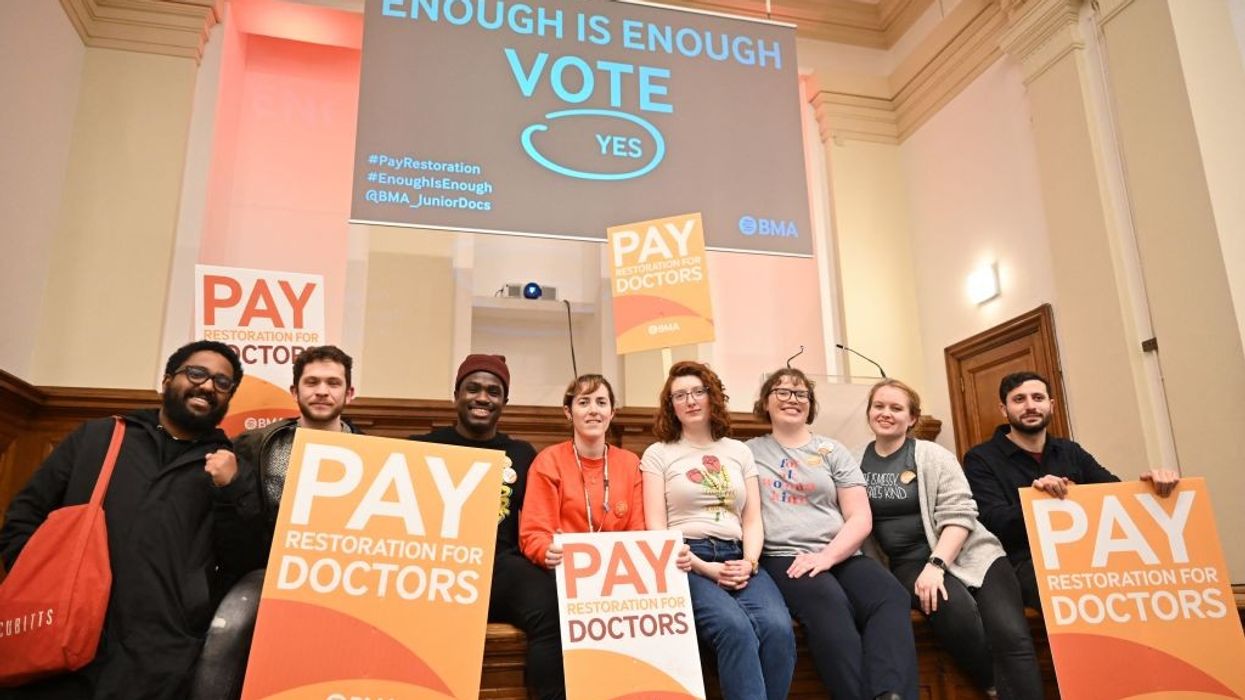

FED UP with a government he says doesn't care, Poh Wang plans to go on strike with tens of thousands of other British junior doctors next week, saying he is overworked, underpaid and burdened with a student loan he cannot imagine paying off.
The 28-year-old says he and his colleagues have been pushed to the brink after below-inflation pay rises collided with the surging cost of living to leave him questioning how he can ever pay off his more than £85,000 of student debt.
He joins junior doctors across England who will go on strike on March 13 for three days, protesting over pay and burnout that risks driving staff out of the health service as it tackles record-high patient waiting lists.
"We've reached a boiling point where we have had enough," said Wang - a council member of the British Medical Association (BMA), which represents doctors and medical students.
The son of Chinese immigrants who ran a takeaway restaurant in Chester, northern England, Wang became a doctor because he enjoyed helping people. Having attended medical school for six years, he has worked for five, two in speciality training as a psychiatry doctor.
Junior doctors are qualified physicians, often with several years of experience, who work under the guidance of senior doctors and represent a large part of the country's medical community.
He is paid around £40,000 a year for his base 40 hours a week, and works additional hours which can add up to around 48 hours a week.
Early on in the pandemic, Wang worked as an emergency medicine doctor in south London where he and colleagues had to make difficult decisions, and comfort those patients who could not be admitted into intensive care units because they were full.
"We went above and beyond to do everything that we could," he said.
He said the fact that he is struggling to get by financially now, as food inflation hits 17 per cent in Britain, leaves him and his colleagues increasingly bitter about the last few years.
"We hate the sound of clapping, applause, because it's empty," said Wang, referring to Britain's Clap for Our Carers campaign for health workers during the height of the pandemic.
The BMA says junior doctors' take-home pay has been cut by more than a quarter over the last 15 years, when using the Retail Price Index (RPI) gauge of inflation.
It says its members voted overwhelmingly to strike.
The walkouts by junior doctors will put more pressure on the state-funded National Health Service (NHS) which is experiencing waves of strike action by nurses, ambulance workers and other staff.
Daniel Zahedi, 27, is another junior doctor who plans to go on strike on Monday (13). He describes his hospital in Cambridge, eastern England, as chronically understaffed and struggling.
"A lot of the time there's not enough of us," Zahedi said.
As a first-year doctor after his medical degree, Zahedi said he gets around £29,000 per year as base pay for 40 hours a week minimum.
(Reuters)