
Highlights
- The 1966 World Cup remains England's sole major international title after 60 years
- No comparable footballing nation is so singularly defined — or psychologically constrained — by one historical result
- The media's recycling of 1966 functions less as celebration and more as an annual reminder for modern players
- With England at the 2026 World Cup, the pressure to finally move beyond Wembley has never been more visible
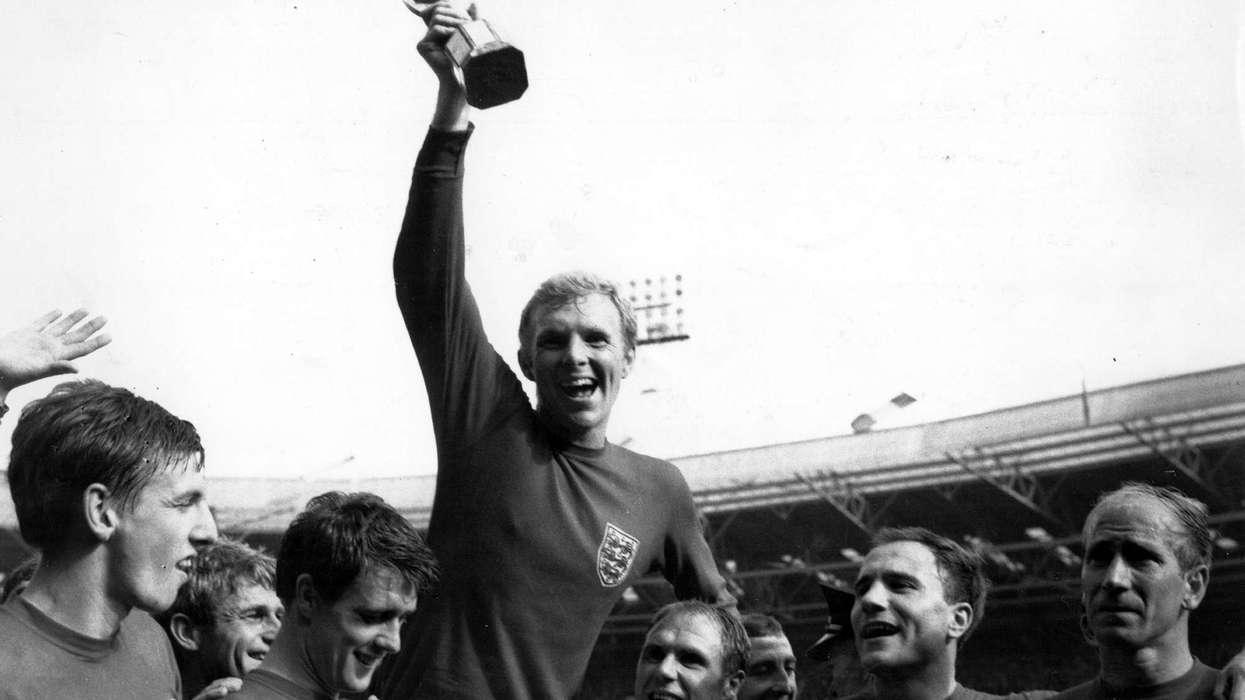
SOMEWHERE in a broadcasting vault there is a reel that gets dusted off every two years without fail. Bobby Moore, clean white shirt, lifting the World Cup trophy above his head at Wembley. Kenneth Wolstenholme's voice. The roar of the crowd. It is among the most replayed moments in English football history, and it is, quietly, one of the most damaging.
Not because 1966 should be forgotten. It shouldn't. England won the World Cup on home soil, played brilliantly, and produced one of the game's most enduring images. That is worth celebrating. The problem is that in England, it has never merely been celebrated. It has been weaponised — turned into a recurring reminder of everything that has come after and failed to measure up.
At some point between Alf Ramsey lifting the trophy and now, the win stopped being a high point and became a haunting. The question is when — and whether anyone in English football has the nerve to finally call it what it is.
Every nation has a history. Only England is trapped by one.
Here is something that rarely gets said plainly: England is genuinely unusual in this. Not uniquely brilliant, not uniquely cursed — just genuinely unusual in the degree to which one result from 60 years ago still sets the terms of every conversation about the national team.
Take the Netherlands. For decades they produced some of the most talented players the world had ever seen — Cruyff, Gullit, van Basten and Bergkamp. Total Football became a byword for beautiful, uncompromising football. Yet Dutch supporters did not spend four generations tying that tradition around the necks of every new midfielder who came through. The legacy lived in how they played, not in what they had not won.
Or look at Hungary. The Mighty Magyars of the early 1950s were arguably the greatest international side never to win the World Cup — a generation that beat England 6-3 at Wembley in 1953, a result so shocking it shook English football to its foundations. Hungary never won the big prize. But Hungarian football did not collapse into 60 years of self-referential mourning either.
Even Argentina, after losing the 2014 World Cup final and the 2015 Copa América final, managed to rebuild rather than retreat into nostalgia. They won in 2021. They won again in 2022. They did not do this by replaying footage of Maradona every time the squad announced itself.
England's situation is not about bad luck or tactical naivety or a shortage of talent. Something deeper is going on — a cultural pattern so embedded that most people inside English football no longer notice it, the same way you stop noticing wallpaper you have lived with for 30 years.
The press didn't just cover 1966. They built a religion around it.
If you want to understand why English players so often look as though they are carrying something invisible onto the pitch at major tournaments, look at what they grew up reading.
The tabloid treatment of England at tournaments is a masterclass in manufactured pressure. In the build-up: archive photographs of Moore, Hurst and Ball. Pull quotes from '66 veterans about what "belief" looks like. Columns asking whether this squad has "what it takes" — the subtext being that the answer is probably no, but let's sell some newspapers finding out.
When England win a group game by a single goal: "Not exactly 1966, is it?" When they go out on penalties: the language of national shame, of dreams deferred, of football coming home and finding the door locked again. The coverage doesn't just report what happens. It frames it — and the frame has been 1966 for so long that most journalists reach for it without even realising they are making a choice.
No German player in the mid-2000s was told he wasn't as good as Gerd Müller. No Spanish midfielder in 2010 faced headlines asking whether he was living up to Alfredo Di Stéfano. The comparison game is English football's particular neurosis, and it is passed down — from the press to the fan, from the fan to the pub, from the pub into the culture at large, until eventually a 19-year-old sitting in the England dressing room before a semi-final has absorbed the weight of it without ever consciously choosing to.
Sports psychologists have a name for this kind of inherited expectation: ego threat. Research suggests that when performance is framed around avoiding failure rather than achieving success, athletes can make worse decisions under pressure. They become conservative where they should be bold. They hesitate. They take penalties the way England teams have taken penalties for 30 years — as though the worst possible outcome is already half expected.
What 1966 was, and what it wasn't
Let's be honest about something that tends to get lost in the mythology. The 1966 World Cup was played on home soil, at a time when international football was less competitive globally than it is today, against a West German side that would go on to become one of the dominant forces in world football. England were excellent. Alf Ramsey was an exceptional manager. But the win happened in a specific context that has never since been replicated — and probably never will be.
More significantly for those of us watching from the British Asian community: the England of 1966 was a team, and a crowd, and a country that looked nothing like the England of today.
That is not a criticism of what those players achieved. It is simply the truth. And it matters, because when the 1966 benchmark is held up as the gold standard against which all future England teams must be measured, it is — whether anyone intends it this way or not — holding a monocultural snapshot from 60 years ago as the defining image of English footballing success.
For British Asian fans who have supported England through the lean years, who cheered Beckham's free-kick against Greece, who went to sleep after Euro 2020 feeling the same gut punch as everyone else, the 1966 mythology has always sat slightly awkwardly. It is a story about England that was written before we were part of the story. And being asked to measure the current squad — a genuinely diverse group of players who reflect what this country actually looks like — against that particular chapter is quietly strange.
The current England side is more representative of this country's make-up than any team that preceded it. That should be worth something. In fact, it should be the story. Instead, it competes for column inches with yet another anniversary retrospective about what it felt like to be in the crowd at Wembley in July 1966.
Germany moved on. Spain moved on. England keeps circling the same drain.
There is a practical football argument here too, separate from questions of identity and psychology, and it is equally damning.
Germany, by the late 1990s, had become stale. A nation that had won the World Cup in 1990 and reached the final in 2002 was producing technically limited, ageing squads that embarrassed themselves at Euro 2000. Rather than retreating into the comfort of their own history, the German FA commissioned a full structural review and spent nearly a decade rebuilding from youth level upwards. By 2014, the results were there on the biggest stage in the world — a 7-1 hammering of Brazil in the semi-final and a World Cup won on merit, not memory.
Spain's transformation was even more radical. They took the passing philosophy that had long existed in club football at Barcelona and built a national identity around it from scratch. Three consecutive major tournament wins between 2008 and 2012 followed — not despite abandoning the past, but because of it.
England, meanwhile, spent those same years having the same arguments. Too much money in the Premier League. Too many foreign players. The game has gone soft. Remember when players played through pain? Remember 1966?
The problem with looking backwards is not that it is sentimental. The problem is that it is expensive. Every column, every broadcast segment, every changing-room conversation that draws energy from the past is energy not directed at the present. And football, at the highest level, is an entirely present-tense game.
The 2026 World Cup: a door and a habit
England are at the 2026 World Cup, a tournament being hosted across the United States, Canada and Mexico. The squad has real quality — better, arguably, than several England generations that came before and were discussed as though they could walk on water. If they go deep in this tournament, the 1966 conversation will intensify before it fades. The newspapers will dust off the reel. The pundits will reach for Wolstenholme. The weight will sit there, unspoken, in the background of every post-match analysis.
And if they go out early? The same cycle. Different players, same script.
What would it actually look like for England to break free of this? Probably not a World Cup win, counter-intuitively — because winning would simply validate the mythology rather than dissolve it. It would look more like a sustained cultural decision: stop making 1966 the reference point. Measure this squad against what they are capable of, not against what 11 men did on a specific afternoon before most of the country's current population was born.
Other nations have quietly figured this out. England keeps choosing not to.
The ghost at Wembley is not going anywhere on its own. It will only leave when the country that invited it in finally decides it has overstayed its welcome.