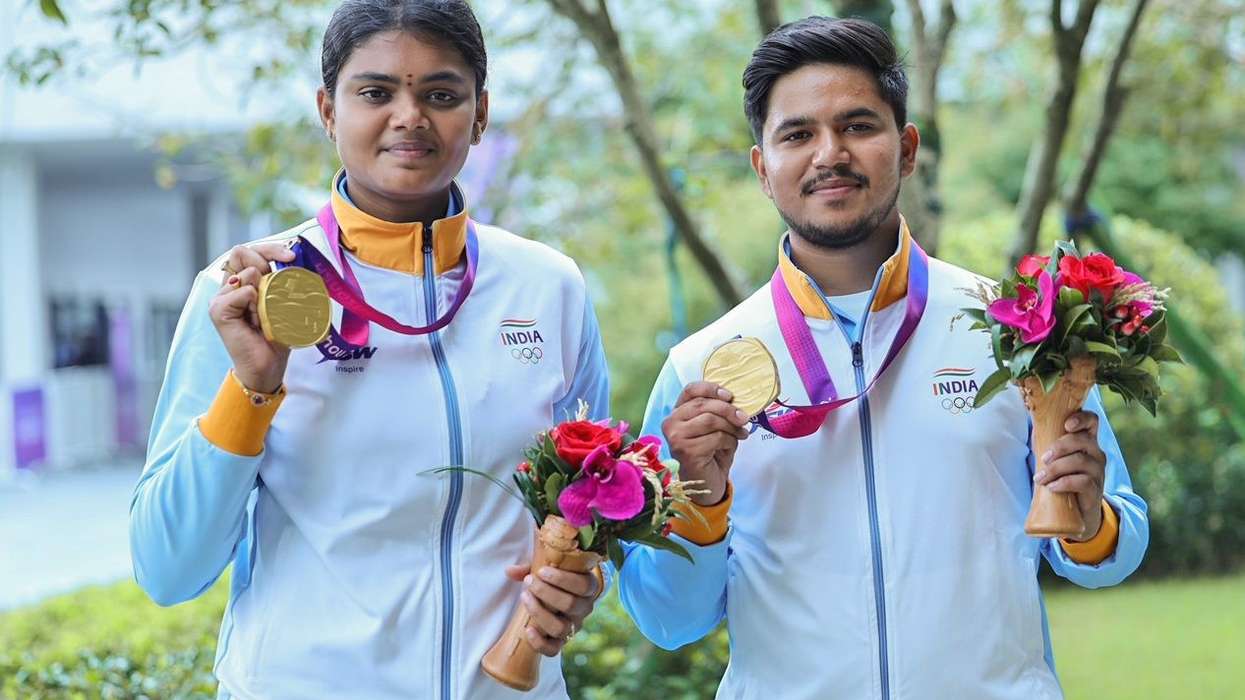

Ojas Deotale and Jyothi Surekha Vennam have clinched India's first gold medal in the compound mixed team event, marking their best-ever performance in archery at the Asian Games in Hangzhou on Wednesday (4).
The 21-year-old reigning world champion Deotale dropped a point but Jyothi made up for it, shooting all perfect scores from her eight arrows to down the second-seeded Korean pair So Chaewon and Joo Jaehoon 159-158.
With this, Indian archers are set to win at least four medals from the ongoing Games, which will better their previous best show at Incheon in 2014 when they bagged a men's team compound gold, one silver, and a bronze.
Playing three back-to-back knockout matches -- quarterfinals, semifinals and final -- in 140 minutes can be gruelling, but the Indian pair was calm, especially the 27-year-old Jyothi, who excelled in some crucial moments to nail it.
That the pair dropped just four points in three matches tells a lot about the authority shown by Deotale and Jyothi.
"I'm not surprised by the result," Deotale said after the win.
"We knew that we could do this. It was very close, but we maintained our form, we stayed calm in every situation," he added.
Making her third Asian Games appearance, the multiple World Cup gold medallist Jyothi, who was chasing an elusive Asian Games yellow metal, first sealed it with a decisive 10 in the final end when India ousted a formidable Malaysia 158-155 to make the semifinals.
The Indian duo entered the final with a 159-154 win over Kazakhstan. They had just one '9' and the rest were all '10s' in the semifinals against the Kazakh pair of Adel Zhexenbinova and Andrey Tyutyun.
In the gold medal clash between the top-two seeds, the No. 1 Indian pair opting to shoot first had all 10s in the first end, to race to a 40-39 lead.
The Koreans had the advantage of starting off in the second end and managed to squeeze in all 10s, while the Indians remained steady to hold onto their lead (80-79).
In the penultimate end, Ojas faltered with a nine while responding to the Koreans' two 10s, but Jyothi held her nerves and responded with a slam-bang 10 right in the inner-circle.
The two teams headed for the final end all squared up (119-119) but the Indian duo remained cool, shooting all 10s from four arrows to seal it before the Koreans' last two arrows.
Talking about his minor blip of 9, Deotale credited his Indian compound head coach Sergio Pagni, a two-time World Cup Final winner, to lift his morale.
Asked whether he was under any undue pressure of being the reigning world champion, he said: "The pressure is gone, I'm playing freely, enjoying stuff."
Both Deotale and Jyothi will also vie for an individual gold medal each.
Deotale will face senior teammate Abhishek Verma, while top-seed Jyothi will take on So Chaewon in the individual finals on Saturday (7).
(PTI)