Highlights:
- Thousands attended Tommy Robinson’s “Unite the Kingdom” march
- Counter-demonstration linked to Nakba Day also drew crowds
- Police deployed 4,000 officers across protests and FA Cup policing
- 43 arrests were made across the two demonstrations
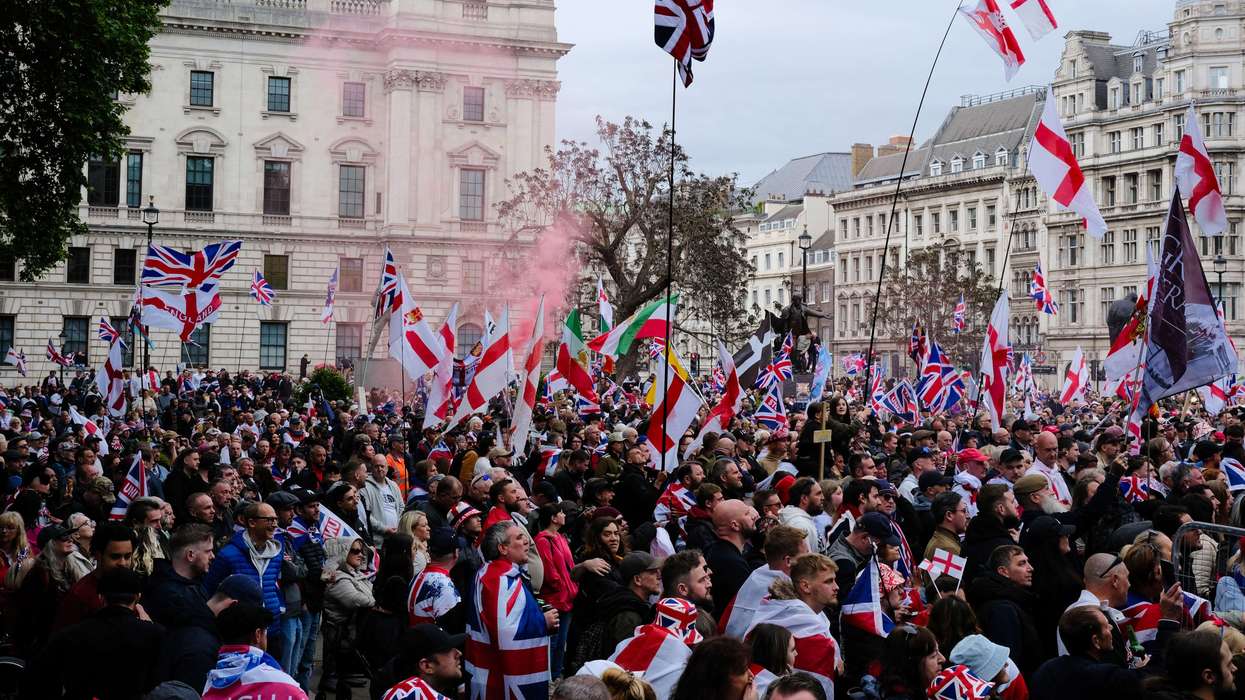
TENS of thousands of people took part in a London march organised by far-right activist Tommy Robinson on Saturday, while a counter-demonstration linked to a pro-Palestinian protest also drew crowds as police mounted a large operation to keep groups apart.
The Metropolitan Police deployed 4,000 officers, along with horses, dogs, drones and helicopters, to police Robinson’s “Unite the Kingdom” march, the Nakba Day rally and the FA Cup Final.
Nakba Day marks the 1948 displacement of Palestinians during the creation of Israel. Protesters gathered in west London before marching towards Piccadilly for speeches. The event also joined an anti-fascism march organised by Stand Up to Racism.
The “Unite the Kingdom” march began in Holborn and ended in Parliament Square, where Robinson and other speakers addressed supporters.
“Immigration's the main concern,” Christine Turner, 66, from northeast England, told AFP.
“We're an island. We've got a clear border that they're not protecting. Something needs to be done. It's gone on too long.”
Some attendees wore “Make England Great Again (MEGA)” caps, while others carried wooden crosses and chanted “Christ is king”.
“The main aspect that I'm behind is to protect women and children,” British-Polish teenager Amelia Stearn told AFP after flying in from Poland.
“Illegal immigration is really taking a toll on the country,” she said of the UK.
Heather Booker attended the combined pro-Palestine and Stand Up to Racism event.
“It's very worrying that there's a real rise in racism and fascism in Britain and across Europe,” she told AFP.
The Met had not released official attendance figures by Saturday evening, but aerial footage shown by UK media showed large crowds at the Unite the Kingdom rally, with people carrying Union Jack and St George’s flags.
An AFP reporter estimated several thousand people attended the counter-protest.
Police later said 43 arrests had been made across the two demonstrations, with another 22 arrests linked to the FA Cup Final between Chelsea and Manchester City at Wembley.
“Four officers were assaulted today. Fortunately none seriously. A further six officers were subjected to hate crime offences,” the Met said on X.
Robinson, whose real name is Stephen Yaxley-Lennon, is a former football hooligan turned anti-Islam activist. His public profile has grown in recent years, particularly online.
In September last year, up to 150,000 people attended a rally he organised in central London around themes including “national unity, free speech and Christian values”.
Robinson has focused on issues including migrants crossing the English Channel in small boats, immigration policy and free speech concerns.
X owner Elon Musk addressed the September rally through a video link. The event drew attention because of its size and clashes between some protesters and police, which left dozens of officers injured.
The Met imposed conditions on both rallies on Saturday in an effort to prevent confrontations. Organisers were also made legally responsible for ensuring invited speakers did not break hate speech laws.
Prime Minister Keir Starmer said on Friday that “anyone who sets out to wreak havoc on our streets, to intimidate or threaten anyone... can expect to face the full force of the law”.
He accused organisers of Robinson’s rally of “peddling hatred and division”.
Robinson, who had urged supporters not to wear masks, drink excessive alcohol and to remain “peaceful and courteous”, told the crowd he was leading a “cultural revolution”.
Leading chants against Starmer, he urged supporters to take part in politics ahead of the next general election expected in 2029.
Before the rally, the government also blocked 11 “foreign far-right agitators” from entering Britain.
Among them was US-based Valentina Gomez, who the government said was “known for using inflammatory and dehumanising rhetoric about Muslim communities”.
The rival demonstrations came after a series of attacks targeting London’s Jewish community. Some people have linked hate speech at pro-Palestinian marches to rising antisemitism.
The UK’s terrorism threat level was raised two weeks ago to “severe”, the second-highest category, with security officials citing the “broader Islamist and extreme right-wing terrorist threat”.
(With inputs from agencies)