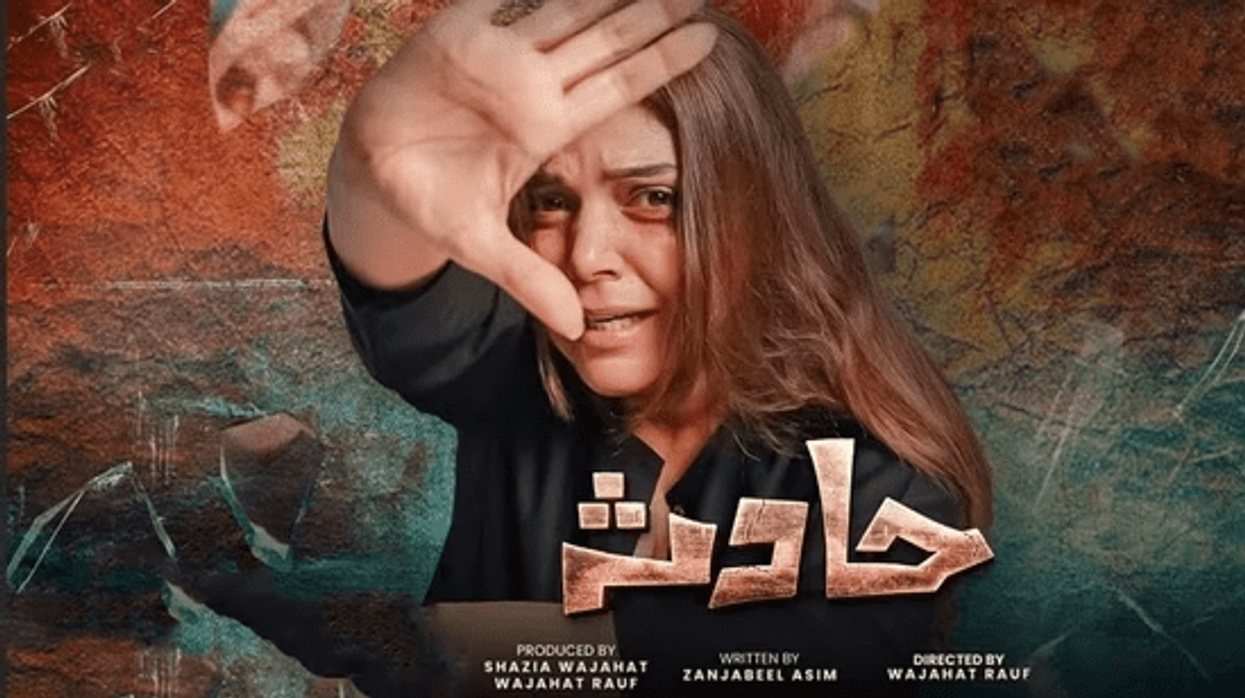

Pakistani censors have banned a TV drama over scenes reminiscent of a notorious gang rape case, saying the series would "tarnish" the nation's image by depicting it as an "unsafe place for women".
Regulators said the show Hadsa would be pulled from airwaves due to parallels to the real-life case of a French-Pakistani mother raped in front of her small children after her car ran out of fuel near the eastern city of Lahore.
"Portrayal of such (a) heinous act will not only trigger the trauma of that unfortunate victim but would also tarnish (the) country's image," said the order from the Pakistan Electronic Media Regulatory Authority (PEMRA).
Sexual violence is endemic in deeply patriarchal Pakistan, where women are often treated as second-class citizens and the rape conviction rate is reported to be as low as 0.3 per cent.
The 2020 Lahore motorway rape case sparked nationwide protests after local police chided the victim for travelling at night without a male escort.
Then-police chief Umar Sheikh had repeatedly berated the woman - a resident of France - saying she probably "mistook that Pakistani society is just as safe" as her home country.
But PEMRA suggested that Hadsa, which began airing recently, would cause overseas viewers to wrongly "perceive Pakistan as (an) unsafe place for women", adding that it did not portray a "true picture of Pakistani society".
Lawyer Muhammad Ahmad Pansota told AFP that he had lodged a complaint against the show with PEMRA on behalf of the rape victim.
"She said to me actually that whenever she watches an episode, or how people react when they watch it, she has to go through the entire trauma again," he said. "She's not very comfortable with that."
Episodes four and five of Hadsa show a woman and her son being kidnapped and assaulted by a gang when their car breaks down, later revealing the character was raped.
Before the series was censored, actress Hadiqa Kiani, who plays the woman, said it was not based on real-life events.
"Unfortunately, the horrific act of rape and violence happens far too often in our society," she wrote on the social media site X. "Hadsa is not based on any one person's story, it is based off of a sickly common part of our reality."
In the wake of the Lahore incident, backlash over victim-blaming and abysmal conviction rates spurred legal reforms, including the establishment of special courts and chemical castration of serial rapists.
Two men were sentenced to death in 2021 for participating in the rape, but have yet to be executed.
Pakistan regularly censors media it deems offensive to the nation's conservative Islamic values.
Earlier this year, the website Wikipedia was blocked for hosting "blasphemous content", while the Barbie movie and the critically acclaimed transgender romance film Joyland also fell foul of censors.






 Curator Emma Slocombe with ikat robes and arabachi coats in the Peter the Great Room in Blickling Hall Amit Roy
 View of the entrance to Blickling Hall on a rainy autumn dayAmit Roy
 Kente cloth from Ghana in the Long Gallery in Blickling Hall
 Decoration in the Great Hall at Blickling Hall Amit Roy
 Palampore fragment made in coastal south-east India in the Brown Room in Blickling Hall Amit Roy
 Bed valance dating from early 1700s in the Italian Print Room at Blickling Hall Amit Roy
 Indian inspired fabric draped on sofas in the South Drawing Room in Blickling Hall Amit Roy
 Indian inspired fabric draped on sofas in the South Drawing Room with Indian carpet in Blickling Hall Amit Roy
 Karun Thakar has picked out the geometric patterns in the bookcase and the Kente cloth in the Long Gallery in Blickling Hall Amit Roy
 Large tapestry depicting Peter the Great defeating the Swedish army at the Battle of Poltava in 1709 Amit Roy
 ikat robes and arabachi coats in the Peter the Great Room in Blickling Hall Amit Roy
 Baghs and kanthas made by women provide contrast to the men only portraits in the Great Hall at Blickling Hall Amit Roy
 Baghs and kanthas in the entrance Great Hall at Blickling Hall Amit Roy
 Baghs and Kanthas in the Great Hall in harmony with stained glass window at Blickling Hall Amit Roy
 Kimonos reflect Japanese influence in Upper Ante Room in Blickling Hall Amit Roy
 Kimono in Upper Ante Room in Blickling Hall
 A view of the Palace and fort at Agra shows romantic side of India Amit Roy
 Blickling Hall Amit Roy
 Table carpet, European 1670-1680 Amit Roy
 Unfinished 17th century Italian embroidery in the Print Room at Blickling Hall Amit Roy
 Picture of Kashmir shows a romantic view of India Amit Roy
 A panel of Ashburnham bed hangings made in Gujarat for sale in Europe in the Brown Room in Blickling Hall Amit Roy
 Colcha made in the 1600s by women in Bengal for the Portuguese market in the Long Gallery at Blickling Hall Amit Roy




