
AT LEAST 17 people have been killed and 100 others injured in Bangladesh after two trains collided on Monday (23), with officials saying they fear the death toll will rise.
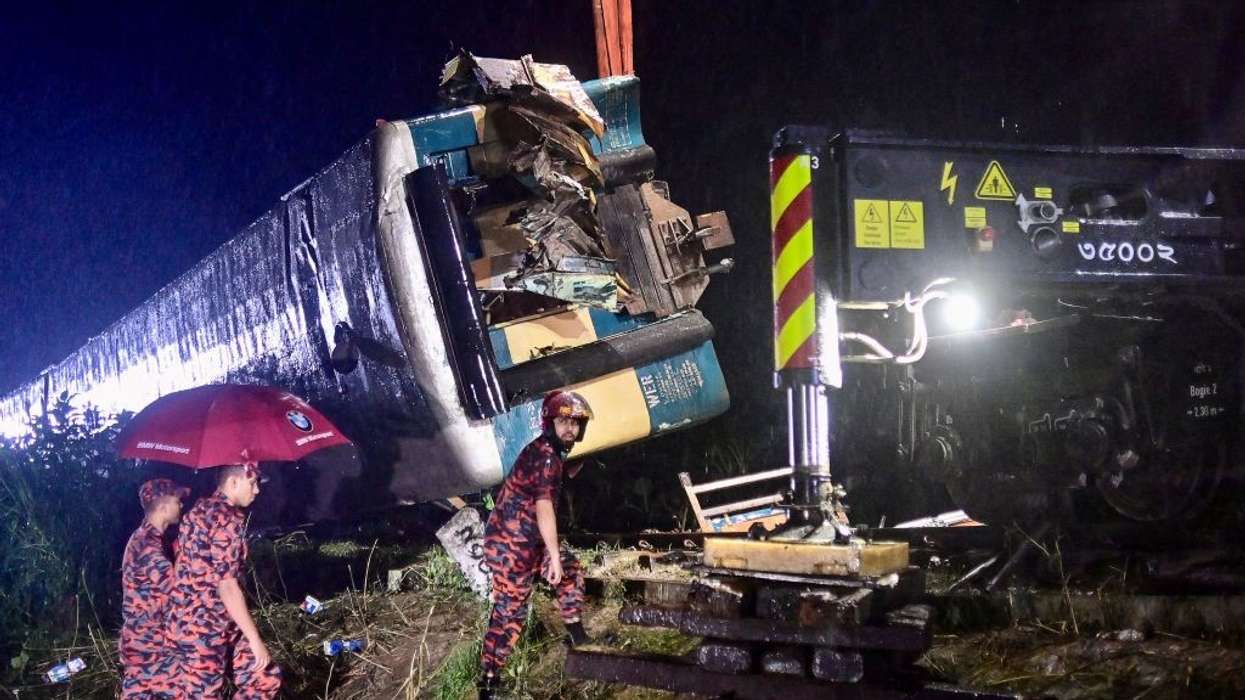
The crash in the eastern city of Bhairab saw a freight train smash into a passenger train travelling in the opposite direction, derailing two passenger carriages, officials said.
"We have recovered 17 bodies. More than 100 people were injured," said Sadiqur Rahman, a government administrator in Bhairab, which lies around 60 kilometres (38 miles) northeast of the capital Dhaka.
"The death toll will rise," Rahman said, with rescuers reporting they could still see bodies crushed and trapped under overturned coaches.
"A rescue train carrying cranes is on its way," he said.
Local residents and volunteers rushed to the scene after the accident took place at around 4:00 pm local time (1000 GMT).
The crash occurred after one train entered the same line as the other, Rahman said.
Video footage broadcast by the private Channel 24 showed hundreds of people crowding the accident site with many in tears as they searched for relatives.
"We have rescued at least two people alive from the overturned coaches," Nazmul Haque, a Red Crescent volunteer, told reporters.
Officials said fire service, police and the elite Rapid Action Battalion security force were at the crash site.
Bangladesh authorities have ordered two investigations into the accident, and appeals have been made for volunteers to donate blood.
Nazmul Islam, a general manager of the state-run Bangladesh Railway, which owns the train, told local media the freight train overshot its signal.
Train accidents are common in Bangladesh and are often caused by poor signalling, negligence, old tracks or other rundown infrastructure.
(AFP)
17 die in Bangladesh train accident
A freight train smashes into a passenger train travelling in the opposite direction






 Curator Emma Slocombe with ikat robes and arabachi coats in the Peter the Great Room in Blickling Hall Amit Roy
 View of the entrance to Blickling Hall on a rainy autumn dayAmit Roy
 Kente cloth from Ghana in the Long Gallery in Blickling Hall
 Decoration in the Great Hall at Blickling Hall Amit Roy
 Palampore fragment made in coastal south-east India in the Brown Room in Blickling Hall Amit Roy
 Bed valance dating from early 1700s in the Italian Print Room at Blickling Hall Amit Roy
 Indian inspired fabric draped on sofas in the South Drawing Room in Blickling Hall Amit Roy
 Indian inspired fabric draped on sofas in the South Drawing Room with Indian carpet in Blickling Hall Amit Roy
 Karun Thakar has picked out the geometric patterns in the bookcase and the Kente cloth in the Long Gallery in Blickling Hall Amit Roy
 Large tapestry depicting Peter the Great defeating the Swedish army at the Battle of Poltava in 1709 Amit Roy
 ikat robes and arabachi coats in the Peter the Great Room in Blickling Hall Amit Roy
 Baghs and kanthas made by women provide contrast to the men only portraits in the Great Hall at Blickling Hall Amit Roy
 Baghs and kanthas in the entrance Great Hall at Blickling Hall Amit Roy
 Baghs and Kanthas in the Great Hall in harmony with stained glass window at Blickling Hall Amit Roy
 Kimonos reflect Japanese influence in Upper Ante Room in Blickling Hall Amit Roy
 Kimono in Upper Ante Room in Blickling Hall
 A view of the Palace and fort at Agra shows romantic side of India Amit Roy
 Blickling Hall Amit Roy
 Table carpet, European 1670-1680 Amit Roy
 Unfinished 17th century Italian embroidery in the Print Room at Blickling Hall Amit Roy
 Picture of Kashmir shows a romantic view of India Amit Roy
 A panel of Ashburnham bed hangings made in Gujarat for sale in Europe in the Brown Room in Blickling Hall Amit Roy
 Colcha made in the 1600s by women in Bengal for the Portuguese market in the Long Gallery at Blickling Hall Amit Roy




