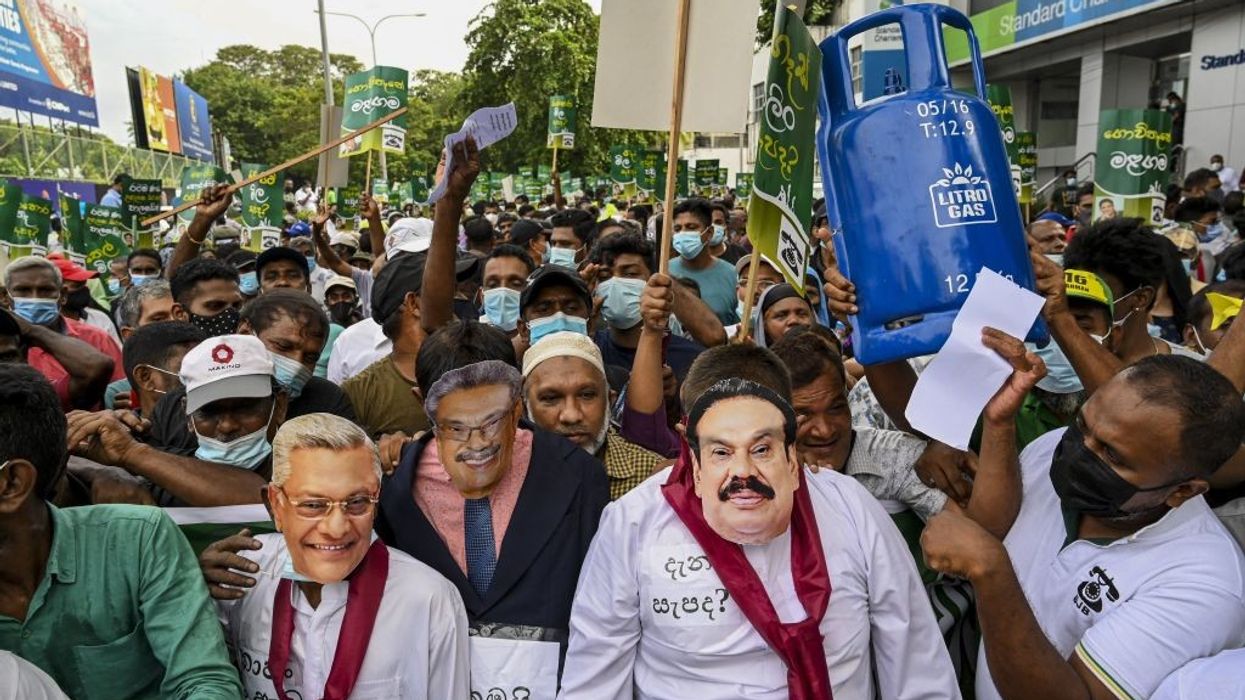

SRI LANKA is investigating a sharp rise in kitchen explosions caused by cooking gas that have reportedly killed at least one person and wounded dozens of others, parliament heard Monday (28).
The island is in the grip of an economic crisis with serious shortages of fossil fuels and other essential goods because of depleted foreign currency reserves.
Opposition lawmakers have blamed increased concentrations of propane in liquified petroleum gas (LPG) cylinders used for cooking, relative to the more expensive butane.
The government is now probing LPG supplies after a dozen blasts linked to kitchen stoves, consumer affairs minister Lasantha Alagiyawanna told parliament.
"During a short space of time there has been a very sharp increase in gas accidents," he said.
"We don't want to have 10 to 15 homes blowing up daily, so I have ordered an investigation."
An official in Sri Lanka's consumer affairs agency, who asked not to be named, said higher concentrations of propane were increasing pressure on LPG cylinders, causing leaks that led to explosive fires.
State-run gas agency Litro has denied changing the proportion of butane and propane in domestic gas cylinders, instead blaming poorly maintained stoves and faulty pipes.
Local media reports said a 19-year-old woman was killed after a gas cylinder leaked and exploded in Sri Lanka's east last week.
Police have denied the death was due to a gas leak.
Consumers have faced serious LPG shortages in recent months with authorities struggling to find foreign exchange to finance gas and crude oil imports.
Sri Lanka's only oil refinery shut for the first time in its 52-year history this month because it could not source dollars to import crude.
The island's economy shrank last year as the pandemic took hold and tourism nosedived.
A resulting foreign exchange shortage prompted authorities to shore up Sri Lanka's trade imbalance with a broad ban on imports, including some food and agricultural products.
That decision eventually sparked food shortages, with supermarkets rationing rice and the price of some staples doubling earlier this month.
(AFP)






 Curator Emma Slocombe with ikat robes and arabachi coats in the Peter the Great Room in Blickling Hall Amit Roy
 View of the entrance to Blickling Hall on a rainy autumn dayAmit Roy
 Kente cloth from Ghana in the Long Gallery in Blickling Hall
 Decoration in the Great Hall at Blickling Hall Amit Roy
 Palampore fragment made in coastal south-east India in the Brown Room in Blickling Hall Amit Roy
 Bed valance dating from early 1700s in the Italian Print Room at Blickling Hall Amit Roy
 Indian inspired fabric draped on sofas in the South Drawing Room in Blickling Hall Amit Roy
 Indian inspired fabric draped on sofas in the South Drawing Room with Indian carpet in Blickling Hall Amit Roy
 Karun Thakar has picked out the geometric patterns in the bookcase and the Kente cloth in the Long Gallery in Blickling Hall Amit Roy
 Large tapestry depicting Peter the Great defeating the Swedish army at the Battle of Poltava in 1709 Amit Roy
 ikat robes and arabachi coats in the Peter the Great Room in Blickling Hall Amit Roy
 Baghs and kanthas made by women provide contrast to the men only portraits in the Great Hall at Blickling Hall Amit Roy
 Baghs and kanthas in the entrance Great Hall at Blickling Hall Amit Roy
 Baghs and Kanthas in the Great Hall in harmony with stained glass window at Blickling Hall Amit Roy
 Kimonos reflect Japanese influence in Upper Ante Room in Blickling Hall Amit Roy
 Kimono in Upper Ante Room in Blickling Hall
 A view of the Palace and fort at Agra shows romantic side of India Amit Roy
 Blickling Hall Amit Roy
 Table carpet, European 1670-1680 Amit Roy
 Unfinished 17th century Italian embroidery in the Print Room at Blickling Hall Amit Roy
 Picture of Kashmir shows a romantic view of India Amit Roy
 A panel of Ashburnham bed hangings made in Gujarat for sale in Europe in the Brown Room in Blickling Hall Amit Roy
 Colcha made in the 1600s by women in Bengal for the Portuguese market in the Long Gallery at Blickling Hall Amit Roy




