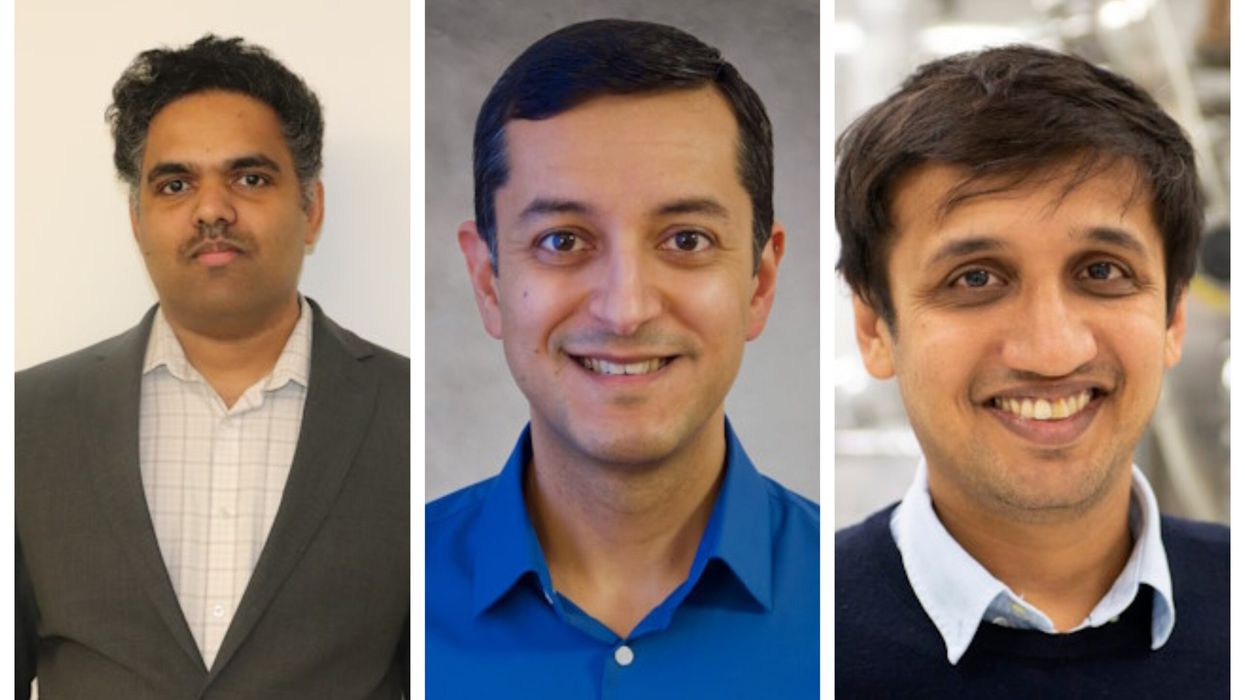

THREE Indian scientists are among the winners of the 2024 Blavatnik awards for young scientists in the UK.
Prof Rahul R Nair, Prof Mehul Malik and Dr Tanmay Bharat are among the nine winners of award instituted by the Blavatnik Family Foundation and The New York Academy of Sciences.
The grants, amounting to £480,000, acknowledge research efforts that are revolutionizing fields such as medicine, technology, and our comprehension of the world in chemical sciences, physical sciences and engineering, and life sciences, a statement said.
Prof Nair, a materials physicist and Carlsberg/Royal Academy of Engineering Research chair at The University of Manchester, will receive £100,000.
Prof Malik, quantum physicist and professor of physics at Heriot-Watt University in Scotland and Dr Bharat, structural microbiologist and programme leader in the Structural Studies Division at the MRC Laboratory of Molecular Biology in Cambridge will receive £30,000 each.
Prof Nair was named Laureate in Physical Sciences and Engineering for developing novel membranes based on two-dimensional (2D) materials that will enable energy-efficient separation and filtration technologies.
Using graphene and other 2D materials, his research aims to study the transport of water, organic molecules, and ions at the nanoscale, exploring its potential applications to address societal challenges, including water filtration and other separation technologies.
Prof Malik was honoured for advancing quantum communications at Heriot-Watt University through techniques that harness high-dimensional entanglement, a complex quantum physics phenomenon.
According to a statement, his innovations enable the normally fragile entanglement to survive long distances and harsh conditions, laying the foundation for noise-robust and high-capacity quantum networks that securely transmit large amounts of information encoded on individual photons.
Dr Bharat was awarded for ackling human health by understanding the mechanisms of biofilm and microbiome formation through new cutting-edge electron cryotomography (cryo-ET) techniques
He has developed and applied cutting-edge cryo-ET techniques to create atomic-level pictures of cell surface molecules on microorganisms, revealing how these molecules mediate the formation of multicellular communities.
His work has important biomedical implications, since most pathogenic bacteria infect humans by forming multicellular, antibiotic-resistant, biofilm communities, the statement added.
They will be honoured at a Gala ceremony at Banqueting House in London on Feb 27 and will speak at a public symposium at the RSA House on Feb 28.