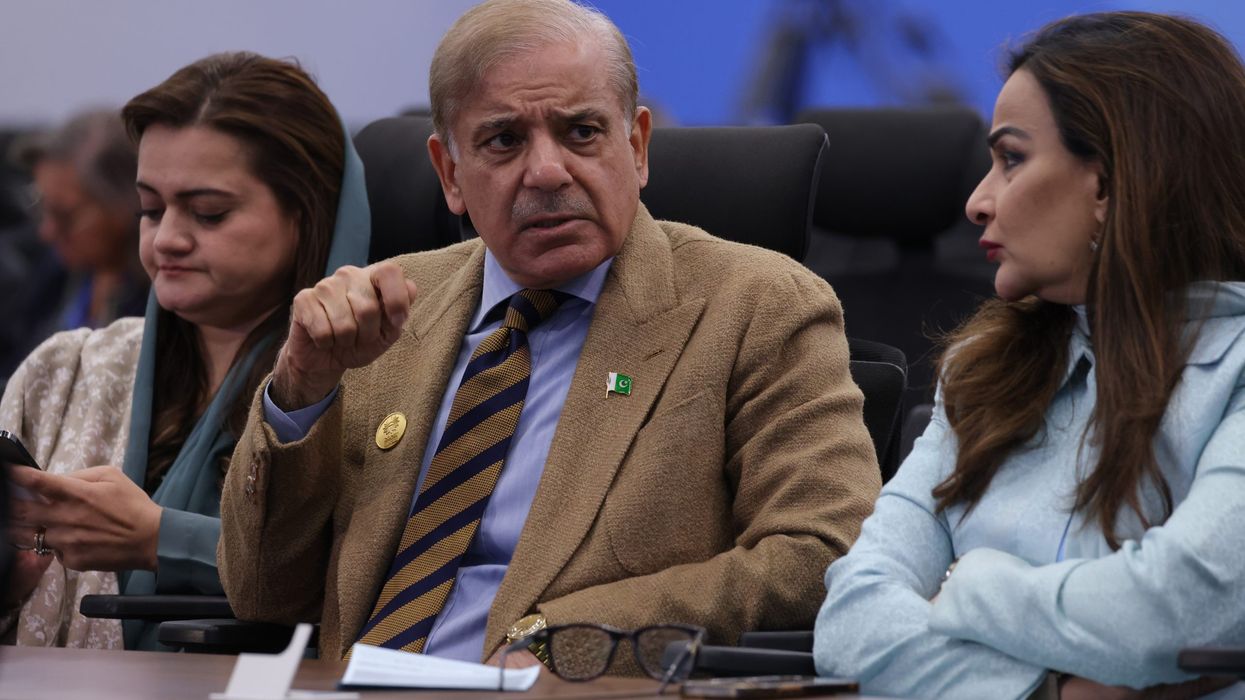

Terrorism continues to be one of Pakistan's foremost problems, said Prime Minister Shehbaz Sharif on Wednesday, as he condemned the attack on a police van in northwestern region of the country.
"Let us make no mistake. Terrorism continues to be one of Pakistan's foremost problems.
Our armed forces & police have valiantly fought the scourge. No words are enough to condemn terrorists' attack on a police van in Lakki Marwat. My thoughts and prayers are with bereaved families," Sharif tweeted.
Six policemen were killed in Wednesday's attack in Khyber Pakhtunkhwa's Lakki Marwat, Pakistan's Daily Times reported. The newspaper said that two terrorists on a motorcycle opened fire on the van. According to police, the assailants attacked the police van on Abbasa Road, Wanda Shahab Khel.
Pakistan Interior Minister Rana Sanaullah also condemned the attack on the police personnel in Lakki Marwat. The federal minister said he sought a report from the Chief Secretary and IG Khyber Pakhtunkhwa of the incident.
"Federal Interior Minister Rana Sanaullah strongly condemned the terrorist attack on the police van in Lakki Marwat and expressed concern over the incident. A report of the incident was sought from the Chief Secretary and IG Khyber Pakhtunkhwa. Expressing deep sorrow and regret over the martyrdom of police personnel," his office tweeted.
Khyber Pakhtunkhwa Chief Minister Mahmood Khan said he has taken notice of the attack on the police van. He directed the police to present a report to him as soon as possible.
The recent surge in attacks in northwest part of the country has given rise to the fear that militancy and violence are making a comeback after more than a decade.
The resurgence of Tehrik-i-Taliban Pakistan (TTP) in Khyber Pakhtunkhwa's Swat has brought back memories of the bloody period of the early 2000s, Global Strat View reported.
"What is more worrying is that the civilian leadership and Pakistan's powerful security establishment have so far failed to handle the emerging situation in Swat," the report added.
- ANI






 Curator Emma Slocombe with ikat robes and arabachi coats in the Peter the Great Room in Blickling Hall Amit Roy
 View of the entrance to Blickling Hall on a rainy autumn dayAmit Roy
 Kente cloth from Ghana in the Long Gallery in Blickling Hall
 Decoration in the Great Hall at Blickling Hall Amit Roy
 Palampore fragment made in coastal south-east India in the Brown Room in Blickling Hall Amit Roy
 Bed valance dating from early 1700s in the Italian Print Room at Blickling Hall Amit Roy
 Indian inspired fabric draped on sofas in the South Drawing Room in Blickling Hall Amit Roy
 Indian inspired fabric draped on sofas in the South Drawing Room with Indian carpet in Blickling Hall Amit Roy
 Karun Thakar has picked out the geometric patterns in the bookcase and the Kente cloth in the Long Gallery in Blickling Hall Amit Roy
 Large tapestry depicting Peter the Great defeating the Swedish army at the Battle of Poltava in 1709 Amit Roy
 ikat robes and arabachi coats in the Peter the Great Room in Blickling Hall Amit Roy
 Baghs and kanthas made by women provide contrast to the men only portraits in the Great Hall at Blickling Hall Amit Roy
 Baghs and kanthas in the entrance Great Hall at Blickling Hall Amit Roy
 Baghs and Kanthas in the Great Hall in harmony with stained glass window at Blickling Hall Amit Roy
 Kimonos reflect Japanese influence in Upper Ante Room in Blickling Hall Amit Roy
 Kimono in Upper Ante Room in Blickling Hall
 A view of the Palace and fort at Agra shows romantic side of India Amit Roy
 Blickling Hall Amit Roy
 Table carpet, European 1670-1680 Amit Roy
 Unfinished 17th century Italian embroidery in the Print Room at Blickling Hall Amit Roy
 Picture of Kashmir shows a romantic view of India Amit Roy
 A panel of Ashburnham bed hangings made in Gujarat for sale in Europe in the Brown Room in Blickling Hall Amit Roy
 Colcha made in the 1600s by women in Bengal for the Portuguese market in the Long Gallery at Blickling Hall Amit Roy




