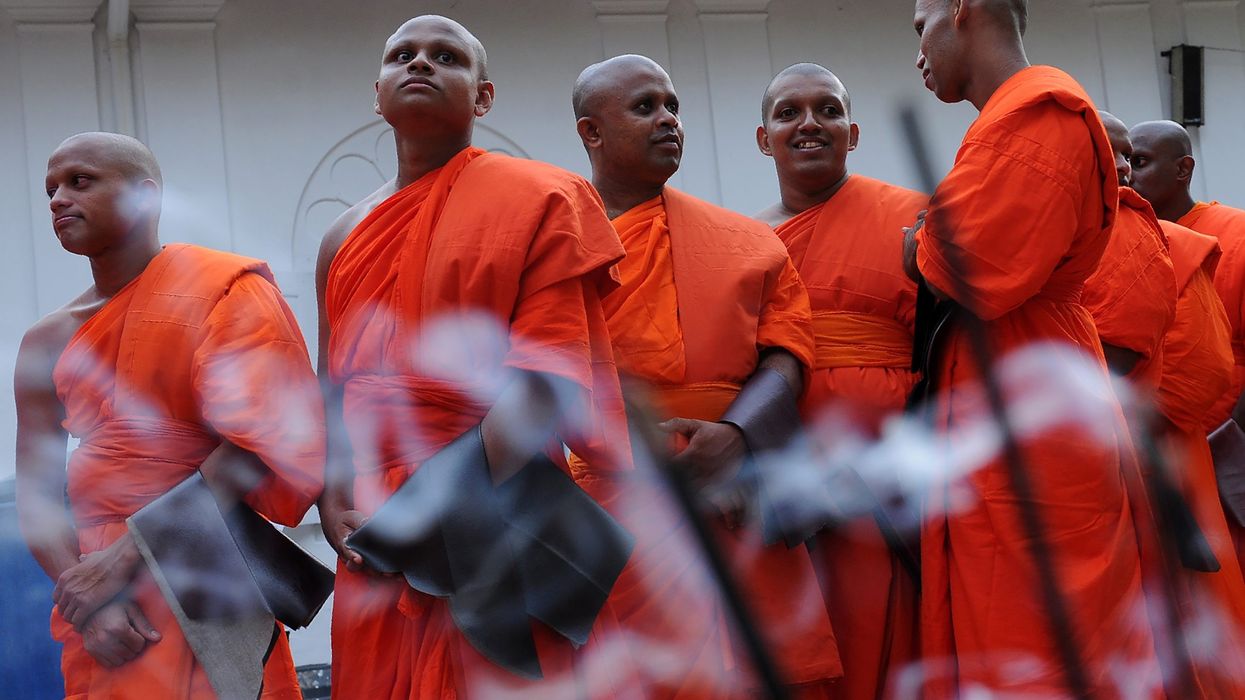

Sri Lankan President Ranil Wickremesinghe's plan to fully implement India-backed 13th Amendment to grant political autonomy to the minority Tamils received a blow on Thursday as the powerful Buddhist clergy expressed strong opposition to the move, claiming it challenges the unitary nature of the country.
The four chief prelates of the main Buddhist sects handed over a letter to Wickremesinghe in the central town of Kandy.
The letter charges that Wickremesinghe’s plan had created dissent in the country as the move challenges Sri Lanka's sovereignty.
It reminds Wickremesinghe that his predecessor presidents didn’t go ahead with the 13th Amendment's full implementation due to the danger posed to the unity of the country. He shouldn’t try it and earn public wrath, the letter warns.
"We are not in agreement with proposals that would endanger the territorial integrity and sovereignty of the country," the Buddhist clergy said in their letter.
President Wickremesinghe has underlined the need to fully implement the 13th Amendment to the Constitution to grant political autonomy to the minority Tamils in the country.
Last week, he offered the full implementation of the 13th Amendment as a solution to the long-standing demand for political autonomy by the Tamil community in Sri Lanka.
The 13A provides for the devolution of power to the Tamil community in Sri Lanka. India has been pressing Sri Lanka to implement the 13A which was brought in after the Indo-Sri Lankan agreement of 1987.
Wickremesinghe, who took over as the president last year amidst the unprecedented economic crisis and political turmoil, said that as the head of the nation, it was his duty to implement the prevailing laws.
“As the president, I am duty bound to implement the prevailing law of the country," Wickremesinghe told an all-party meeting.
He was to announce the full implementation of 13A in his address to parliament on February 8.
During his visit to Sri Lanka last month, External Affairs Minister S Jaishankar emphasised India's wish to see the full implementation of 13A.
India considers the full implementation of the 13th Amendment in Sri Lanka as "critical" for achieving reconciliation with the minority Tamil community, Jaishankar said, underlining that New Delhi always supported political and economic stability in the island nation.
India has been pressing Sri Lanka to implement the 13th Amendment.
Wickremesinghe in mid-December had initiated talks with the minority Tamil political groups in order to achieve reconciliation by February 4 - the 75th anniversary of Sri Lanka's independence from Britain.
Sinhalese, mostly Buddhist, make up nearly 75 per cent of Sri Lanka's 22 million population while Tamils are 15 per cent.
(PTI)