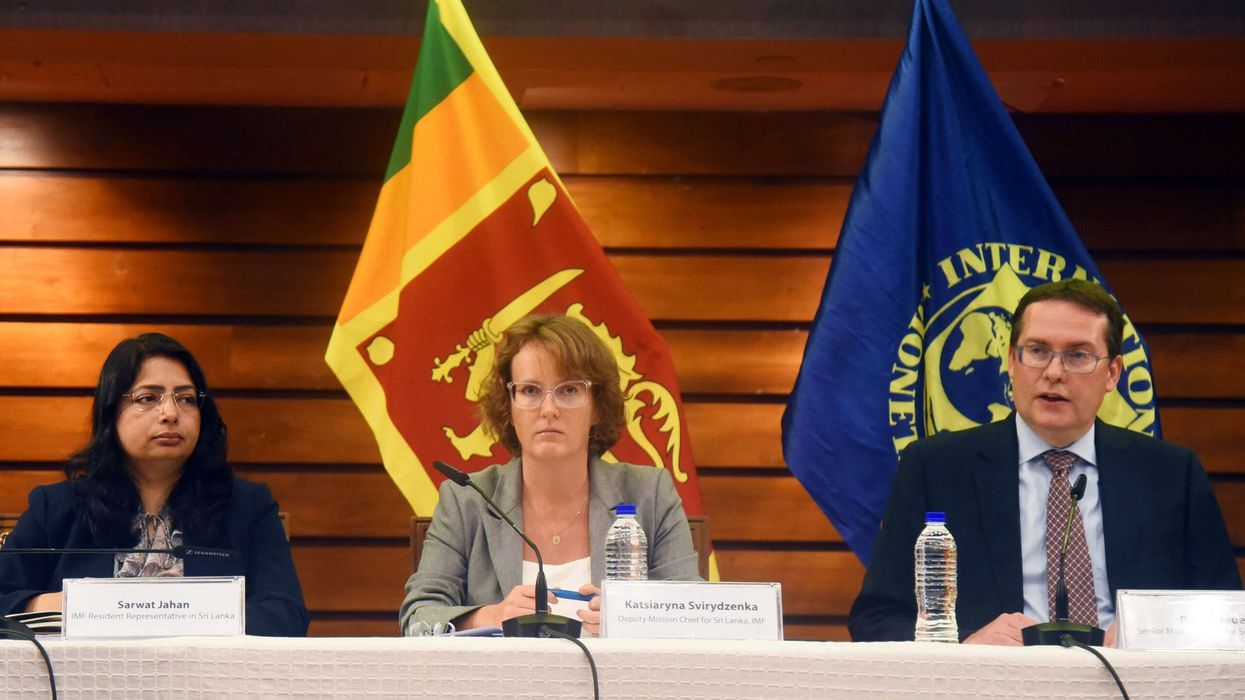

SRI LANKA’S pact with creditor nations to restructure its debt prepares the way for the International Monetary Fund (IMF) to consider clearing the first review of a bailout next month, the global lender said last Thursday (30).
Last Wednesday’s (29) in-principle deal comes about a month after Sri Lanka’s pact with the ExportImport Bank of China covering about $4.2 billion (£3.3bn) of outstanding debt, while clearing the IMF review could trigger a second tranche of about $334 million (£265m) in funds.
“This agreement serves as a key milestone in Sri Lanka’s ongoing endeavour to achieve public debt sustainability and to foster economic recovery,” said Sri Lanka’s treasury secretary Mahinda Siriwardana.
Sri Lanka and the IMF clinched the staff-level agreement on the first review of the four-year extended fund facility arrangement in October, after a month’s delay.
The second tranche will be disbursed once the IMF’s executive board clears the review.
“These understandings pave the way for the IMF executive board to consider completion of the first review,” Peter Breuer, the IMF’s mission chief for Sri Lanka, said in a statement.
“We look forward to the executive board taking up this review by mid-December and the continuation of our productive collaboration with Sri Lanka.”
Sri Lankan officials did not immediately respond to a request for comment on the IMF statement.
The finance ministry said the deal with the creditor panel covered about $5.9bn (£4.6bn) of outstanding public debt, consisting of a mix of long-term maturity extension and reduction in interest rates.
Japan, together with France and India, cochairs the committee of 15 nations. But Sri Lanka’s largest bilateral creditor, China, has not joined as a formal member.
“I expect this case will be applied as a leading case in dealing with debt problems in middle income nations,” said Japan’s top financial diplomat, Masato Kanda, describing the agreement as a “major achievement”.
Since locking down the IMF bailout of $2.9bn (£2.3bn) in March, Sri Lanka has managed to partly stabilise its economy, bring down runaway inflation and rebuild currency reserves.
Finance ministry data shows external debt of $36.6bn (£29bn) at the end of June. Once the debt restructuring is completed, Sri Lanka hopes to cut its overall debt by $16.9bn (£13.4bn).
After receiving the IMF money, Sri Lanka could get further funding from the Asian Development Bank and the World Bank, taking the total to about $900m (£714m), the central bank governor, P Nandalal Weerasinghe, said last week.
The finance ministry said it would next focus on striking similar deals with other bilateral creditors for debt amounting to $274m (£217m) and seek pacts with bondholders who have the bulk of its $12.5bn (£10bn) of international sovereign bonds.
A debt restructuring proposal by private creditors in October did not get a favourable response from the finance ministry, which said it had “serious reservations” about the proposed macro-linked bonds.
Kanda said negotiations were “on track” with bilateral creditors and they were working on details of a memorandum of understanding. He declined to comment on details such as the interest rates for the restructured debt, or the repayment period.