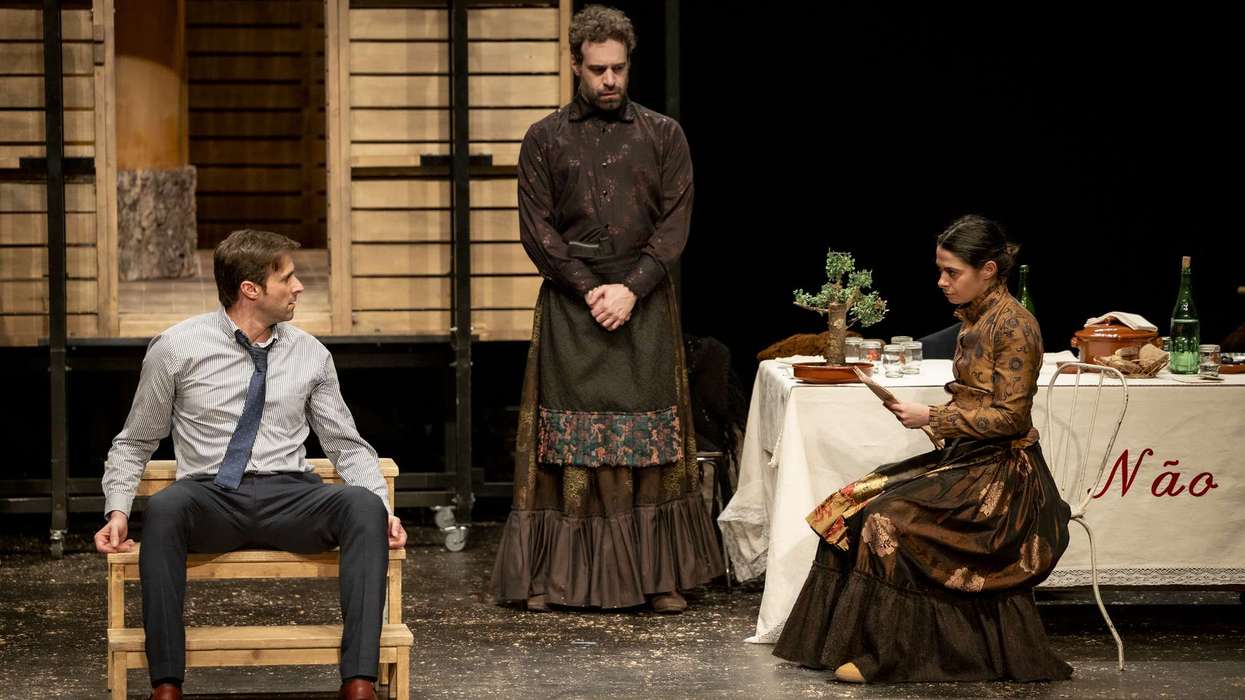

THE National Theatre has put on a Portuguese play, Catarina and the Beauty of Killing Fascists, as part of its mission not only to take the National Theatre to the world but also to bring the world to the National Theatre.
This 2020 play, written by Portuguese playwright and director Tiago Rodrigues, is performed in Portuguese, with English subtitles. It’s a bit of an endurance test as the play is 2 hours and 30 minutes long without an interval. Also, the play ends with a long speech with a defence of fascism. It seemed like half an hour long to me, but I was told it was more like 20 minutes. It became a rant which was perhaps what the playwright had in mind in order to poke fun at fascists.
The play has provoked protests and walkouts when it was staged elsewhere. At the Dorfman Theatre at the National, the audience stayed mainly silent, though I did try and steal a glance at my (digital) watch.
The thought occurred to me that maybe we were getting a little taste of what a right-wing government in Britain might look like.
The play explores the ethics of political violence and anti-fascism. Set in South Portugal in the near future of 2028, the drama follows a family that has maintained a seventy-year tradition of kidnapping and executing a fascist annually to avenge the 1954 murder of peasant activist Catarina Eufémia.
The central conflict arises when the youngest family member, also named Catarina, refuses to carry out the execution, triggering a fierce debate among relatives about whether undemocratic violence is justified to defend democracy.
Catarina is a name that echoes in Portuguese national life. Catarina Efigénia Sabino Eufémia (February 13, 1928 – May 19, 1954) was an illiterate harvester from Alentejo, Portugal, who was murdered during a worker’s strike by lieutenant Carrajola of the Guarda Nacional Republicana in Monte do Olival, Baleizão, in Beja, Alentejo. Catarina had three children, one eight months old, who was with her when she was shot.
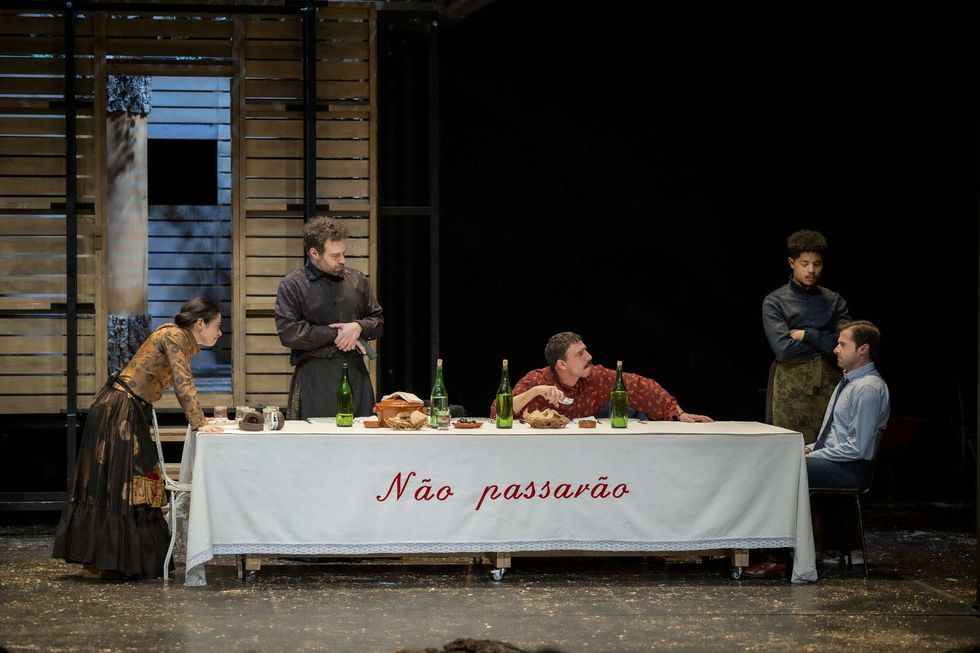 Catarina and the beauty of killing fascists Photo credit: Carlos Fernandes
Catarina came to personify the resistance movement against the regime of António de Oliveira Salazar[a] (28 April 1889 – 27 July 1970) was a Portuguese dictator, academic, and economist who served as his country’s prime minister from 1932 to 1968. Catarina was adopted as an icon by the Portuguese Communist Party in Alentejo.
On May 19, 1954, during the wheat harvest, Catarina and thirteen other harvest-women complained with the supervisor of the property where they were, trying to obtain a two escudo increase in their daily pay. The fourteen women frightened the supervisor enough for him to go to Beja to call the owner and the police.
Catarina was chosen to present the worker’s grievances to the police. In response to a question of a police lieutenant, Catarina answered that they only wanted “work and bread”. The lieutenant slapped her and she fell to the ground. When Catarina stood up, she said: “Now kill me already.”
The lieutenant shot her three times, shattering her vertebrae. The eight-month-old boy she had in her arms was injured, along with another peasant. Catarina died a few minutes later.
After the funeral, fearing the reaction of the populace, the authorities resolved to carry out Catarina’s funeral secretly. The coffin was hastily removed and taken not to the cemetery of Baleizão, but to the land of Catarina’s husband António Joaquim, Quintos, about 10 km outside of Baleizão. In 1974, her remains were transferred to Baleizão.
In the sequence of disturbances during the funeral, nine peasants were accused of disrespecting authority; the majority of them were sentenced to two years in prison. Lieutenant Carrajola was transferred to Aljustrel but he never came to be judged in court. He died in 1964.
The play, which is on at the Dorfman Theatre at the National for one week only until Saturday, 26 September, begins with a reflection on starting a fire. Putting out a fire is mundane stuff. But starting a fire is much more exciting because the consequences are unforeseen.
This is what happens when one of the younger members of a Portuguese family refuses to execute a kidnapped fascist. The action is taking place in what seems to be a remote Portuguese village. They share a meal and discuss the best way to cook pig’s trotters (I always thought this was more a Polish favourite). All the characters, including the men, wear dresses and shawls.
Later one man is shown digging a grave. The ritual is that when someone turns 26, he or she is inducted into the family tradition of shooting a fascist in the head.
Characters defend political violence as a necessary and beautiful ritual to combat totalitarianism, asserting that passive opposition is insufficient. They argue that intolerance cannot be fought with tolerance alone and frame the annual execution as a defence of democracy. Family members justify their ritual political violence using a mix of the matriarch’s historical letters, democratic aphorisms, and modified Brechtian quotes.
Key lines include the great-grandmother’s command that “no murdered woman forgotten... if you have the need, don’t hesitate to do harm in order to practice good”, along with assertions like “it is not enough to be against, you must act against” and comparisons of moderate liberals to those who “would like to eat beef without killing the cow”.
Is a particular quote from Bertolt Brecht? No, the audience is told (to laughter). It’s from “Gandhi”.
Gandhi’s core principle was using non-violent resistance (Satyagraha), to which the British ultimately had no answer as people like Winston Churchill struggled to keep India as a colony.
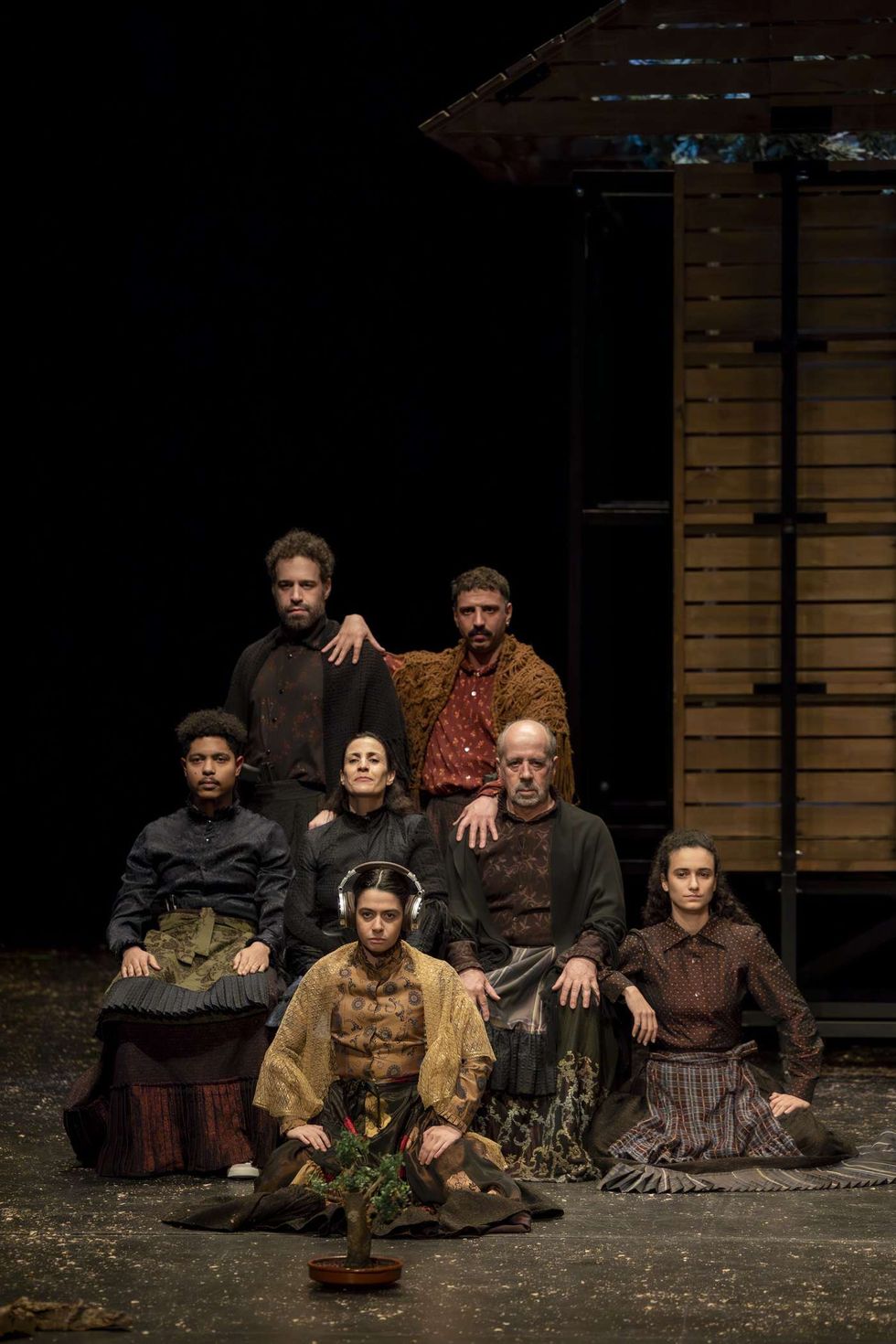 Photo credit: Carlos Fernandes
Gandhi said: “When I despair, I remember that all through history the ways of truth and love have always won. There have been tyrants and murderers, and for a time, they can seem invincible, but in the end, they always fall. Think of it—always.”
He also apparently said: “Though violence is not lawful, when it is offered in self-defence or for the defence of the defenceless, it is an act of bravery far better than cowardly submission.”
He added: “I do believe that, where there is only a choice between cowardice and violence, I would advise violence... I would rather have India resort to arms in order to defend her honour than that she should, in a cowardly manner, become or remain a helpless witness to her own dishonour.”
On the fateful day of the execution, all the characters call themselves Catarina. But the young woman in question (played by Beatriz Maia) puts down her gun. She thinks there are non-violent means to counter fascism. She is reminded that her great-grandmother had shot her soldier husband because he had been a fascist.
Suddenly, the young Catarina is shot. Then, in a massacre, all the other characters, save one, are also mown down.
On stage, tied to a chair, is the kidnapped fascist, who, unlike the other characters, is dressed in shirt, tie and trousers. Played by Romeu Costa, he utters not a word until he realises he is free.
He calmly unties himself and then makes a speech targeting minorities, immigrants, left-wing politicians and especially left-wing journalists, the gay community, and those who make a fuss about a little bit of domestic violence. He does test the patience of the audiences by going on and on. And on. He is all for what “the Portuguese people” really want.
But his speech does reflect what is going on across Europe, with the Reform party and its fellow travellers in the UK, the AfD in Germany, and possibly President Le Pen in France, not to forget some of Trump supporters in the US.
The programme leaflet includes a message from Indhu Rubasingham, the National Theatre’s artistic director: “I am delighted that we are presenting the UK premiere of Tiago Rodrigues’ internationally acclaimed production Catarina and the Beauty of Killing Fascists at the National Theatre.
“I am excited for UK audiences to have the opportunity to see this bold, compelling and provocative piece of contemporary theatre which speaks so strongly to the world around us, perhaps even more so today than when it first premiered in Portugal in 2020. At the heart of my artistic vision is an ambition to bring the world to the National Theatre and the National Theatre to the world, Tiago’s production exemplifies this.”
Catarina and the Beauty of Killing Fascists is at the Dorfman Theatre at the National until Saturday 26 September.





 Kate Varah Adama Jalloh
 Hiran Abeysekera (Hamlet) in Hamlet at the National Theatre. Sam Taylor
  Ncuti Gatwa as Algernon in The Importance of Being Earnest at the National Theatre Marc Brenner
 Sharon D Clarke as Lady Bracknell in The Importance of Being Earnest at the National Theatre Marc Brenner
  Indhu Rubasingham left and Kate Varah Amit Roy
 The company of Bacchae at the National Theatre Marc Brenner
  Ballet Shoes poster National Theatre
  Rosamund Pike (Jessica) in Inter Alia at the National Theatre resize Manuel Harlan
