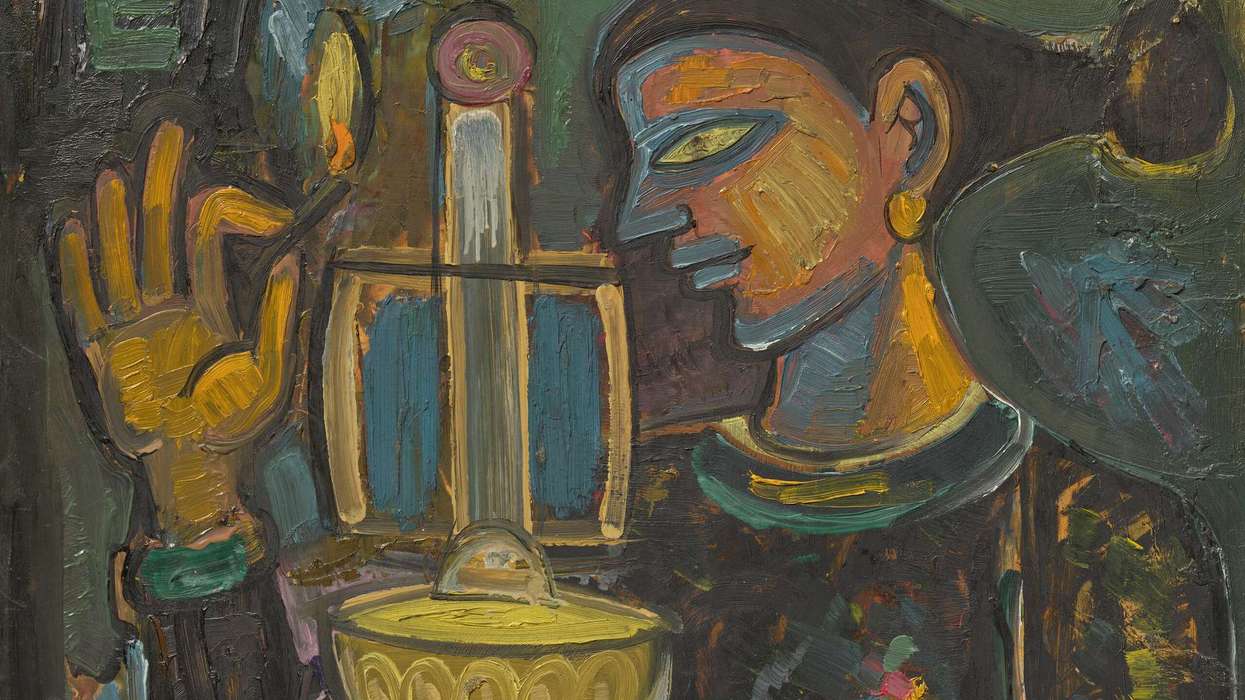

Francis Newton Souza, an early British Indian, was undoubtedly the global star of Christie’s auction of South Asian Modern & Contemporary art in New York on Wednesday, 16 September 2026.
Among the highlights of the sale were two important early pictures by Souza, Woman with Lamp (1949), which made $2,304,000, almost six times its low estimate, and Building in Trafalgar Square (1955), which fetched $1,120,000.
Among other of his works, Rome, Church by Tiber realised $512,000, and Untitled (Head) $972,800.
The auction prices are all in US dollars – £1 is worth about $1.34.
Ahead of the auction in New York, Eastern Eye was given a tour of about 30 of the 112 works in the New York sale at Christie’s offices in King Street in London.
The tour was conducted by Damian Vessey, director, international specialist for South Asian Modern & Contemporary Art at Christie’s, who is based in London.
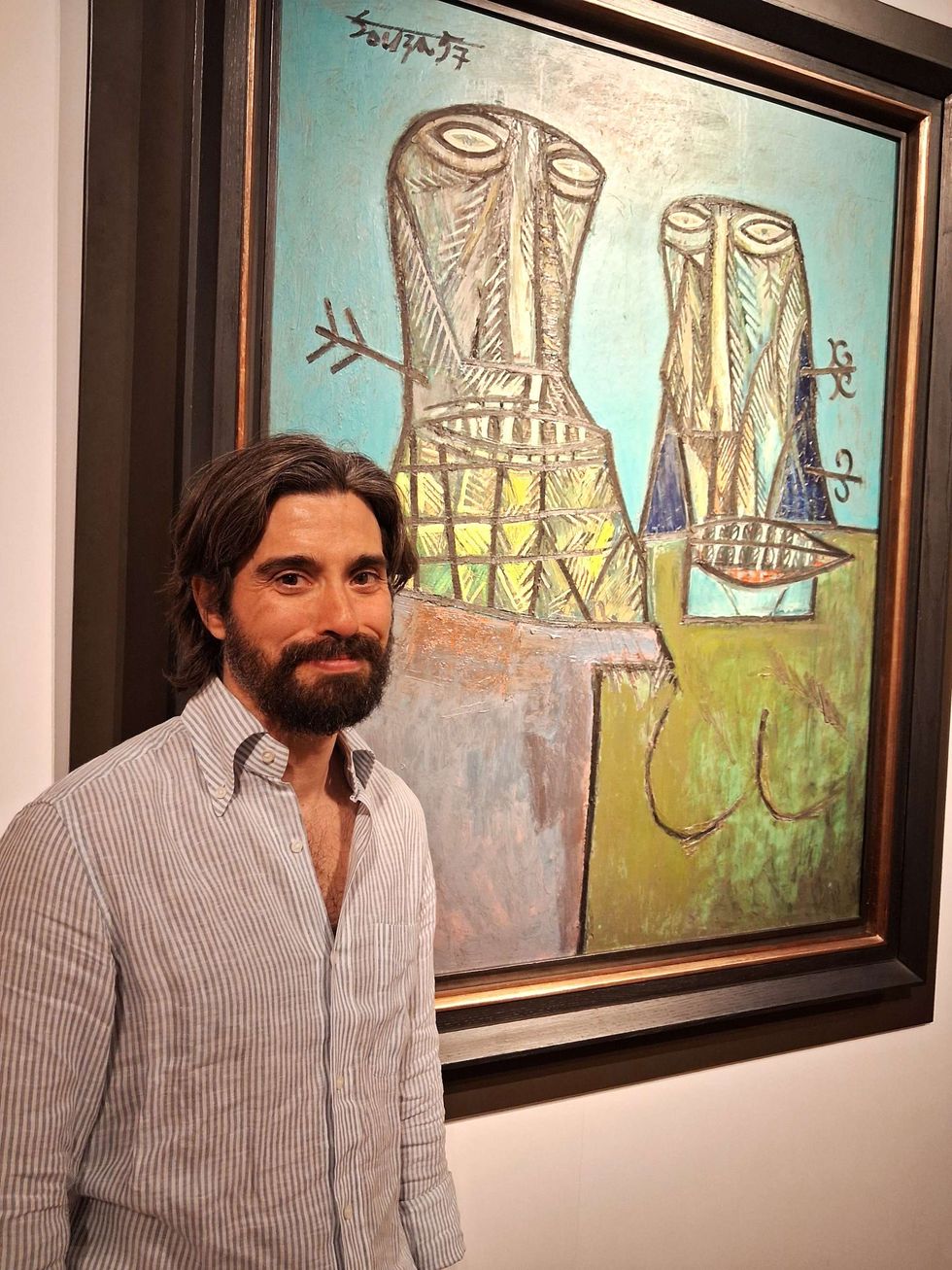 Damian VesseyAmit Roy
He also produced the catalogue for the exhibition.
He told Eastern Eye: “We are very excited about this sale. It’s got a lot of F N Souza in it, in particular. In our March sale, we maybe went heavier on Ganesh Pyne than on Souza, so we’re making up for it this time. Given he was a Londoner, I always feel Souza needs to be well represented.”
He went on: “We have Souza from 1949 with this Woman with Lamp, estimated at $400,000 to $600,000, and it’s a particularly significant year because it is the year that Souza comes to London from Bombay (now Mumbai). It’s interesting that he actually kept this work in his collection for most of his life. It actually stayed with him until the late ‘90s. You’ll see many women that Souza paints are a little bit more salacious and wilder than this.”
Vessey said: “Souza wrote rather wonderfully in the first year of his arrival in London about the sort of nostalgia he was feeling towards not even just India, but specifically Goa, where he was from. He talked rather amusingly about
getting lost on the London Underground and trying to navigate his way around London.
“And in this painting, you see that kind of warmth and nostalgia. The rendering of the woman is distinctly influenced by the sort of Indian temple sculpture and miniature painting, the kind of almond eyes, the hair raised up high. Even the skin tone and colours are just so much more vibrant than you’ll see even a couple of years later. He was brought up Catholic, and very influenced by the imagery of the Catholic Church.
“He would reference various different Old and New Testament stories, and that’s sort of visually there. And then the holding of the lamp, which, of course, is common in both Catholic and Jewish ceremonial liturgies, and then lighting the matches.”
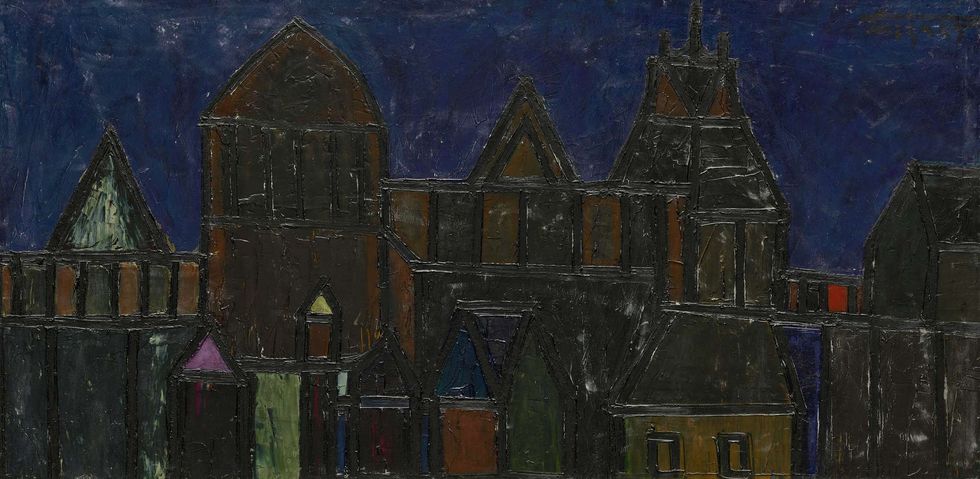 Building in Trafalgar Square by Francis Newton SouzaChristie’s
Souza found London was not what he had expected, said Vessey. “He was a little bit taken aback by what post-war London was like. It was not the seat of empire that he was expecting. London was very much rebuilding itself at that point, and the competitive scene for artists was also tough. You have rationing and so forth. His initial expectations of being immediately greeted as an artistic genius and being propelled to success took a bit more time.”
By and by, “he starts to get gallery representation. And this is a wonderful image of Trafalgar Square is called Building in Trafalgar Square. I haven’t worked out whether that means building the noun or building the verb. You’ve got this stained-glass window look, which is very signature Souza, and again influenced by his Catholic upbringing.”
Vessey commented on Rome, Church by Tiber, “which is probably my personal favourite in the whole auction because it’s part of a brief series that he did over a six-month stint in Rome on a scholarship from the Italian government. If you imagine how influenced he was by the kind of imagery and pageantry of the Catholic Church, there’s nothing like six months in Rome to really reinvigorate that. It’s the only period really where you have this really joyous, bright palette. He returns to his more morose palettes afterwards. We know for sure he did 27 paintings in Rome because he came back and had a show at (Victor Musgrave’s) Gallery One called ‘27 Paintings of Rome’.
“This is a view across the Tiber and to the back of the Vatican. With a bit of creative licence, this tower has morphed from somewhere else. To someone who has a mother who lives in Rome but spends a lot of her year in Goa, this for me is a personal favourite for that reason.”
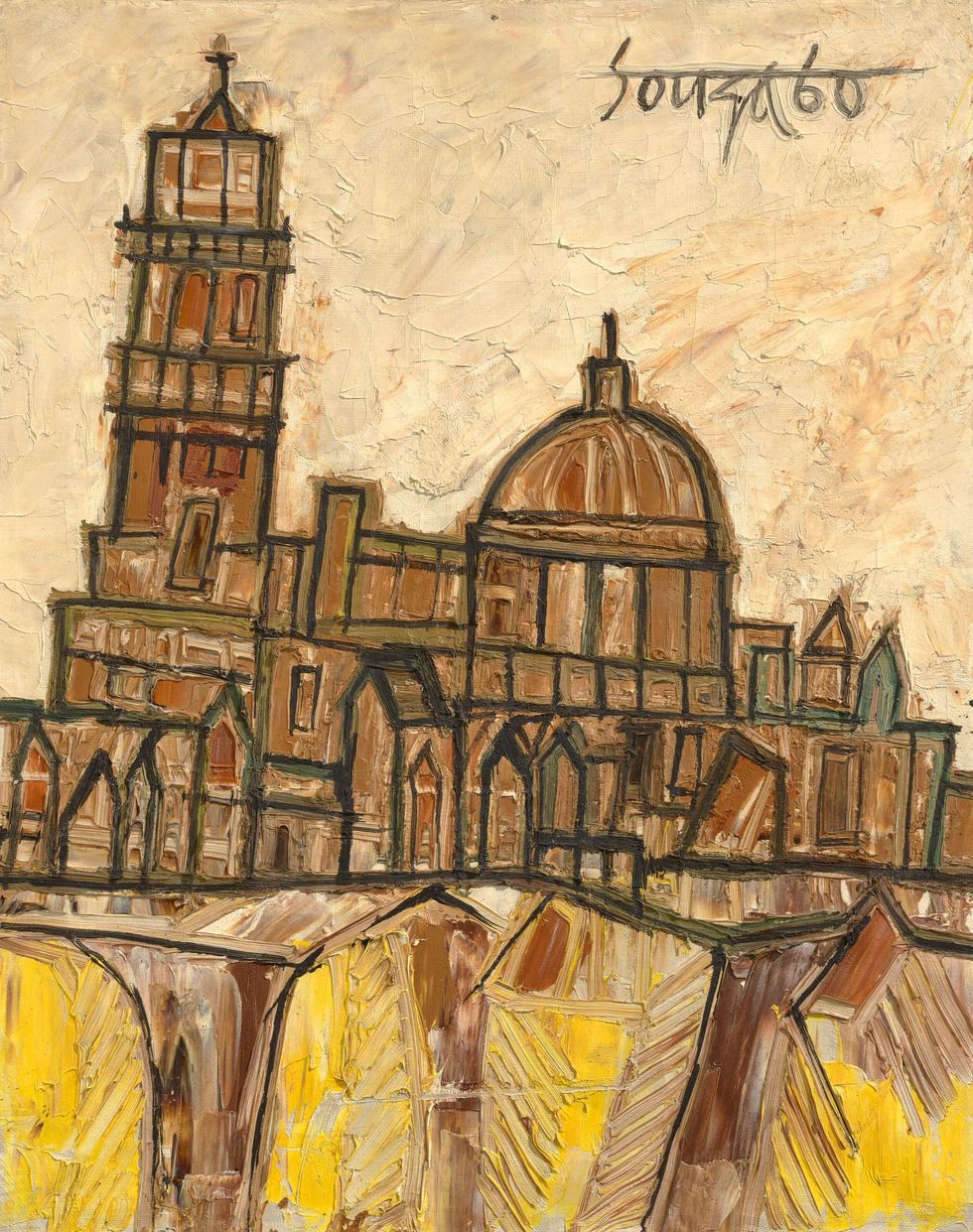 Rome, Church by Tiber by Francis Newton SouzaChristie’s
Christie’s have also published a long account setting out Souza’s increasing global significance.
Francis Newton Souza was born in Goa, then a Portuguese colony in India, in 1924, and would go on to become one of India’s most influential modern painters, the auction house said. After his death in 2002, Indian modernist M F Husain paid a moving tribute to the artist.
“Souza was my mentor,” he said. “He is the most significant painter, almost a genius.”
As a small child, Souza moved with his mother from Goa, which was a Portuguese Catholic colony at the time, to Bombay, and went on to attend St Xavier’s High School, then run by Jesuit priests. It was there that he developed an interest in drawing, studying oleographs, prints and pictures imported from Europe. He was a precocious, rebellious child, however, and was expelled at 15 for, among other antics, drawing pornographic images in the school lavatories.
He later enrolled at the Sir J J School of Art in Bombay, from which he and 21 other students were suspended for joining Gandhi’s Quit India movement. On the day of his suspension, Souza produced The Blue Lady (1945), a landmark work painted with pigment squeezed straight out of the tube and spread over the canvas with a palette knife.
It was, according to Edwin Mullins in his monograph of the artist, utterly different from anything he had done before: “It was an angry impulsive picture, and in painting it he discovered the way he wanted to paint.”
Souza elected not to return to the art school to complete his studies.
Over the course of his six-decade career, Souza experimented with a number of genres and styles, but it’s probably his strong figurative practice, his line drawings and series of “black paintings” produced in London during the 1950s and ’60s for which he is most famous.
His well-known themes and motifs include Catholicism, the female nude, and the dichotomy between good and evil. What unites his work, though, is a visceral, evocative sensuality that’s sometimes violent, sometimes sexual.
Souza co-founded the Progressive Artists’ Group (PAG) in Bombay in 1947, the same year that India gained independence and he joined India’s Communist Party.
Although the founding members of the PAG, which included S H Raza, K H Ara, M F Husain, S K Bakre and H A Gade, had wildly different styles, they unanimously agreed to define the meaning of modern art in India.
Nishad Avari, the head of Christie’s South Asian Modern & Contemporary Department, explains: “They saw the importance of looking back to India’s classical, artistic past and to the West for innovations in technique and style.”
Avari adds: “In doing so, they created a new language for modern art in India.”
The Progressive Artists’ Group largely disbanded after Souza moved to London in 1949 and Raza went to Paris to study the following year.
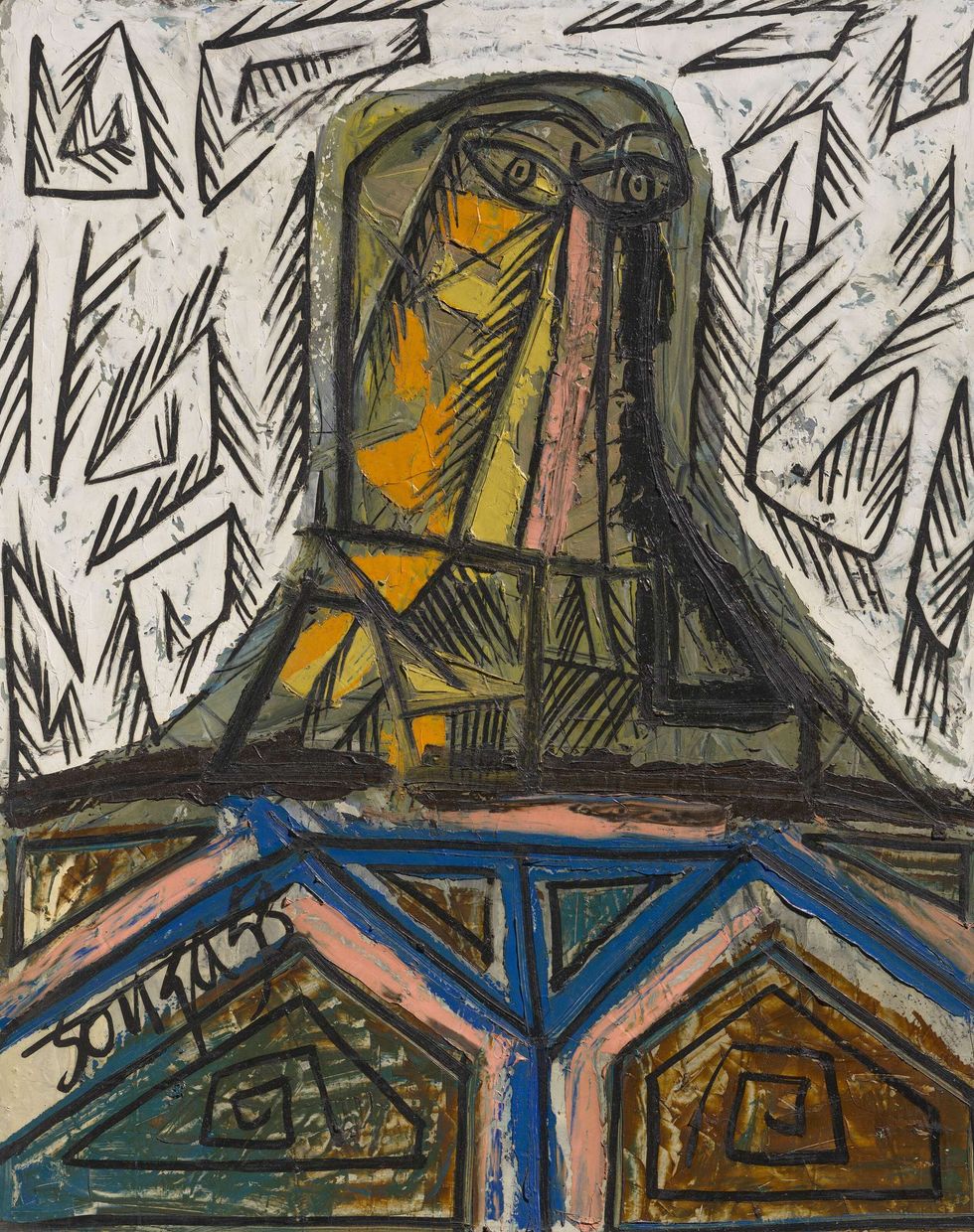 Untitled (Head) by Francis Newton SouzaChristie’s
In the late 1940s, Souza was primarily painting small-format watercolours of Goan landscapes and illustrating the plight of the Indian poor, though he did experiment with oil on board and canvas, too.
Among his most compelling paintings from this early period are Indian Family (1947), an oil on board depicting a family of four outside a house with empty bowls at their feet, while fish and fruit sit atop a table inside the house behind them; and Pietà (1947), an oil painting featuring the Virgin Mary.
Many of his paintings from this period are deeply influenced by the Church, observes Avari. “Some even resemble stained-glass windows. In these, Souza applies daubs of brightly coloured paint to heighten religious iconography such as the pietà.”
Souza exhibited many of these provocative paintings in the working-class colonies of Bombay. He was hailed in the People’s Age, the Communist Party paper, as “a patriot and a revolutionary”. Despite this, his affiliation with the Communist Party was short-lived. He quit in 1949.
Souza left Bombay for London in 1949 in search of patronage and a more liberal audience for his work. Although he would remain in London for the better part of two decades, his early years in the capital (1949-1954) were among the most difficult of his career.
In the aftermath of the Second World War, London was not the bohemian centre it had once been, and Souza struggled to establish himself in its artistic and literary circles. His works from the early 1950s explore controversial themes, in particular religion and sex, which, according to the writer and art critic Yashodhara Dalmia, would turn into “uneasy companions”.
Souza’s early exploits failed to attract the attention of key London galleries and patrons. He travelled around Europe and to Paris, where he reunited with fellow Indian modernists Raza and Akbar Padamsee, and met Picasso for the first time.
Souza was profoundly struck by Picasso’s art and personality, later describing his encounter with the modern master as a defining moment in his career.
Young Ladies from Belsize Park (1962), sold at Christie’s in 2018 for $250,000, borrows from Picasso’s “visual world” by channelling the compositional structure of Les Demoiselles d’Avignon (1907), a masterpiece that introduced the world to the artistic idea of Cubism. The stylistic influence of traditional African art played into Picasso’s Cubist breakthrough, and similarly finds resonance in Souza’s paintings and drawings from the period.
During the early years in Europe, Souza alighted on his signature style — a synthesis of western and eastern techniques and motifs. According to Avari, Souza’s paintings from this early period are influenced by an eclectic array of sources, from South Indian bronzes and the temple sculptures of Mathura and Khajuraho, to Spanish Romanesque painting, the work of European Old Masters, tribal art from Africa, European Modernism, and Catholicism.
Raised as a Roman Catholic in Goa, Souza was initially enthralled by the various facets and traditions of the church and its representatives, from the imposing architecture to the vestments of its priests and the implements they used in worship.
Although this fascination would turn into a repudiation of the faith later in life, the visual culture of Catholicism would continue to influence his work. Many paintings depicting religious iconography have passed through Christie’s, including Untitled (The Prophet) (1955), Untitled (Still Life with Fish) (1961) Black Pope (1965) and Untitled (Flagellation of Christ) (1965).
For the first six years in Europe, his first wife Maria was the sole breadwinner for the family, while Souza struggled to support himself financially with his art through the occasional exhibition and commission, and through his journalism. As well as being a talented painter, Souza was a remarkable writer, publishing his semi-autobiographical essay in the book Words and Lines in July 1959.
The year 1954 saw Souza on the brink of defeat. By 1955, however, the tide had turned. He penned his autobiographical essay, Nirvana of a Maggot, which was published by his friend, the poet and influential editor Stephen Spender, in Encounter magazine; exhibited three paintings at the recently opened Institute of Contemporary Arts alongside works by Francis Bacon and Henry Moore, among others; and painted many of his most iconic works, such as Birth, which currently holds the world auction record for the artist at $4,085,000.
It was also the year of Souza’s first solo exhibition at Victor Musgrave’s Gallery One, which together with New Vision Centre, Signals and Indica, played an important role in defining London as a centre for radical artistic expression. Souza’s show was a triumph — he won patrons as well as acclaim from key art critics of the time, including Edwin Mullins and David Sylvester, who likened the expressionistic nature of his art to that of Graham Sutherland and Francis Bacon.
It’s not surprising that there were affinities between Souza and Bacon, particularly in their depictions of the grotesque, observes Avari: “They shared models, such as Henrietta Moraes, and would hang out together at the Colony Club in Soho.”
By the end of the year Souza was considered among the most exciting painters in the city. Almost a decade of success and patronage followed. Despite great professional success, Souza had developed a reputation as a lothario and a reprobate. It was about that time, says Mullins, that drink began to be a serious problem, too: “He took to drinking continuously almost every day, was rarely sober, and a little more drunk month by month, until his craving for alcohol became insatiable.”
Having grown bored, dissatisfied and increasingly dissolute, Souza decided to stop drinking in 1960. Although Mullins argues that sobriety did not have a “deep influence” on his work, it did gain in “strength and vitality”: his pictures “show a greater freedom from the formal techniques and repetitive themes which had tended to over-stylise his work”. While there is often passion in his earlier work, Mullins adds, “there was seldom movement as well”.
“Souza’s life was defined by rebellion from beginning to end,” states Avari.
His “black paintings”, which he began in 1955 and represent a profound but brief departure within his oeuvre, are, he maintains, “evidence of this rebellious streak”. First exhibited at Grosvenor Gallery in 1966, they depict a range of
Souza’s favoured subjects, only discernible when viewed at certain angles under light.
While Souza often used black to explore his favourite themes, including nudes, portraits, religious scenes and landscapes, his investigations into black in this monochrome series enabled him to further explore the relationship between the ominous and sublime aspects of nature, as well as the ties that he believed connected nature, man and God.
Souza may have drawn inspiration from Pinturas Negras by Francisco de Goya and the monochromatic works of conceptual artist Yves Klein, whom he most likely encountered when Klein exhibited at Galerie Iris Clert in Paris in the 1950s and ’60s.
Souza’s meteoric rise in London was followed by a sharp fall in the late 1960s. It began with the start of his affair with Barbara Zinkant, who was 17 at the time; saw him split from Liselotte de Kristian, who had modelled for him in the 1950s and with whom he had three daughters; and witnessed the finalisation of his divorce from Maria Souza. Commissions dried up, and in 1967 Souza emigrated to New York with Barbara, who had become his second wife in January 1965. In 1971, she would give birth to his son.
While travelling around America in the early and mid-1970s, Souza experimented with a more colourful, joyful palette and a more energetic, gestural style of brushstroke. The drips and splashing gave free expression to his creative vision, with Avari explaining that the artist attributed “this exuberant new palette to the joy he felt on the birth of his son”.
Souza’s years in America were arguably the most technically innovative of his career. He painted colourful cityscapes and landscapes of the places he visited, such as Oklahoma City, which realised £162,500 at Christie’s in 2018, and embarked on his series of “Chemical Paintings” and drawings. This contemporary form of expressionism involved painting over or drawing figures onto pages torn from colour magazines, catalogues, printed photographs and newspapers, using chemicals to dissolve and manipulate the printer’s ink.
The artist continued to travel extensively and paint large-scale works from his small apartment in Manhattan right up until his death in 2002. In his mature years, Souza revisited the themes and motifs that had preoccupied him in his early career. These included religious iconography, Goan vistas, sex and visceral, grotesque heads, many with fantastic tubular formations.
“Souza’s period in London is widely regarded as the apex of his career,” says Avari. “It was when he was the most driven and had the means to produce works on a larger scale.”
His works made between 1955-1963 rarely come to market, adds Avari, and “are therefore in higher demand among collectors of Indian Modernism”.
In June 2010 Christie’s held an auction of more than 140 lots from Souza’s estate, which realised over £5 million. In March 2024, the artist reached a new world record, having exceeded 698 per cent of the low estimate for his work, The Lovers (1960) which sold for $4,890,000.
Since then, many more important works by Souza have been offered and his market continues to grow.
“Nowadays, the collector base for Souza’s work extends far beyond America and Europe,” says Avari. “We’re also seeing more and more East Asian clients looking to Indian Modernists.”
Avari recommends Souza’s works on paper as a more accessible entry point for new collectors. Particularly noteworthy are his line drawings, which demonstrate the intimacy and spontaneity that Souza so valued throughout his career.
As one of the first post-Independence Indian artists to achieve recognition in the West, Souza has been the subject of numerous solo exhibitions around the world. Tate Britain paid tribute to him in 2005 with its major retrospective Religion and Erotica, and Tate Modern re-hung his landmark 1959 Crucifixion, which the museum acquired in 1993.
More recently, Tate Britain’s All Too Human exhibition in 2018 featured a dedicated room to Souza’s works; and The Asia Society in New York staged a monumental retrospective of Indian Modern Art, featuring a large grouping of Souza’s works. His work is also represented in the collection of the National Gallery of Modern Art in New Delhi, and in public institutions across the world.




 Kate Varah Adama Jalloh
 Hiran Abeysekera (Hamlet) in Hamlet at the National Theatre. Sam Taylor
  Ncuti Gatwa as Algernon in The Importance of Being Earnest at the National Theatre Marc Brenner
 Sharon D Clarke as Lady Bracknell in The Importance of Being Earnest at the National Theatre Marc Brenner
  Indhu Rubasingham left and Kate Varah Amit Roy
 The company of Bacchae at the National Theatre Marc Brenner
  Ballet Shoes poster National Theatre
  Rosamund Pike (Jessica) in Inter Alia at the National Theatre resize Manuel Harlan