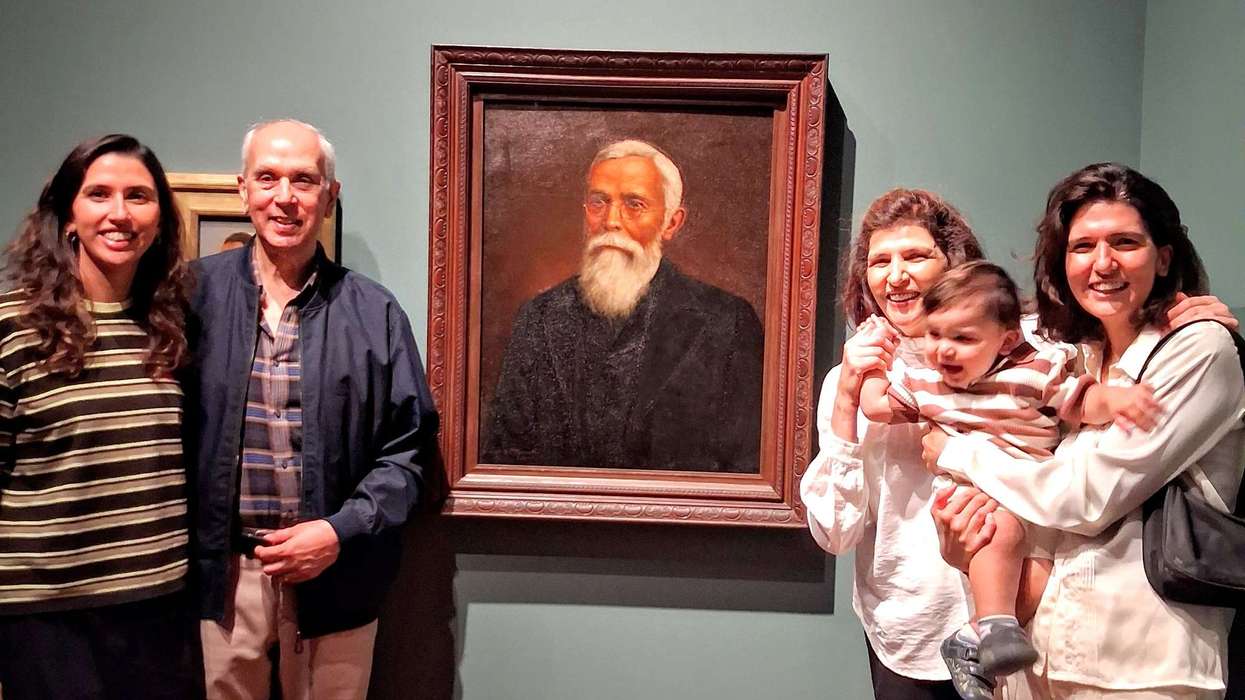

The portrait of Dadabhai Naoroji, which gathered grime and dust over many decades in the India Club restaurant in The Strand, has been restored by the Courtauld Institute of Art and gone on display at the National Portrait Gallery in London.
It is causing quite a bit of excitement in the British Asian community at large and among Parsis in particular. The latter are small in number but, like the late Ratan Tata and Adar Poonawalla of the Serum Institute of India, hugely influential.
Those who admired the restored Naoroji portrait in its new home included Malcolm Deboo, president of the Zoroastrian Trust Funds of Europe, and Lord Karan Bilimoria, the first Parsi to enter the House of Lords, who said: “I was very happy to see the portrait and it made me feel very proud.”
Naoroji’s significance as Britain’s first Asian MP has been recognised by putting up his portrait in the gallery’s second floor in room 23 which is labelled, “Empire and Resistance, 1850–1914”.
Naoroji, who belonged to the Parsi community, was born in India in 1825. After his period in Britain, he returned to India to continue the struggle for Indian independence, served as president of the Indian National Congress on three separate occasions, and came to be revered as the “grand old man of India”. He died in India in 1917.
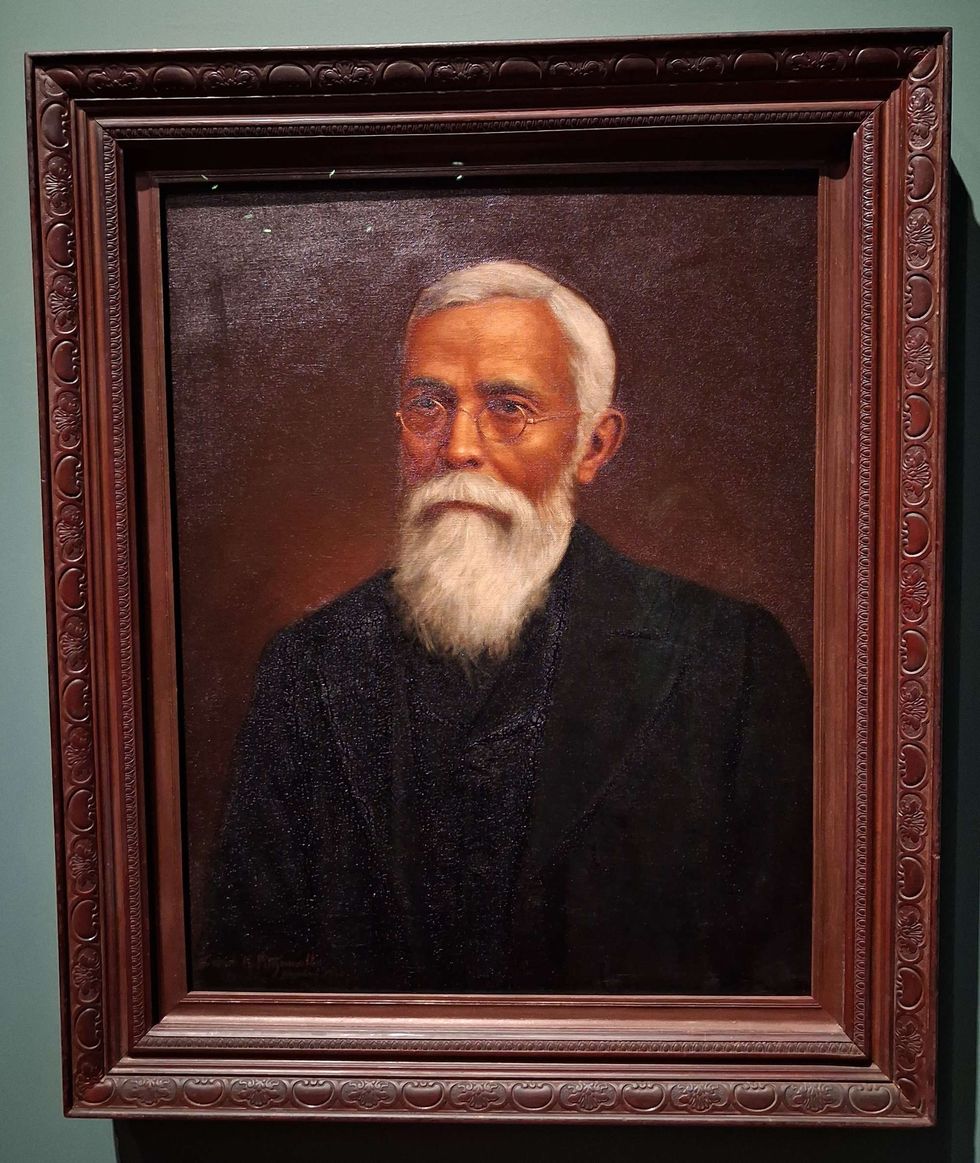 Restored portrait of Dadabhai Naoroji Amit Roy
The 756 x 615 x 24 mm painting is on a three-year loan from Yadgar Marker, who ran the India Club for 26 years on a long lease, together with his daughter, Phiroza. The India Club was forced to close in 2023 after the freeholders, Marston Properties, said they wanted to turn the building into a luxury hotel, though the place still remains boarded up.
Next to the portrait, which went up on display on Wednesday, 2 September, is a caption with details of the oil on canvas painting, Dadabhai Naoroji, 1825-1917, By Sorab M. Pithawalla, done in 1946.
It said: “Dadabhai Naoroji was one of the first Asian people to become a British MP [he was, in fact, the first], representing London’s Finsbury Central between 1892 and 1895. Having moved from India to Britain in 1855, he became one of the leading critics of British colonial rule. His influential ‘drain theory’ argued that Britain’s extraction of wealth from India was driving the country’s poverty. It helped to lay the intellectual foundations for the movement towards self-government.
“Painted in 1946, a year before Indian Independence, this posthumous portrait by the Bombay (now Mumbai) artist Sorab M. Pithawalla was probably based on a photograph. The son of a portrait artist, Pithawalla belonged to the Western academic tradition that developed in colonial India through British art schools.
“The framed portrait was sent to London to hang in the India Club, first in Charing Cross and later on the Strand, just a short walk from the National Portrait Gallery. The Club was a renowned meeting place and restaurant for the Indian diaspora and anti-colonial campaigners. Displayed on its walls, Naoroji’s portrait became a symbol of the pioneering political ideas that continued to inspire the struggle for justice and independence.”
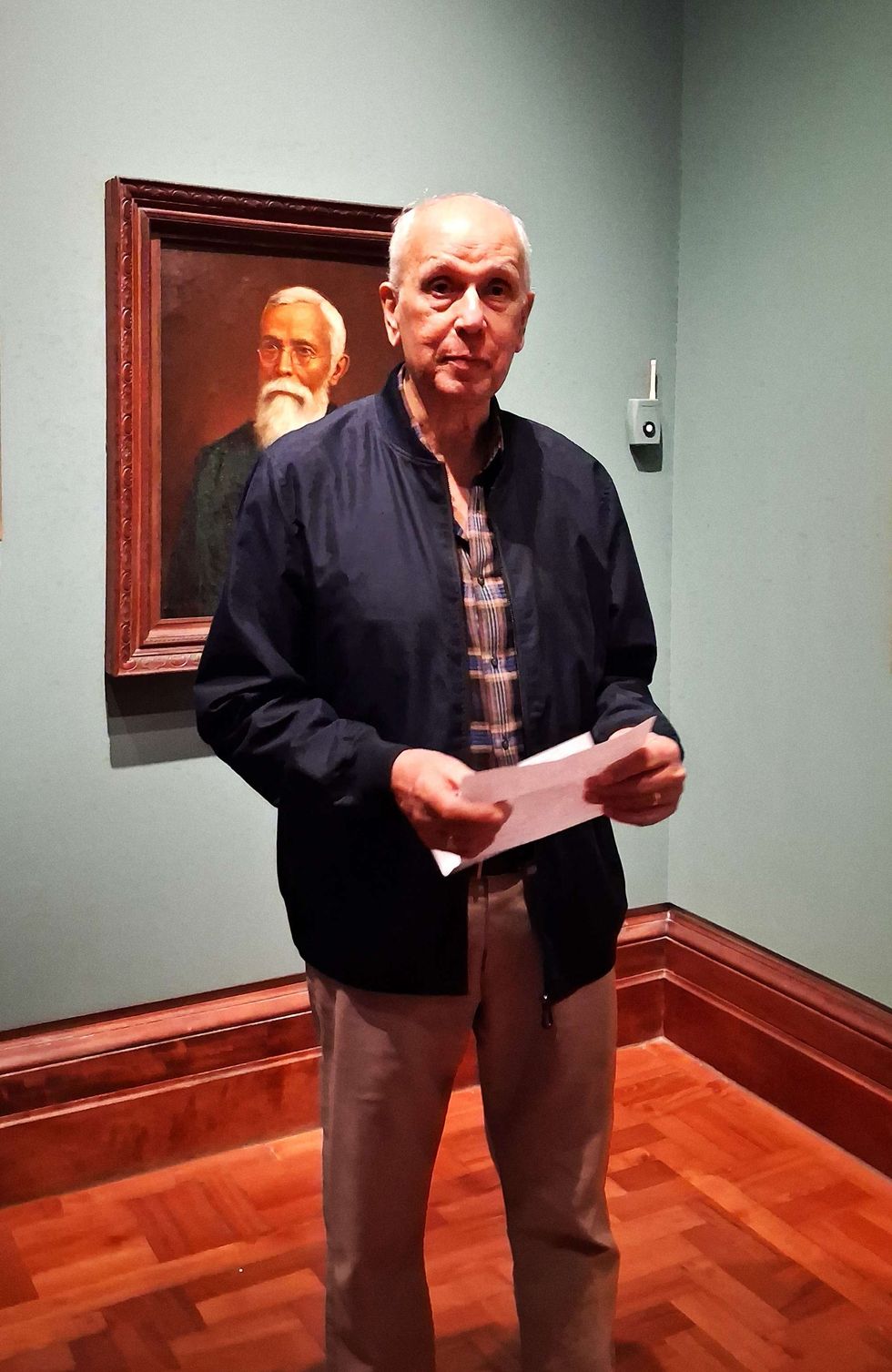 Yadgar Marker Amit Roy
The lender’s name is given as Yadgar Marker’s son, Rustom Marker.
Rustom was not present last week but Yadgar Marker’s wife, Freny, attended, along with his daughters, Arnaz and Phiroza, and grandson, Jai.
To the right of Naoroji’s portrait is large painting of Queen Victoria handing over a Bible to an African. It has been described as a “troubling painting”. Victoria was in many ways a kindly and radical woman who resisted racism and cared for her overseas subjects but the painting does sum up the underlying philosophy that freedom fighters like Naoroji were up against.
The oil on canvas, done in 1862-3 by Thomas Jones Barker, is called The Secret of England’s Greatness (Queen Victoria Presenting a Bible in the Audience Chamber at Windsor.
A caption says: “A Bible is suspended in motion between the hand of Queen Victoria (1819-1901) and that of an exoticized African man. He may be based on Ali bin Nasr, governor of Mombasa who attended Victoria’s coronation in 1838
and visited again in 1842. They almost (but will never) touch as he reaches up to receive the gift of Christianity, the ‘secret’ of England’s ‘greatness’.
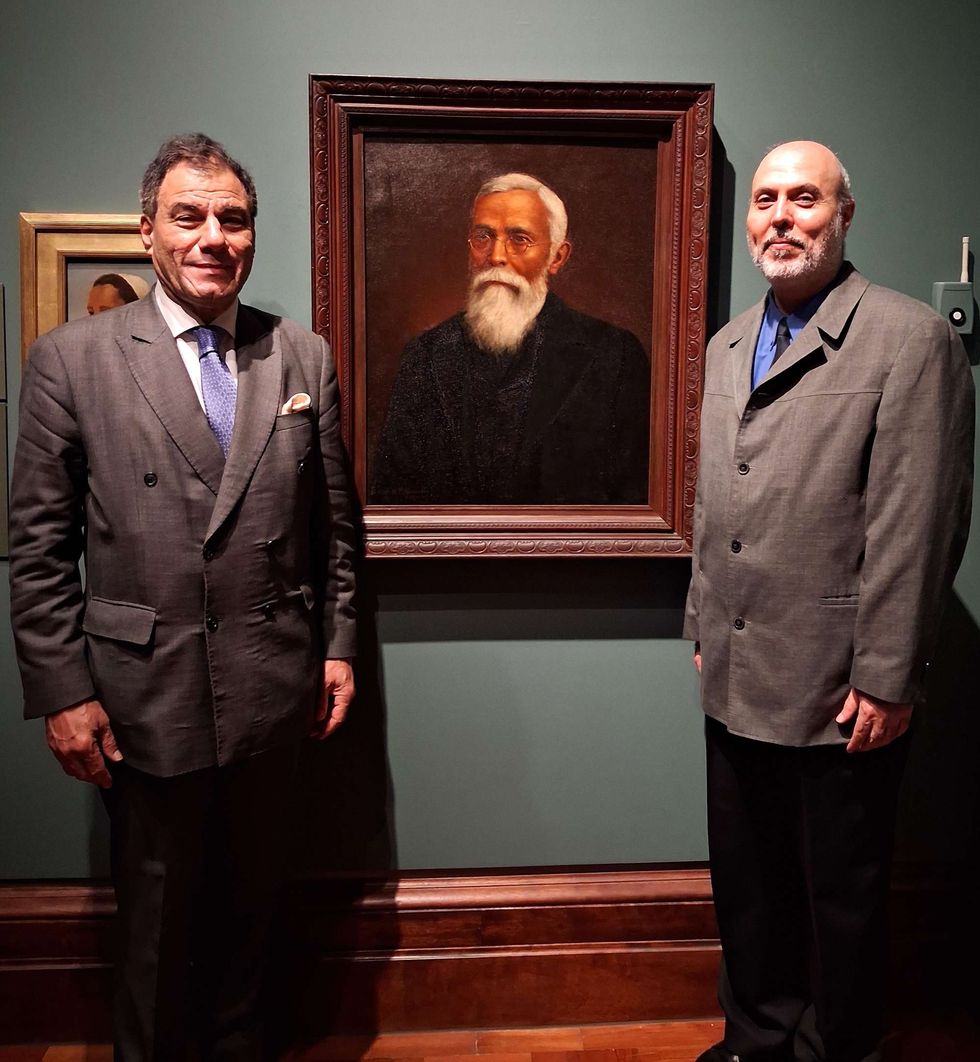 Lord Karan Bilimoria (left) and Malcolm Deboo Amit Roy
“This is the title of Thomas Jones Barker’s painting. It shows an imagined scene based on an 1850s anecdote about Queen Victoria receiving an unnamed African ambassador. When he asked how Britain had become so powerful, she responded, handing him a Bible: ‘this is the Secret of England’s Greatness.’
“In Victorian times, ‘greatness’ was linked to a sense of Christian duty. This helped justify British colonialism as a civilising mission, supporting the belief that religious conversion brought about global improvement.
“Here, the black man likely represents ‘Africa’ in the most general sense, a continent over which Britain was exercising huge imperial influence. His pose also recalls earlier Abolitionist depictions of enslaved Africans begging for freedom, positioning him at the bottom of a hierarchy that favoured white Christian power.”
The “Empire and Resistance, 1850–1914” display “explores how Victorian portraiture promoted the British Empire as global power and civilisation, while also highlighting the challenges, colonial realities, and resistance to that rule.”
Key personalities on display include “military leaders and colonial administrators alongside people living under imperial rule, critics of colonialism, and figures of resistance”.
Examples include the cricketer Prince Ranji; Lord Kitchener; Lord Curzon; the Prince of Wales in India (the future King Edward VII); Sir Richard Francis Burton; and Lord Palmerston.
Naoroji’s portrait, which has almost a luminescent quality after being cleaned up, is the latest addition to the room.
Many conservators and academics were involved in the restoration of the portrait, it was made clear by Dr Sarah Moulden, senior curator, 19th-century collections, at the NPG.
She said: “There’s such an amazing community here. There are colleagues from the Courtauld and also City & Guilds, colleagues from the National Portrait Gallery’s conservation department here. It’s been such a group effort; of course, from Yadgar and his family as well to get this amazing painting on the wall.”
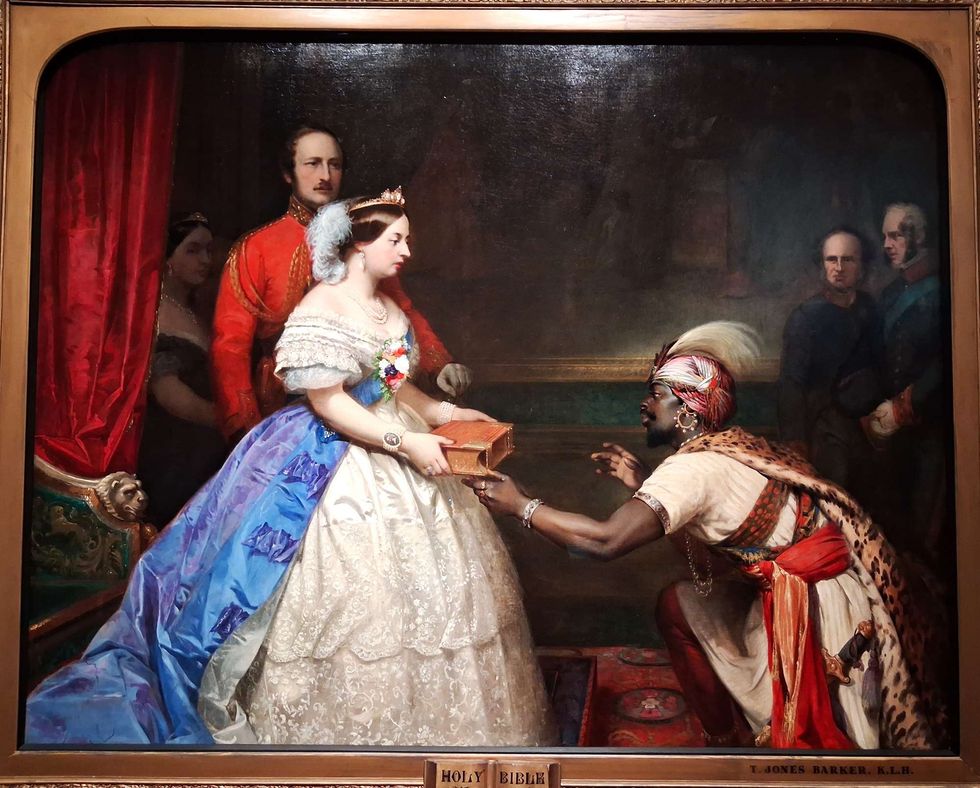 The Secret of England's Greatness. Queen Victoria presenting a Bible in the Audience Chamber at Windsor. By Thomas Jones Barker Amit Roy
Moulden, who did her BA and MA from the Courtauld, has previously explained that her interests “focus on British portraiture of the long 19th century across all media, particularly portraiture’s role in promoting imperial ideology in an age of empire. This research has underpinned the ‘Empire and Resistance’ room at the National Portrait Gallery, which reopened in 2023 after a major redevelopment project involving a comprehensive redisplay and reinterpretation of the collection.”
Last week, she said: “What we love about this painting is that it is allowing us to put Dadabhai Naoroji on the walls in a much more permanent way than we’re ever able to do (before) because the representations we have of Naoroji at the National Portrait Gallery are photographic, or they are in drawings, and those are very light-sensitive media, which means we have to swap them every few months.
“He sits in this gallery, which is known as ‘Empire and Resistance’, that thinks about how figures both within Britain and beyond resisted the ideas of empire and resisted the idea that empire was something that happened outside of Britain.”
She expanded on the “drain theory” propounded by Naoroji, which sets out how British colonial rule systematically extracted wealth, resources and goods from India without providing adequate economic or material returns.
Naoroji, she said, was “sticking up for people who felt injustice. That wasn’t just people from the Indian subcontinent in Britain and in India, but it was women. It was people from Ireland. It was all people who were experiencing empire in quite negative ways. And so he’s a hugely important figure for us, and to be able to show him in a painting is incredible.”
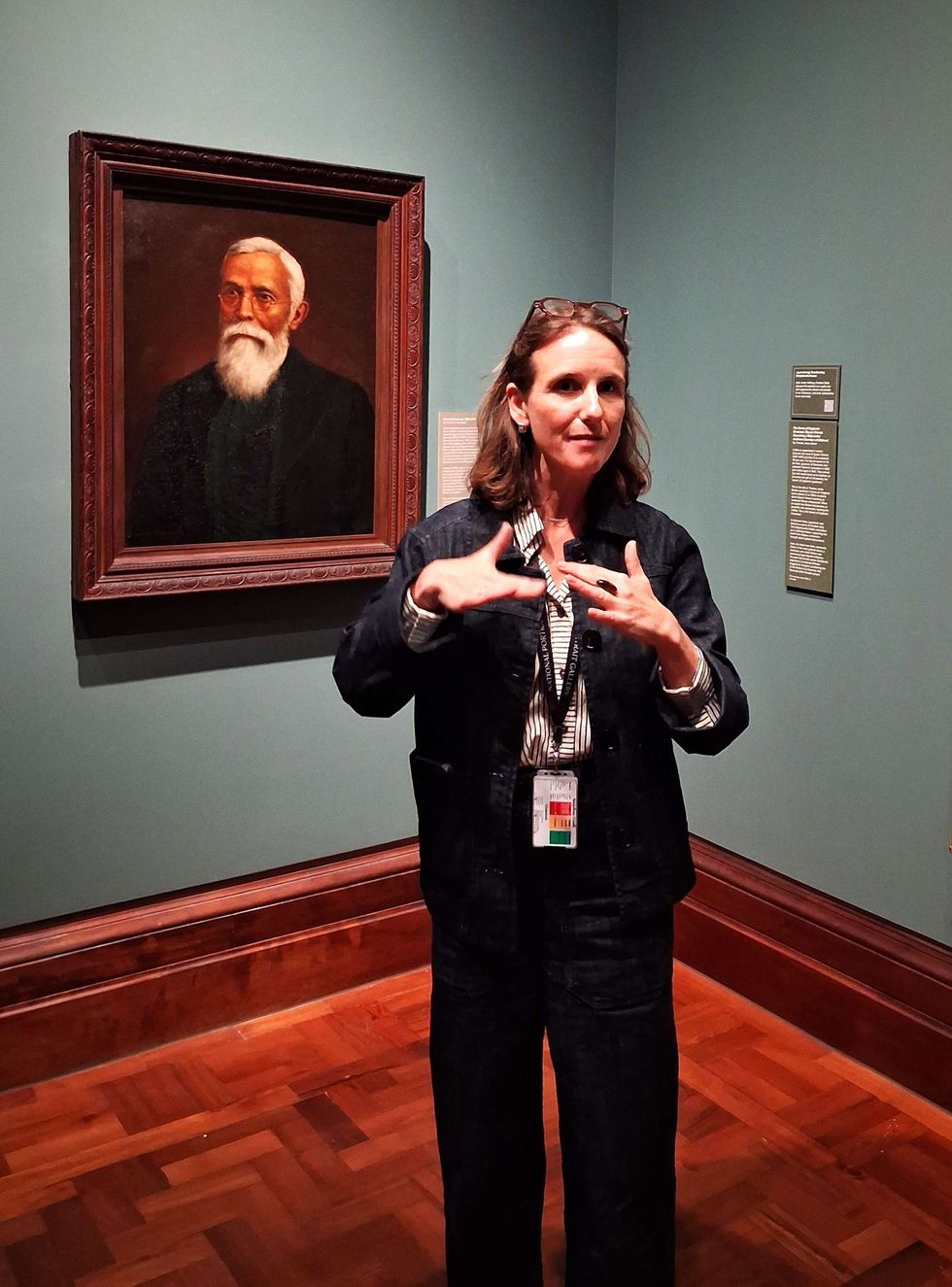 Sarah Moulden Amit Roy
Moulden went on: “What I think our visitors will be so excited about is the incredible story of this painting, and that it was made in what was then Bombay
in 1946, a year before independence, a year before partition. Then it comes to the India Club in (41 Craven Street near) Charing Cross, just a spitting distance from the National Portrait Gallery. And then it then stood (in 143-145 The Strand) next to the Courtauld where I trained in the early 2000s and went often. I probably saw this, but was unaware at the time, which is this amazing personal story for me.”
She added: “This is just another evidence of how important Naoroji’s image is, even though this is made after his death. Naoroji’s image is in the UK, and to have him in the National Portrait Gallery in a painted portrait – it is bigger than some of the portraits that we have on display here – is testament to the role he played in British history, but also what role he plays now. So I’m so grateful to you, Yadgar and your family, for putting this on long-term loan.
“The other amazing thing to say about this portrait is that it was a big collaboration. The Courtauld and City & Guild (which restored the original frame) have made this displayable in a national gallery. I want to thank colleagues from the Courtauld and from City & Guilds who are here today because you’ve done a really amazing job to get it back to its former glory.”
Marker read out a prepared statement: “Today is a very happy occasion for all of us to come here to this prestigious institution, the National Portrait Gallery, to honour the installation of a very fine painting of an extremely remarkable man, Dadabhai Naoroji. We are all aware of Naoroji’s achievements, probably the greatest Zoroastrian of our time – scholar, priest, professor, politician, and freedom fighter. Not only being a pioneer of the Indian freedom movement, but also an inspiration for freedom movements all over the world.”
Those he thanked included Moulden; Katherine Robson, collections registrar at NPG “whose advice I always accepted and assiduously followed”; Sally Higgs, who trained as a painting conservator at the Courtauld and works part time at the NPG; and Pippa Balch, paintings conservator and senior lecturer in the department of conservation at the Courtauld “who continually advised and updated me on the restoration’s progress”.
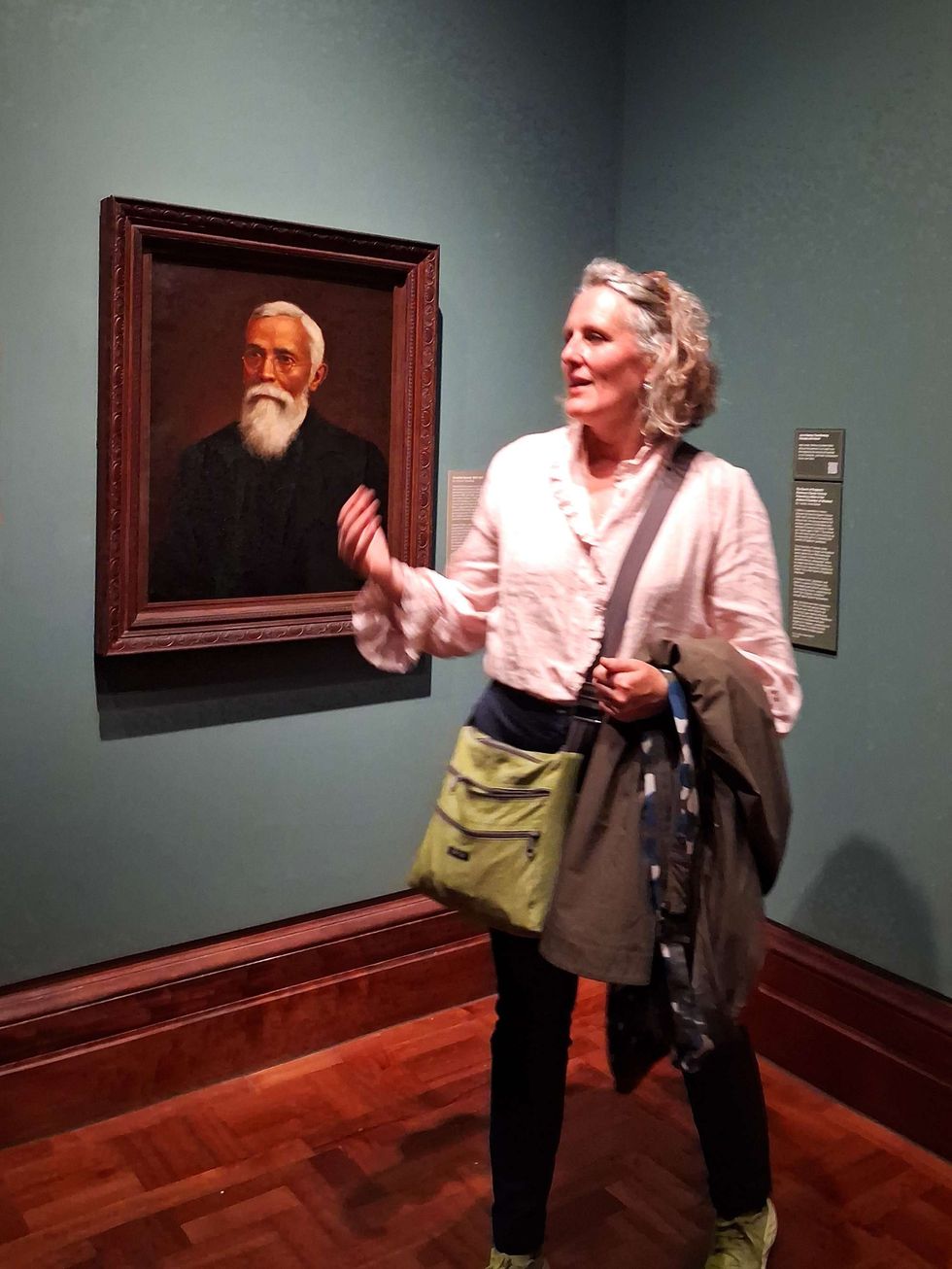 Pippa Balch Amit Roy
“Last but not least” he expressed his “most heartfelt gratitude” to the people who were most hands on in restoring the portrait under under a programme known as “Painting Pairs”. They were MA conservation of easel paintings student Ursula Griffiths and MA history of art student Benjamin Singer.
Balch said: “This has been an absolutely wonderful project, exactly the kind of project we love at Courtauld, a painting with a fantastic history. We absolutely loved the India Club. It gave us (and) Ursula a very challenging and interesting project, and we’re pleased with the results. And we were really pleased that the City & Guilds students collaborated and worked on the frame. So, lots of people were involved. It’s actually very nice that we’re here together because you really are reminded of how many people it takes to bring something together like this.”
Griffiths also told the gathering: “This has been such a fantastic collaboration opportunity. I really thank you, Yadgar, for making this happen, and everyone at the NPG. It was such a joy to be able to complete the conservation work of such an interesting painting of such an interesting figure.
“What this painting showed us through the technical analysis and through the art historical research, that was done by my colleague Ben, is the painting technique and its history, and all the interplaying parts that come together to make this painting so interesting. Working on all those aspects was just wonderful. And he looks really great here with this lovely coloured (green) wall and a lovely frame, which was very kindly taken on by City & Guilds. It looks absolutely gorgeous, and does Naoroji justice.”
Afterwards, Griffiths spoke to Eastern Eye, explaining the work she had done in restoring the portrait. She said her mother had visited the India Club when she had worked in the science section of the Courtauld. But it was about to shut by the time she herself joined the Courtauld as an MA student (she has since qualified). Given the painting had hung in the India Club for 77 years, she found it was in remarkably good condition, and there were very few areas where it needed to be touched up with new paint.
Ultra violet and X-rays were taken to assess the location and exact nature of the damage. A microscope was also used to identify some flaking of the paint.
She and Singer also did extensive research on Sorab Pithawalla (1911-1959) and his technique, and found that his father, Manchershaw Fakirjee Pithawalla
(1872–1937), was an even more eminent artist who was the first Indian to have a solo exhibition in Britain.
Griffiths, who read art history as an undergraduate at Trinity Hall, Cambridge, before coming to the Courtauld, said: “Considering everything, it was in fantastic condition and I had very few areas that I had to put new paint back on where there was paint lost.
“In terms of the cleaning, though, it was very difficult because the painting is unvarnished. There’s nothing between the sensitive paint and the dirt layer that had formed on the surface. It wasn’t protected. It makes the cleaning more difficult because you have to find something that will tackle that very thick layer of dirt. I used a combination of organic and aqueous solvents. We used very small cotton swabs to apply the cleaning mixture onto the surface and remove the dirt carefully.”
The testing phase to find the right method of cleaning took “a couple of months”, and the cleaning itself took “another few months”.
The loss of the original paint was mainly in the background, especially near the frame, which was repaired and cleaned.
In the touching up process, she used “modern synthetic resin-based paint, which allows it to be taken off in the future very easily in comparison to the original paint underneath. So, everything we do is reversible. We use dry pigments that we mix in this easily removable binder to match the surrounding paint perfectly.”
The original painting was not protected by a resin-based varnish but had an “oiling out layer”. This “essentially acts as a varnish wood, but it’s an oil that’s put across the surface. Now I’ve put on a modern varnish that will protect the surface, but is also easily removable because the paint underneath is quite sensitive.”
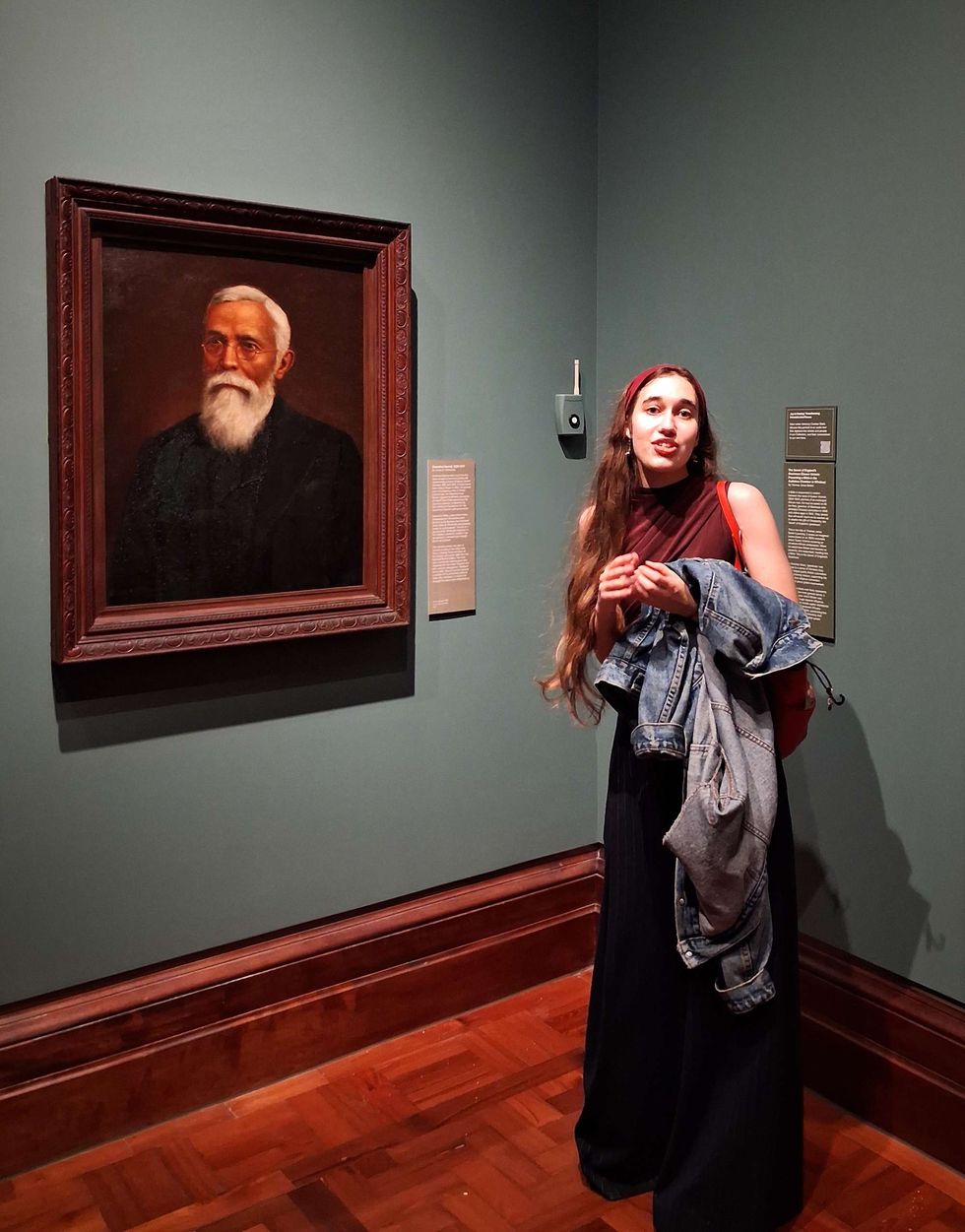 Ursula Griffths Amit Roy
Griffiths found traces of nicotine on the painting “because smoking was allowed in restaurants and public spaces [before the ban in 2007]. There was also a splash of food on the right of his jacket.”
Whether it was bhuna lamb, masala dosa or prawn curry – three of the most popular dishes at the India Club – will forever remain a mystery.