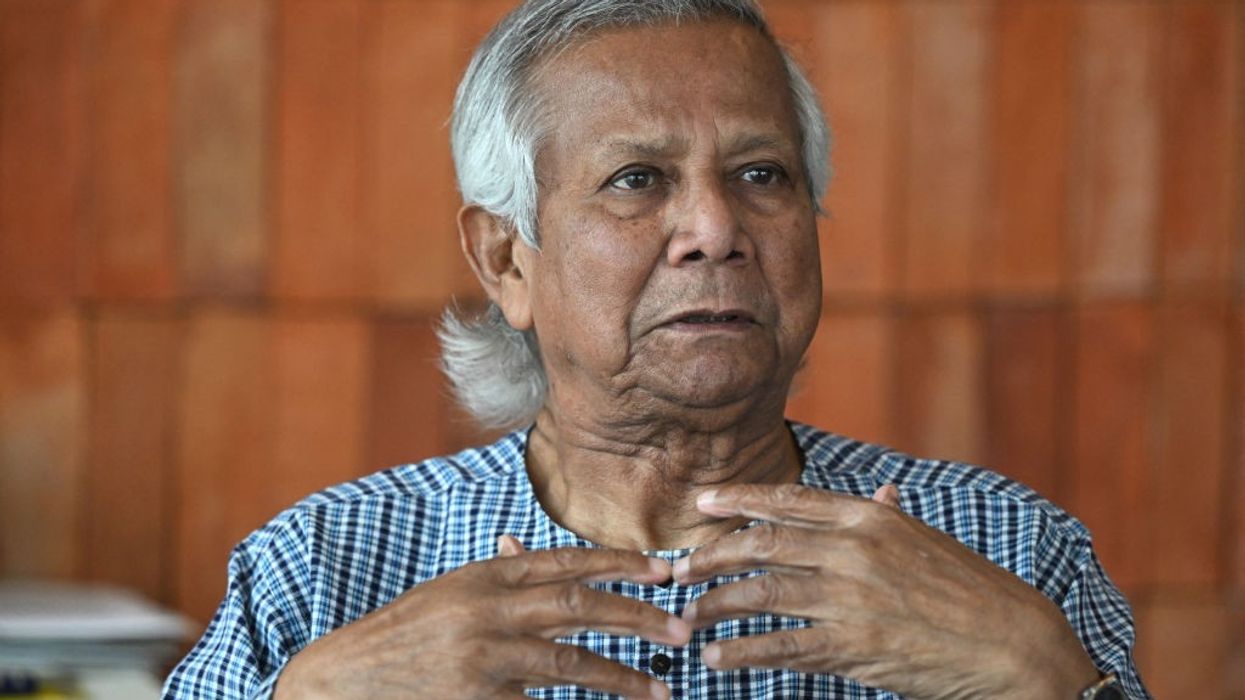

BANGLADESH has turned into a "one-party" state as the ruling party stamps out political competition, Nobel Peace laureate Muhammad Yunus, a pioneer of the global microcredit movement, said in an interview.
An election in January won prime minister Sheikh Hasina a fourth straight term, but it was boycotted by the main opposition party, whose top leaders were either jailed or in exile ahead of the poll.
Yunus, who helped to lift millions from poverty by providing tiny loans of sums less than $100 (£78.5) to the rural poor, angered Hasina with a 2007 plan to set up a political party.
The 2006 Nobel laureate accused Hasina's ruling Awami League party of being involved in rampant corruption, saying Bangladesh lacked a genuine political opposition.
"Bangladesh doesn't have any politics left," Yunus, 83, said last week in his office in Dhaka, the capital. "There's only one party which is active and occupies everything, does everything, gets to the elections in their way."
He added, "They get their people elected in many different forms - proper candidates, dummy candidates, independent candidates - but all from the same party."
Law minister Anisul Huq said he completely disagreed with Yunus' comments, however.
"It's not only I who disagree, but the people of the country will also disagree," Huq told Reuters by telephone, calling the remarks an "insult" to the people of the country.
"Democracy is fully functional in this country," he added.
Yunus, an economist who won the Nobel for his work on microcredit, was forced out of Grameen Bank in 2011 by Hasina's government, which said he had stayed on past the legal retirement age of 60.
Hasina, 76, is the daughter of Sheikh Mujibur Rahman, the founding father of the South Asian nation killed in an army coup in 1975, along with most of his family. She first became prime minister in 1996.
As Bangladesh's longest-serving prime minister, Hasina has been credited with turning around the economy, though critics have also accused her of human rights violations and suppression of dissent.
The US State Department said January's elections were not free and fair while the British government's foreign office also condemned acts of "intimidation and violence".
At the time, the main opposition Bangladesh Nationalist Party (BNP)denounced the exercise as a "sham" election, calling for its cancellation, Hasina's resignation and the formation of a non-party neutral government to hold a fresh one.
Just before the election, a court in Bangladesh had sentenced Yunus to six months in prison for violations of labour law, which he denied.
Although he is not in prison after securing bail in that case, Yunus faces more than 100 cases regarding the violations and graft accusations, which he dismissed as "very flimsy, made-up stories".
Huq denied the accusations against Yunus were false, however, adding, "He has gone to the highest court of the country, which found there was a case against him."
As an example, Huq cited taxes paid by Yunus after the Supreme Court ruled against him in a tax-evasion case, but declined comment on others as being sub-judice.
Yunus' supporters say Hasina's government has sought to discredit him because he once considered setting up the political party, called "Citizens' Power".
Hasina, who denies the contention, called Yunus a "bloodsucker" of the poor in 2011.
"Is it a crime for a citizen to try to make a political party?" Yunus asked, saying he dropped the idea of such a party after just 10 weeks, on realising that he was not suited to politics.
Reviving a competitive political landscape in Bangladesh will be difficult, however, Yunus said.
"Restarting will be very painful because we have brought it to a point where it has completely disappeared."
(Reuters)