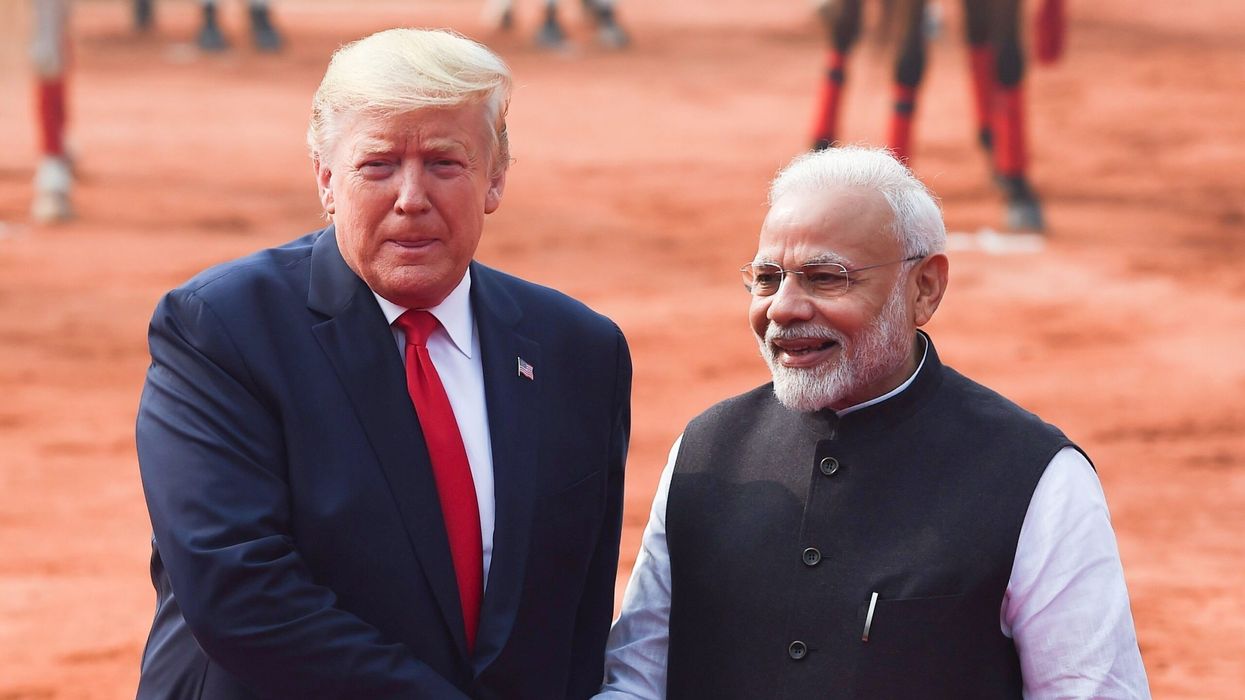

INDIA’S prime minister Narendra Modi and Donald Trump call each other friends, but analysts said looming trade disputes will test their cosy relationship when the latter again becomes US president.
The bear hugs and bonhomie both men have shared during their official encounters belie Trump’s occasionally aggressive posture towards New Delhi in his first term, when he dubbed India a “tariff king” and “trade abuser”.
Trump pledged to impose “reciprocal” tariffs on countries that have trade surpluses with the United States, a move that could stymie industries in the world’s fifth-largest economy.
“Look at the direction Trump wants to take America... to bring economic and industrial activity back to the US,” Indrani Bagchi, the chief executive of the Delhi-based Ananta Aspen Centre thinktank, said.
“For decades, America has lived off the idea that things are produced elsewhere and you get them cheap,” she added.
“If manufacturing indeed moves back to the US, what does that mean for countries that have a trade surplus with America?”
India is the ninthlargest trading partner of the United States, with a trade surplus of more than $30 billion (£23.3bn) in the 2023-24 financial year.
Modi’s government has also sought to promote local manufacturing through its “Make in India” campaign, offering simplified laws and generous tax concessions for new enterprises.
This initiative has borne fruit with a growing presence by Apple and other tech giants seeking to diversify their supply chains out of China.
And India’s biggest tech companies, including TCS and Infosys, have become corporate leviathans by giving their American counterparts a means to outsource their information technology needs to a cheaper labour force.
All could take a hit if Trump seeks to fulfil his pledge to bring jobs back onshore and unleash a “tariff war”, said Ashok Malik of business consultancy The Asia Group. Trump’s reprisal of his aggressive first-term trade policy will again be primarily aimed at China, “but won’t leave India unaffected,” he added.
Modi and Trump both heaped praise on each other in a joint appearance at a Houston stadium during Trump’s first term in 2019, touting a close, personal alliance in front of tens of thousands of Indian Americans.
Around 50,000 people attended the event, billed as the largest gathering ever staged for a foreign leader other than the pope in the US.
Modi returned the favour the next year by hosting Trump at a rally in his home state of Gujarat that was attended by around 100,000 people.
“He’s a friend of mine,” Trump said of the Indian leader on a podcast hosted by comedian Andrew Schultz last month.
“On the outside, he looks like he’s your father. He’s the nicest. Total killer.”
Professor Harsh V Pant of King’s College London said India stood to benefit from the personal warmth shared between the two leaders.
“Modi is certainly the kind of strong leader Trump likes,” he said.
“Embracing Modi is politically convenient, optics are good, and there are a lot of positives for Modi to exploit.”
The years ahead nonetheless threaten major diplomatic frictions that could upset their mutual camaraderie.
India is among the largest sources of legal migration into the United States, but tens of thousands of Indians have also entered the country illegally in recent years by crossing the Canadian and Mexican borders.
That will necessarily be a problem when Trump pursues his avowed policy to crack down on illegal immigration, Bagchi said.
“We are looking at a PR disaster if Indians are picked up and mass deported,” she added.
India has unveiled a slew of new partnerships with the United States under Modi’s government, including in defence, technology and semiconductor production.
The world’s most populous country is also a member of the US-led Quad alliance, with Australia and Japan, seen as a means of countering China’s growing strength in the Asia-Pacific.
Trump’s “unpredictability” raises doubts whether this trajectory of ever-closer cooperation will continue, said Pant.
“The fact that he doesn’t view the world in a strategic sense, there is a transactionalism inherent in his approach, that makes it complicated and brings uncertainty.” (AFP)