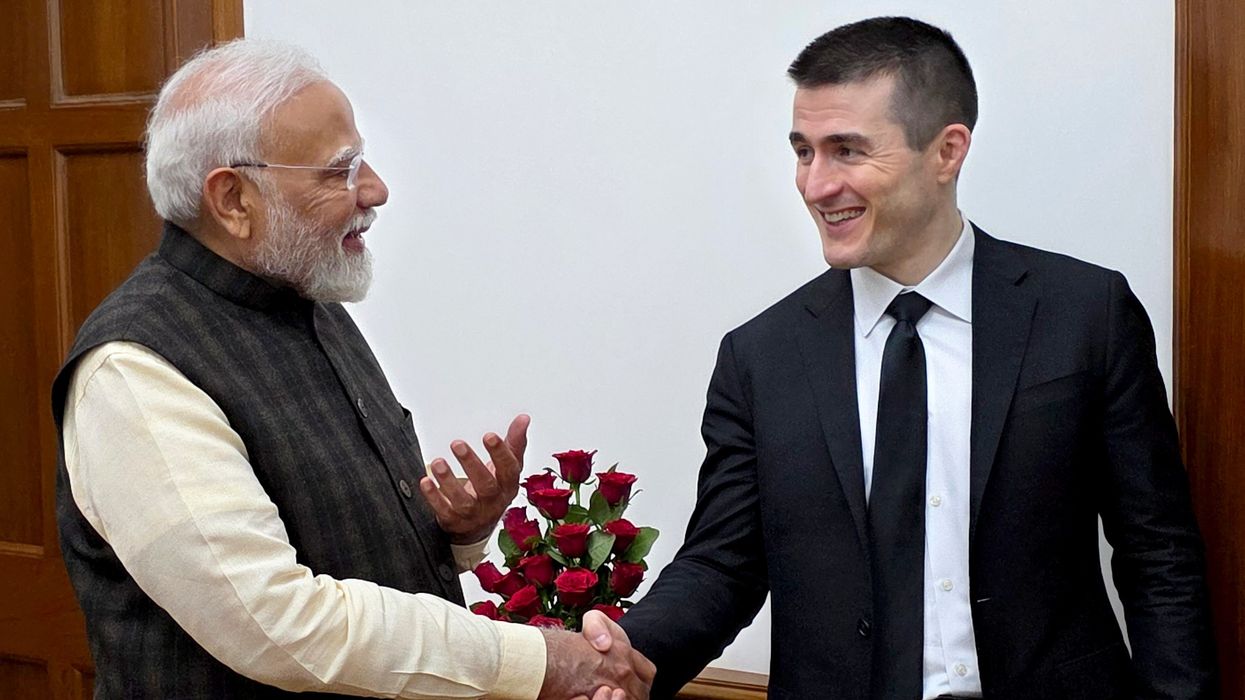
INDIAN prime minister Narendra Modi spoke on a range of foreign policy and domestic issues in a podcast interview on Sunday.
He emphasised that cooperation between India and China is necessary for global peace and prosperity and criticised Pakistan for its links to global terrorism. He said his attempts to improve ties with Islamabad were met with hostility.
In a discussion lasting over three hours with US-based podcaster and computer scientist Lex Fridman, Modi said he shares a strong connection with former US president Donald Trump as both prioritise their respective countries. He stated that their mutual trust remained intact even when Trump was out of office during Joe Biden’s presidency.
Modi spoke about his personal journey, describing how the Hindutva organisation Rashtriya Swayamsevak Sangh (RSS) instilled patriotic values in him. He praised Mahatma Gandhi’s legacy and described himself as someone who has urged both Russian and Ukrainian leaders to engage in dialogue.
Here's my conversation with @narendramodi, Prime Minister of India.
It was one of the most moving & powerful conversations and experiences of my life.
This episode is fully dubbed into multiple languages including English and Hindi. It's also available in the original (mix of… pic.twitter.com/85yUykwae4
— Lex Fridman (@lexfridman) March 16, 2025
On India-China relations, he said normalcy had returned to the border following his discussions with Chinese president Xi Jinping to ease tensions after the 2020 clashes in eastern Ladakh. He noted that differences between neighbours are natural and highlighted the historical cultural ties between the two countries.
“Our cooperation is not only (mutually) beneficial but also essential for global peace and prosperity,” Modi said.
On Pakistan, he said he had invited its leader to his 2014 swearing-in ceremony and visited Lahore in 2015 in an effort to improve relations. However, he said these efforts were met with hostility.
"Yet, every noble attempt at fostering peace was met with hostility and betrayal," he said, expressing hope that Pakistan would abandon terrorism. He added that Pakistan has engaged in a proxy war against India and that links to global terror incidents often trace back to the country. He cited Osama bin Laden’s presence in Pakistan as an example.
Asked about Trump, Modi recalled that the former US president had agreed to take a lap around the stadium during the ‘Howdy Modi’ event in Houston, disregarding security protocol.
"I was touched by his courage and his trust in me," he said, noting that Trump showed similar courage after the recent assassination attempt on him. Modi said Trump’s “America First” approach aligns with his own “India First” policy, which helps them connect well.
On the Russia-Ukraine conflict, Modi said the crisis can only be resolved through dialogue, not war. He said he maintains good relations with both Russian president Vladimir Putin and Ukrainian president Volodymyr Zelenskyy.
"I have a close relationship with Russia and Ukraine alike. I can sit with president Putin and say that this is not the time for war. And I can also tell president Zelensky, in a friendly way, that brother, regardless of how many people stand with you in the world, there will never be a resolution on the battlefield," Modi said.
Speaking about the RSS, Modi said he felt fortunate to have learned life’s values from the organisation. He described it as a group that has worked since 1925 to inspire people to dedicate themselves to the country. He said the RSS gave him a sense of purpose, with its various affiliates involved in multiple sectors.
On the 2002 Gujarat riots, which took place when he was the state’s chief minister, Modi said his political opponents tried to create a false narrative against him. However, he said courts had cleared him of any wrongdoing.
"The perception that the 2002 riots were the biggest riots ever in Gujarat was an attempt to push misinformation," he said.
He pointed out that Gujarat had experienced frequent riots before 2002, with curfews imposed regularly over minor incidents. He cited the 1969 riots in Gujarat, which lasted over six months, as an example of earlier violence.
Modi said the Godhra train burning incident occurred just three days after he was elected as a legislator in the Gujarat Assembly. He added that a false narrative had been created about the case.
"But, the courts investigated the matter thoroughly and found us completely innocent. Those who were truly responsible have faced justice from the courts," he said.
He said Gujarat, which used to witness regular violence, has not had riots since 2002.
Fridman, who moved to the US from Russia after the collapse of the Soviet Union, started his podcast in 2018.
Initially called the Artificial Intelligence Podcast, it was later renamed the Lex Fridman Podcast in 2020. His guests have included Donald Trump, Volodymyr Zelenskyy, SpaceX founder Elon Musk, Amazon’s Jeff Bezos, and Meta CEO Mark Zuckerberg.
(With inputs from PTI)