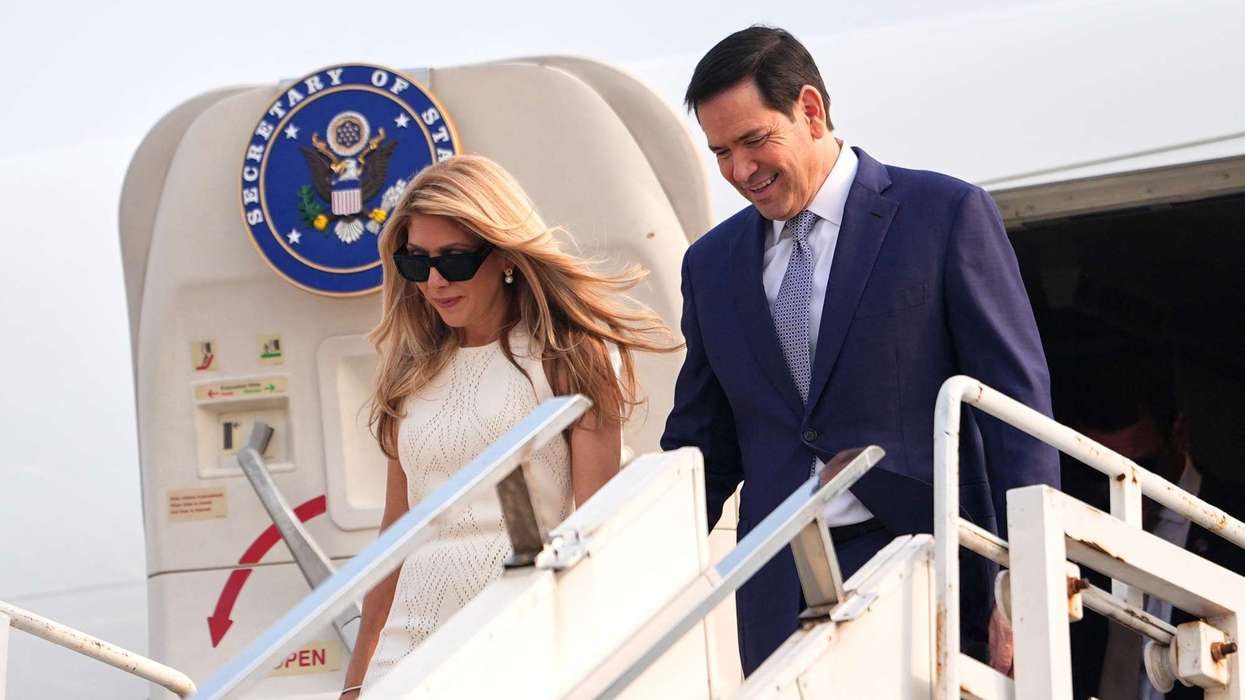
US SECRETARY of State Marco Rubio on Saturday began a visit to India that will include talks with Prime Minister Narendra Modi, as Washington looks to renew ties with a partner often seen as closely aligned with the United States, a week after President Donald Trump’s summit with China.
Rubio started his four-day, four-city visit in Kolkata, where he toured the headquarters of Missionaries of Charity and prayed at Mother Teresa’s tomb.
Wearing a yellow garland over his suit, Rubio, visiting India for the first time, smiled before an assembly of nuns dressed in the late humanitarian’s white and blue saris.
“Rubio spoke about aiding the homeless, terminally ill and those afflicted by leprosy,” Sister Marie Juan of Missionaries of Charity told reporters after his hour-and-a-half-long visit.
“He was happy to pray and we were also happy to have him,” she said.
Sergio Gor, the US ambassador to India and also a Catholic, later posted that the visit showed the relationship between the two countries was based “not only on strong policies, but also on shared values”.
Rubio, accompanied by his wife Jeanette, later flew to New Delhi where he was scheduled to meet Modi on Saturday.
Before leaving on Tuesday, Rubio will also attend a meeting of foreign ministers from the Quad — Australia, India, Japan and the United States — four democracies seen as a counterweight to China’s presence in the Indian Ocean.
China has long viewed the Quad with suspicion, calling it an attempt to encircle the country, and has criticised India in the past for participating in it.
Rubio’s visit comes as Trump changes traditional US foreign policy priorities.
Trump visited China last week and praised the reception he received from President Xi Jinping despite few concrete announcements from the trip.
During the visit to Beijing, Trump described the United States and China as a “G2” — a term that had fallen out of use in recent years as US allies feared being excluded from Washington’s dealings with China.
While Trump rarely speaks about human rights, some of his supporters have raised concerns about the treatment of Christians under Modi’s Hindu nationalist government, making Rubio’s first stop significant.
Rights groups say attacks on minority Christians in India, including church vandalism, have increased since Modi came to power in 2014.
The Indian government rejects the allegations as exaggerated and politically motivated.
Ahead of the visit, Rubio called India a “great ally, great partner” and said the United States wanted to explore ways to sell more oil to the country.
India’s growing economy depends heavily on energy imports and, like many countries, has been affected by the US-Israeli attack on Iran. Iran responded by blocking the Strait of Hormuz, causing global oil prices to rise sharply.
India has historic ties with Iran as well as growing relations with Israel, which Modi visited days before the war.
The conflict has also brought renewed US attention to Pakistan, India’s traditional rival. Pakistan has positioned itself as a mediator, with its army chief travelling to Tehran on Friday.
The United States was a Cold War ally of Pakistan but later shifted focus towards India, viewing the world’s largest democracy as an important partner amid China’s rise.
Trump has recently improved ties with Pakistan, which praised him for his diplomacy during its short war with India last year and welcomed a cryptocurrency company owned by the US president’s family.
Modi irritated Trump by not crediting him with ending the conflict, during which India carried out strikes on Pakistan after the killing of mostly Hindu civilians in Indian-administered Kashmir.
Trump later imposed punitive tariffs on India at rates higher than those imposed on China, although they were later eased under a trade agreement.
(With inputs from agencies)