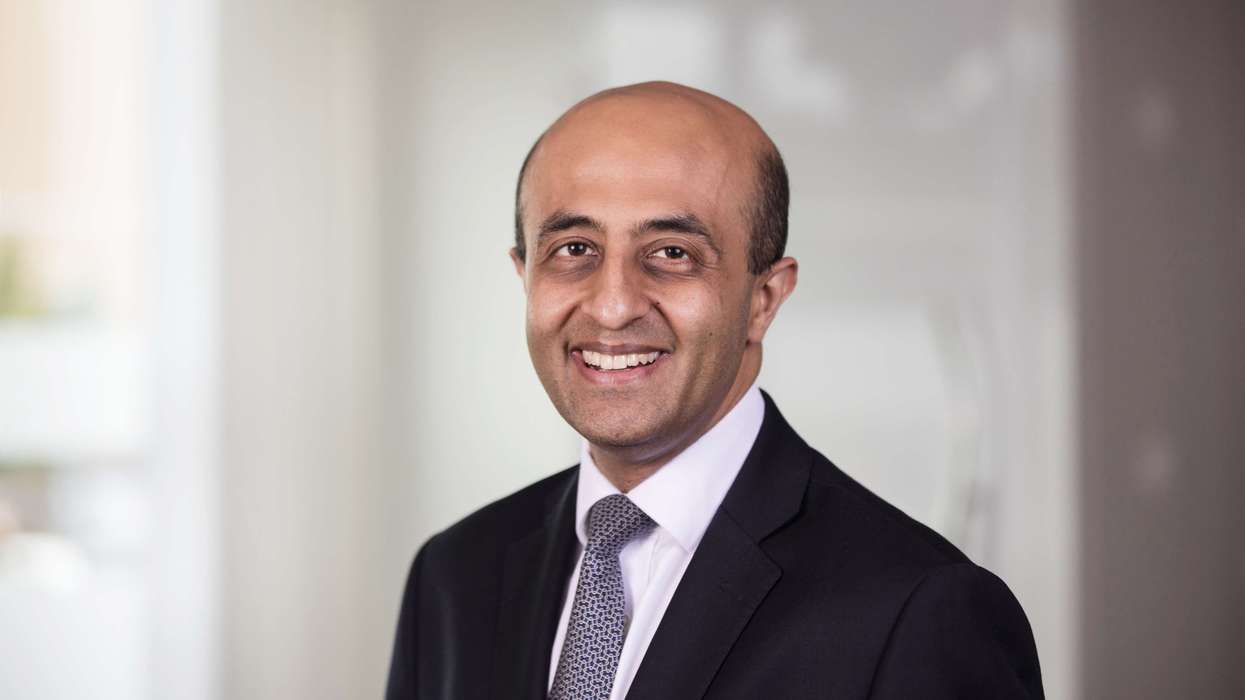

Lord Jitesh Gadhia is a hugely influential figure who acts unobtrusively – and with much charm – behind the scenes to try and bring “predictability, certainty and consistency” to the British economy, boost investor confidence in the UK, and strengthen the business relationship between Britain and India.
He was at Chequers, the British prime minister’s country residence in Buckinghamshire, when Sir Keir Starmer met his Indian opposite number, Narendra Modi, for the official signing of the bilateral Free Trade Agreement in July 2025.
And when Starmer went to India last October on an official visit, Gadhia was part of the delegation. In one photograph taken of the delegation members in the Taj Mahal Hotel in Mumbai, Gadhia happened to be positioned close to the British prime minister.
Among the many hats that he wears, Baron Gadhia, of Northwood in the County of Middlesex – he sits in the Lords as a non-affiliated peer – is a non-executive member of the Court of the Bank of England, the governing body of the 331-year-old venerable institution.
He is a non-executive director at Rolls-Royce Holdings, the £100bn flagship engineering group, which has interests in aerospace, defence and power systems, and at the leading housebuilder, Taylor Wimpey.
He is also close to King Charles in his capacity as chair of the British Asian Trust, a charity given top priority by the monarch. The trust was founded in 2007 by Prince Charles, so Gadhia will soon begin preparations to mark its 20th anniversary next year.
In September this year, Gadhia will celebrate 10 years in the House of Lords. Jitesh Kishorekumar Gadhia, a former banker, was given his peerage by David Cameron in September 2016.
“I took my oath on the Rig Veda,” he recalled.
He was born in Kampala, capital of Uganda, on 27 May 1970, came to Britain at the age of two with his family during the refugee crisis, flourished at school and got into Fitzwilliam College, Cambridge, to read economics.
Gadhia’s style is to try and persuade decision makers through reasoned debate based on carefully gathered facts and figures.
“Yes, I was appointed by David Cameron but I am not affiliated, partly because of my role at the Bank of England,” he explained in an interview. “Hopefully, people don’t see me as political with a capital ‘P’. Therefore, I can try and do things behind the scenes. In the end, it’s our national interest that really matters.”
Take, for example, the Free Trade Agreement, where he used his influence to get over the last remaining sticking points.
“Last year (when the FTA was signed) was quite a big moment,” he observed. “Everything that had been developed over many years across multiple governments came to fruition. The reality is that 90 per cent of the work had been done under Rishi Sunak. But there were sticking points. After ‘Liberation Day’ (US president Donald Trump imposed a wide range of tariffs on 2 April 2025), both countries accelerated the negotiations. Trump was the trigger. US policy gave an impetus for the UK and India to seal the deal. I was involved throughout the process, trying to get agreement on thorny issues.”
He continued: “Now that we have secured the agreement, we need to take full advantage of the opportunities. FTAs are not the be and end all; it acts as a Trojan Horse, helping to push through mutual recognition of qualifications. Ultimately, the UK is an 80 per cent service economy and India approaching 60 per cent.”
With the Indian economy set to grow at about 7 per cent for the next few years, Gadhia suggested “there is an element that the UK can rediscover of itself through India. There is a great opportunity for the revival of UK manufacturing because we have a lot of tech and design capability. India has a lot of STEM (Science, Technology, Engineering, or Mathematics) graduates, lots of engineers, lots of cost competitive resources and scale.”
He gave the example of Royal Enfield, a classic British motorcycle brand which was bought by Madras Motors in India. Its design and technology centre is located at the Bruntingthorpe Proving Ground in Leicestershire. The motorcycles are manufactured in Chennai and exported to the world. Such an arrangement fits in with Modi’s “made in India” philosophy.
Admittedly, India has also signed an FTA with the EU. But the one with the UK will be ratified first, giving British businesses the chance to clinch deals ahead of the competition from Europe, according to Gadhia.
He said: “Apart from business and trade, I have done stuff on what India can do around defence collaboration.”
With Rolls-Royce, there could be even greater engagement with India.
“Rolls-Royce is an incredible transformation story. When the CEO was appointed, the market value of Rolls-Royce was £7.9bn. It’s now over £100bn. As a board director and chair of the remuneration committee, I’ve obviously had quite a lot of involvement.
“Rolls-Royce makes engines for wide-bodied aircraft. There have been a lot of orders from Air India and Indigo. In fact, the largest orders for Airbus globally have come from India.”
Rolls-Royce makes engines for the A350, “currently the most popular wide-bodied aircraft”.
The UK has traditionally had a “special relationship” with the US, but Gadhia is using his influence to ensure India becomes just as important a partner.
“I would say increasingly, the UK and US are almost divided by a common language, whereas with India and the UK, I hope we’re united by a common language. If we are looking to Washington for a special relationship, Delhi is almost equidistant from London. I would argue that the special relationship of the 21st century should be looking east, not just west.”
As someone with experience both of Westminster and the world of business, Gadhia brings special expertise to his role at the Bank of England.
“Whilst the economic functions of a central bank are relatively focused, it’s one of the important anchors of stability,” he said. “The court meets seven times a year. Then, in between, we have the audit and risk committee, and various other meetings around strategy. I help with other aspects of the bank, including recruitment.
“We are responsible for the overall organisation of the bank, ranging from reviews of the functioning of the policy committees through to the financial budgets, the accounts, the balance sheets, and various other statutory responsibilities. It is quite complex, codified by legislation. It’s not just the setting of interest rates, it’s also financial stability, and financial market infrastructure.
“It’s a wide remit of activities, including, for example, the real time gross settlement system. So when payments are made, they’re all reconciled with each other, almost £800 billion of transactions per day. That infrastructure is provided by the Bank of England. It’s probably one of the most important things the Bank of England does.
“In the last decade, we’ve had Brexit, we’ve had the pandemic, we have had Liz Truss’s infamous, notorious budget. We’ve had turbulence from tariffs. Having an independent central bank provides an anchor.”
There is usually a dinner that precedes the day when the court meets. Vegetarian fare is provided for Gadhia, who remarked: “Yes, it gets served up by gentleman in pink coats – they still exist. What do people around the world respect us for? They respect us for stability and probity and independence of our institutions.”
To provide greater understanding between the worlds of politics and business, he has organised a range of discussions. “We had an amazing discussion in parliament between (Financial Times journalist) Martin Wolf and Prof Kenneth Rogoff of Harvard, who came up with a timely book called Our Dollar, Your Problem (An Insider's View of Seven Turbulent Decades of Global Finance, and the Road Ahead). There was another great discussion on longevity and an ageing population with Prof Andrew Scott and Sir Jonathan Symonds, chair of GSK”
Gadhia was the first parliamentarian to express concern about entrepreneurs leaving the UK. “The single biggest thing that has driven people away is inheritance tax.”
When Rishi Sunak was prime minister, his wife, Akshata Murty, announced she would pay tax on her Indian earnings.
He argued this was unfair. “Her father (N R Narayana Murthy), through blood, sweat and tears, created Infosys, together with other people. Akshata has been the beneficiary of some shares. That wealth was not created in the UK but she’s subject to taxation on it. I find that quite a novel concept that people in the UK should feel entitled to the fruits of somebody else’s efforts.”
He said: “The evidence is now more than anecdotal that we’ve lost a lot of wealth creators to other countries. The biggest beneficiary, certainly from the south Asian diaspora, has been the UAE.”
He said it was “quite perilous (for the government) to make decisions based on rear view mirror data”. Information on those who had left the UK based on tax returns lagged behind what was really happening by a year or two.
“If you have lost people because they’ve lost trust in the tax system, you are not going to get them back,” warned Gadhia.
He recommends extending the period people can stay before they become liable to worldwide UK tax from 90 days to 182 days. “It’s what Singapore does. We are very fortunate with the UAE, in particular, that the months April to September or October are the months that they would want to stay here (because of the heat in the Gulf states). We would get the benefit of people staying here for half the year. It’s not just people spending their money here. They are likely to do more things in the UK from a business perspective.”
Again, Gadhia exercises his influence quietly. “I have made sure that all the people that need to know or take action on this are fully briefed, not just by me, but across the board. There isn’t a consensus on what to do about it, unfortunately.”
Gadhia’s meetings with King Charles, including summer visits to Balmoral, are meant to remain confidential but some information comes out in the court circulars.
“One of the exciting things this year will be to kick off the 20th anniversary celebrations for the British Asian Trust,” he said. “The King is very empathetic towards the diaspora communities. He has been a real unifier. One of the more pleasurable things last year was to take the Indian cricket teams, both men and the women, to meet the King at Clarence House. That’s a great example of his diplomacy in action.”
Gadhia remains a family man. He and his wife, Angeli, have two children, Priyana, 14, and Dev, 11. Despite all that he does, Gadhia is best described as unshowy.
ends