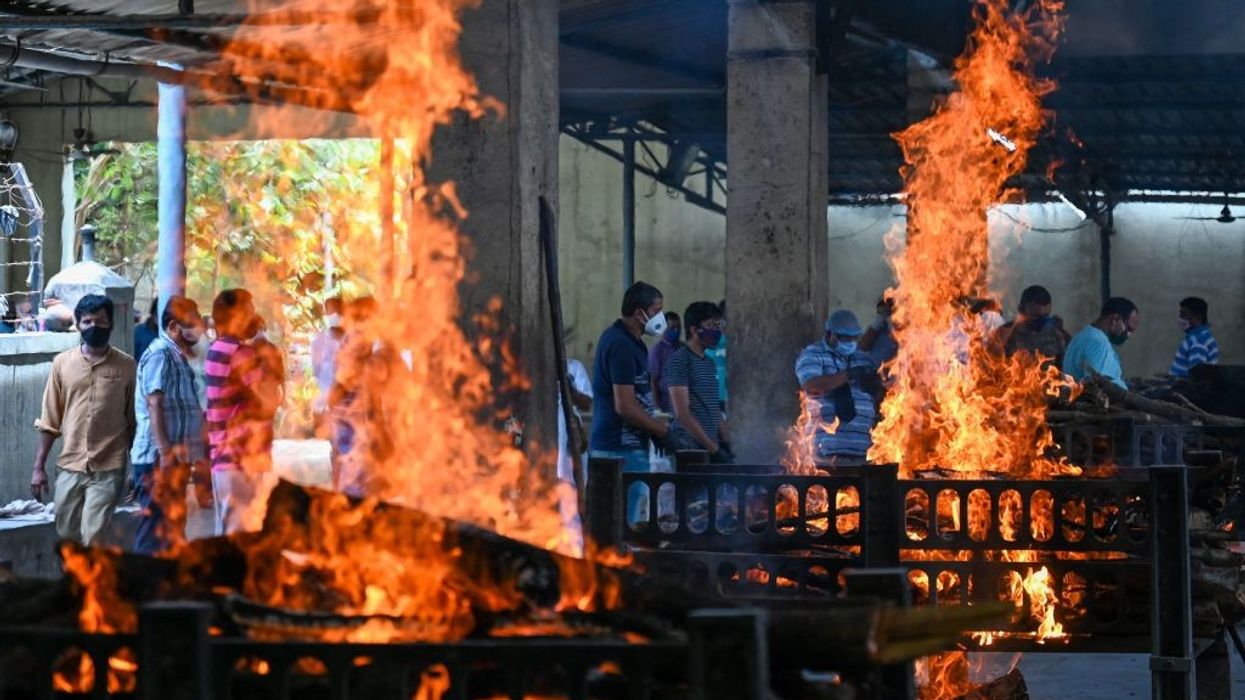

INDIA reported the world's highest daily tally of coronavirus infections for a second day on Friday (23), surpassing 330,000 new cases, as it struggles with a health system overwhelmed by patients and plagued by accidents.
Deaths in the past 24 hours also jumped to a record 2,263, the health ministry said, while officials across northern and western India, including the capital, New Delhi, warned most hospitals were full and running out of oxygen.
Delhi hospitals issued desperate appeals for oxygen on Friday and 13 Covid patients died in a fire. The capital reported more than 26,000 new cases and 306 deaths, or about one fatality every five minutes, the fastest since the pandemic began.
The latest in a string of fires at hospitals broke out on the outskirts of Mumbai early Friday morning, a local official told AFP. It has since been put out and the cause was being investigated.
"There were 17 patients inside when a fire broke out in the ICU of Vijay Vallabh Hospital, out of which 13 died and four have been shifted to other facilities," fire department official Morrison Khavari said.
India's new Covid outbreak has seen critical shortages in oxygen, drugs and hospital beds, sparking desperate pleas for help.
Earlier this week, 22 Covid-19 patients died at another hospital in the same state of Maharashtra when the oxygen supply to their ventilators was disrupted by a leak.
Oxygen shortage
Hospitals in New Delhi have been posting daily desperate appeals for oxygen to the state and national government.
"SOS -- less than an hour's oxygen supplies at Max Smart Hospital & Max Hospital Saket," one of the biggest private hospital chains in India said on Twitter early Friday morning. "Over 700 patients admitted, need immediate assistance."
At least six hospitals ran out of oxygen supplies in the Indian capital late Thursday night before deliveries arrived in the early hours.
Medical oxygen tanker trunks have been doing supply runs around the clock in a number of states and air force transport planes have started airlifting big oxygen tanks around the country.
The first "Oxygen Express" train left the southern industrial hub of Vizag on Thursday headed for Maharashtra with trucks carrying supplies on board.
The defence ministry said it would fly in 23 mobile oxygen generation plants from Germany within a week.
India has now recorded more than 16 million cases and 187,000 deaths from the coronavirus. Per capita numbers are however much lower than in many other countries.
Modi meets state heads
Prime minister Narendra Modi, whose government has been criticised for relaxing virus curbs too quickly, met chief ministers of the worst-affected states.
Later he said the government was making a 'continuous effort' to increase oxygen supplies, including steps to divert industrial oxygen.
Modi asked states to work together to meet the needs for medicine and oxygen, and stop hoarding and black marketeering.
"Every state should ensure that no oxygen tanker, whether it is meant for any state, is stopped or gets stranded," he was quoted as saying in a statement.
Bhramar Mukherjee, a professor of biostatistics and epidemiology at the University of Michigan in the United States, said it seemed as if there was no social safety net for Indians.
"Everyone is fighting for their own survival and trying to protect their loved ones. This is hard to watch," he said.
India has recorded more than four million infections this month, dashing hopes at the start of the year that it may have seen the worst of the pandemic.
Health experts say India got complacent in the winter, when new cases were running at about 10,000 a day and seemed to be under control, and lifted restrictions to allow big gatherings.
Britain, Canada, Singapore and the United Arab Emirates have banned flights from India.
India, a major vaccine producer, has begun a vaccination campaign but only a tiny fraction of its population of 1.39 billion has received a dose, with experts saying supplies are scarce.





 Dr Kalpana Lakhani Garavi Gujarat