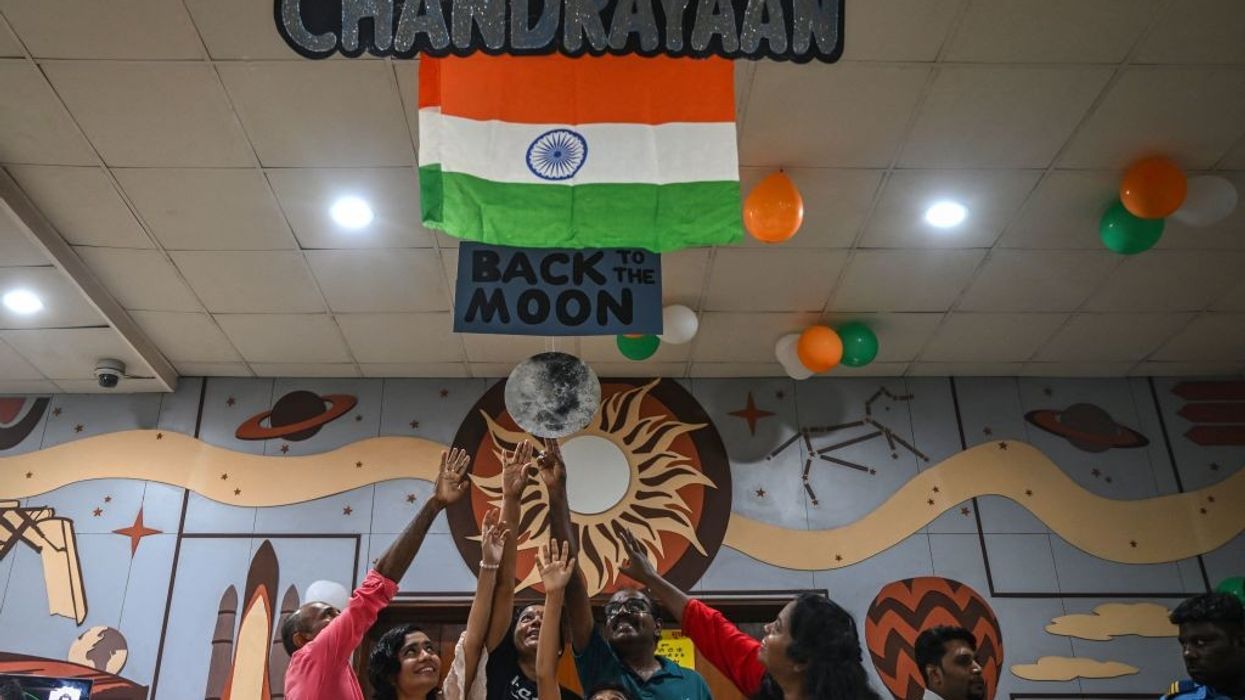

INDIA readied Wednesday (23) to become the first nation to land a spacecraft on the Moon's south pole, days after a Russian probe crashed in the same region.
The latest attempted Moon landing is a historic moment for the world's most populous nation, as it rapidly closes in on milestones set by global space powers.
Chandrayaan-3, which means "Mooncraft" in Sanskrit, is scheduled to touch down shortly after 6 pm India time (12.30 GMT) near the little-explored lunar south pole.
"India reaches for the Moon", The Times of India front-page headline read Wednesday, with the hoped-for lunar landing dominating local news. "It's D-Day for Moon Mission", The Hindustan Times said.
A previous Indian effort failed in 2019, and the latest attempt comes just days after Russia's first Moon mission in almost 50 years, destined for the same region, crashed on the lunar surface.
But former Indian space chief K. Sivan said the latest photos transmitted back home by the lander gave every indication the final leg of the voyage would succeed.
"It is giving some encouragement that we will be able to achieve the landing mission without any problem," he told AFP on Monday.
Sivan added that the Indian Space Research Organisation (ISRO) had made corrections after the failure of four years ago, when scientists lost contact with the previous lunar module moments before its slated landing.
"Chandrayaan-3 is going to go with more ruggedness," he said. "We have confidence, and we expect that everything will go smoothly."
The mission was launched nearly six weeks ago in front of thousands of cheering spectators, but took much longer to reach the Moon than those of the Apollo missions in the 1960s and 1970s, which arrived in a matter of days.
India is using rockets much less powerful than those the United States used back then, meaning the probe must orbit Earth several times to gain speed before embarking on its month-long lunar trajectory.
The spacecraft's lander, Vikram, which means "valour" in Sanskrit, detached from its propulsion module last week and has been sending back images of the moon's surface since entering lunar orbit on August 5.
A day ahead of the landing, the ISRO said on social media the landing was proceeding on schedule and that its mission control complex was "buzzed with energy and excitement".
"Smooth sailing is continuing," the agency posted on X, formerly known as Twitter.
India has a comparatively low-budget aerospace programme, but one that has grown considerably in size and momentum since it first sent a probe to orbit the Moon in 2008.
The latest mission comes with a price tag of $74.6 million -- far lower than those of other countries, and a testament to India's frugal space engineering.
Experts say India can keep costs low by copying and adapting existing space technology, and thanks to an abundance of highly skilled engineers who earn a fraction of their foreign counterparts' wages.
In 2014, India became the first Asian nation to put a satellite into orbit around Mars and is slated to launch a three-day manned mission into Earth's orbit by next year.
Sivan, the former ISRO chief, said India's efforts to explore the relatively unmapped lunar south pole would make a "very, very important" contribution to scientific knowledge.
Only Russia, the US and China have previously achieved a controlled landing on the lunar surface.
(AFP)