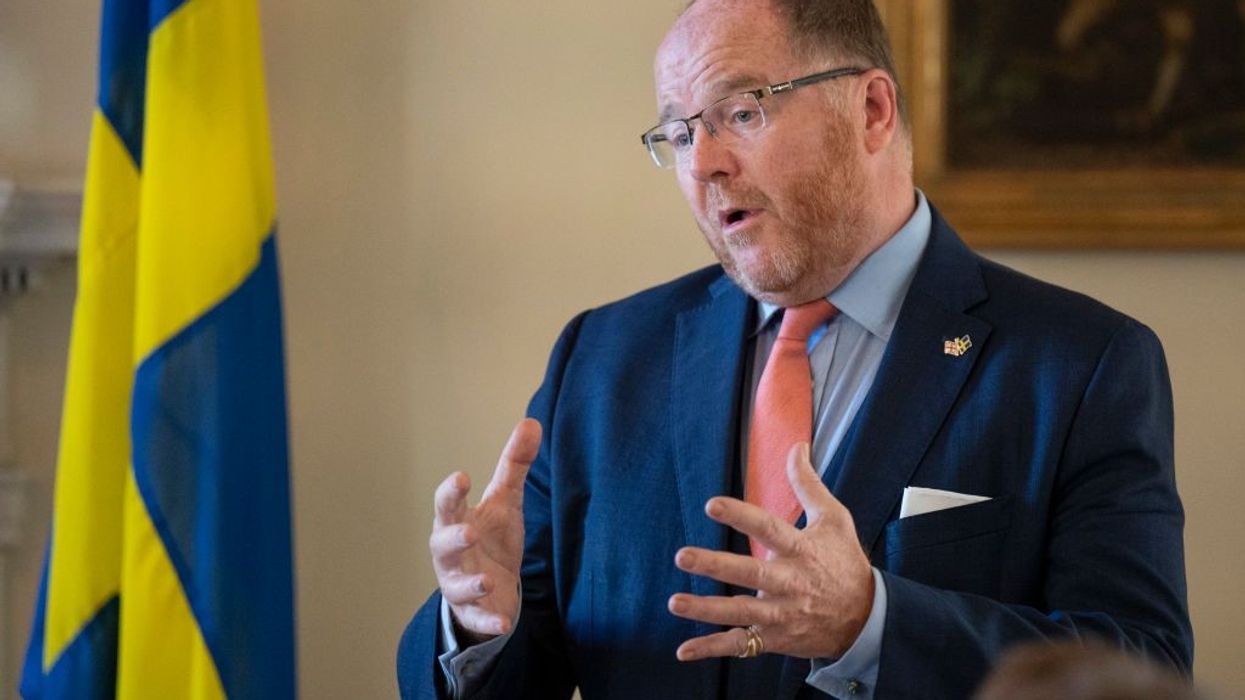
BRITAIN and India will connect their space clusters, starting with Leicester space park, the UK’s science, research and innovation minister George Freeman has said.
He said in Mumbai that the two countries are also discussing how they can better harness low earth orbit satellite communications.
According to Freeman, the UK and India are keen on collaborating on nuclear energy.
“We are looking to connect the UK space cluster parks with Indian space parks, starting with Leicester (space park). So that we grow the space economy and nurture the skills for the new generation of young Indian scientists working with UK scientists and innovators in a commercial space economy,” Freeman said.
Freeman, who was in India last week to attend a meeting of G20 science ministers, met his Indian counterpart Jitendra Singh.
He said the UK is investing in its space clusters that are spread around the country. Freeman added the UK is committed to not trying to grow a "vertical integrated sovereign closed space economy", but an open commercial global economy.
Britain has passed the Space Act, the first nation in Europe to launch and set the regulatory framework for space, he said.
“This summer we are looking at how quickly to develop these ideas so when prime minister (Rishi) Sunak comes to India later this year, he and prime minister (Narendra) Modi will have a very rich package of measures to announce. So talks are going on this summer,” Freeman said.
He said India and the UK are also looking at areas where the two countries have strategic interests and very strong synergy.
“In the area of future telecoms, satellite communications, AI, and 5G, we see India as the world's largest democracy and rapidly becoming the biggest and influential economy.
“India's adoption of technologies and the regulation of those technologies would be absolutely key for global security. So, we have agreed to work on those very important technologies to develop both technological cooperation and also regulatory cooperation,” the UK minister said.
India's innovation economy, the scale of growth and the digital technologies mean the UK and India have “a very, very exciting few years next decade,” Freeman added.
(PTI)
India, UK to connect their space clusters
Britain's science minister George Freeman says the two countries are keen on cooperating on nuclear energy