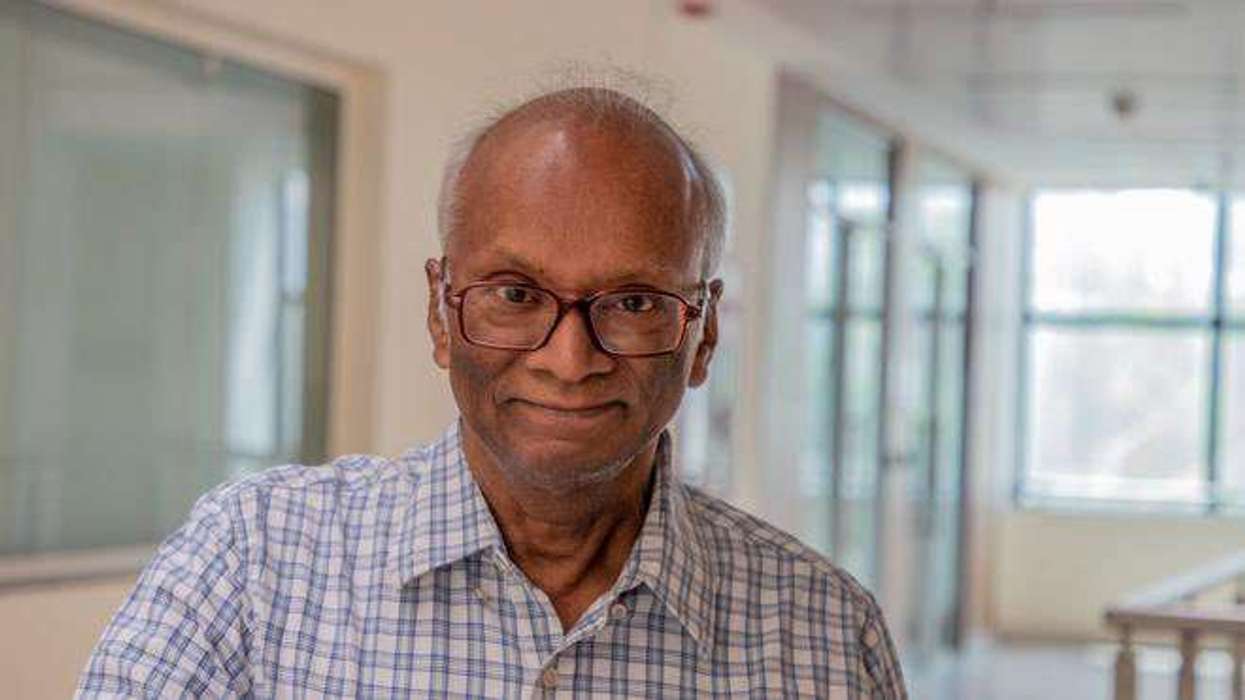

INDIAN physicist Deepak Dhar has won the 2026 Dirac Medal, one of the leading awards in theoretical physics, for his contributions to statistical mechanics.
Dhar is one of four physicists to receive this year's medal, the International Centre for Theoretical Physics (ICTP), which gives the award, said in a statement.
Dhar is an INSA distinguished professor at the International Centre for Theoretical Sciences of the Tata Institute of Fundamental Research (ICTS-TIFR) in Bengaluru.
The Dirac Medal, first awarded in 1985, recognises contributions to theoretical physics. Several past recipients have gone on to receive other major scientific awards, including the Nobel Prize and the Fields Medal.
Dhar shares the 2026 medal with Bernard Derrida of France, Marc Mézard of Italy and Haim Sompolinsky of Israel and the US.
The four were recognised for their work in statistical mechanics, which helps explain how the behaviour of large numbers of particles or other individual elements can produce complex patterns.
Diverse applications
Dhar is particularly known for his work on the sandpile model, which helps explain how a system can remain stable for a long time before undergoing a sudden change. His work on the model has helped scientists study self-organised criticality and other complex systems.
The work of the four scientists has applications in areas including biology, computer science and artificial intelligence, the ICTP said.
ICTP director Atish Dabholkar, who chairs the medal selection committee, said the recipients' work had helped establish statistical mechanics as a framework for studying questions beyond its traditional field.
“I am particularly happy that this year’s Medal recognises a research field that has had a long tradition here at ICTP,” Dabholkar said. “I warmly congratulate the four winners.”
Dhar received his PhD from the California Institute of Technology in 1978. He joined the Tata Institute of Fundamental Research in 1978 and worked there until 2016, when he moved to the Indian Institute of Science Education and Research, Pune. He later joined ICTS-TIFR as an INSA distinguished professor.
His research focuses on statistical physics and stochastic processes. His work includes studies of critical phenomena, branched polymers, disordered magnets and the abelian sandpile model.
Dhar received the Shanti Swarup Bhatnagar Prize in 1991, the TWAS Prize in 2002, the Boltzmann Medal in 2022 and the Padma Bhushan in 2023. He was the first Indian to receive the Boltzmann Medal.
(PTI)