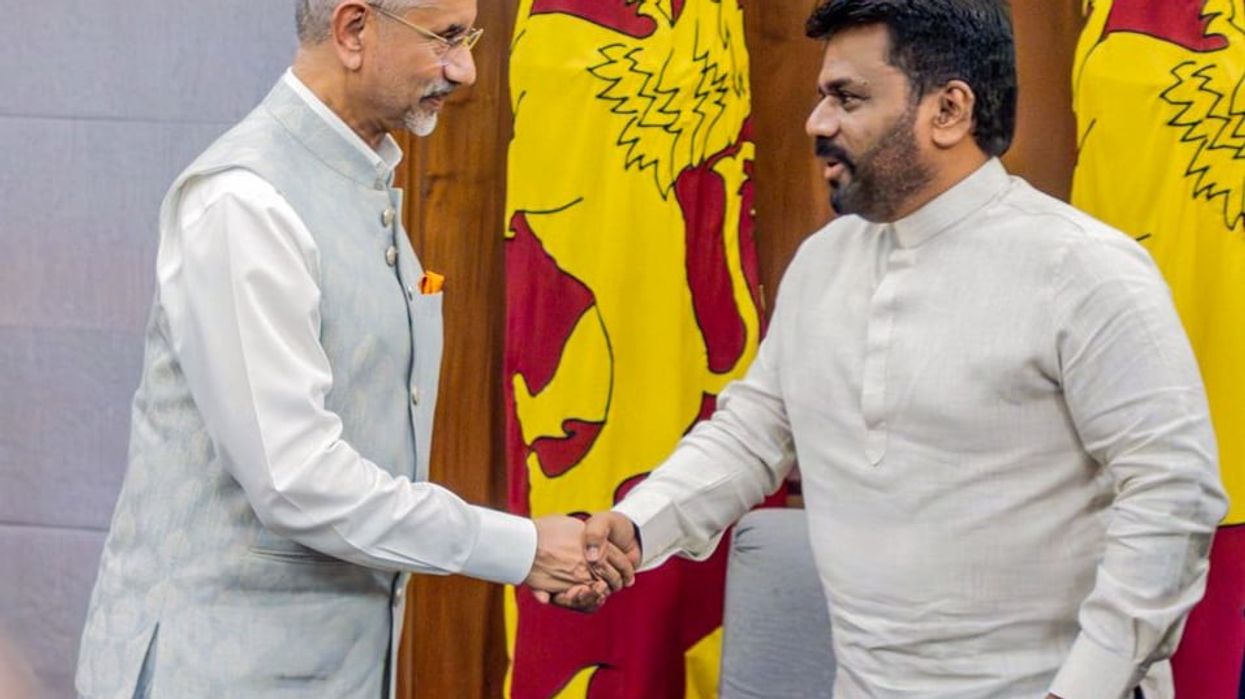

INDIA’S external affairs minister S Jaishankar met Sri Lankan president Anura Kumara Dissanayake last Friday (4) and discussed “ways to deepen ongoing cooperation and strengthen India-Sri Lanka ties.”
He also assured India’s continued support to the island nation’s economic rebuilding.
Jaishankar arrived in Colombo the morning on a day-long visit, less than a fortnight after president Dissanayake was sworn in.
“Honoured to call on President @ anuradisanayake today in Colombo. Conveyed warm greetings of President Droupadi Murmu and PM @narendramodi,” Jaishankar posted on X.
“Appreciate his warm sentiments and guidance for the India-Sri Lanka relations. Discussed ways to deepen ongoing cooperation and strengthen India-Sri Lanka ties for the benefit of people of two countries and the region,” he said further in the post.
Jaishankar is the first foreign dignitary to visit Sri Lanka since the National People’s Power (NPP) government led by Dissanayake came to power on September 23.
He was received at the airport by Sri Lankan foreign secretary Aruni Wijewardena and the Indian High Commissioner to Sri Lanka Santosh Jha.
Earlier, Jaishankar met his Sri Lankan counterpart Vijitha Herath. “Concluded wide-ranging and detailed talks with FM Vijitha Herath today in Colombo. Congratulated him once again on his new responsibilities,” Jaishankar posted on his X handle.
“Reviewed various dimensions of India-Sri Lanka partnership. Assured him of India’s continued support to Sri Lanka’s economic rebuilding. Our Neighbourhood First Policy and Sagar outlook will guide the advancement of India-Sri Lanka ties,” he added.
“Minister of Foreign Affairs Vijitha Herath welcomed visiting Indian External Affairs Minister @DrSJaishankar at @MFA_SriLanka this afternoon and discussed a range of matters of mutual interest,” Sri Lanka’s foreign ministry posted on its handle.
Sri Lanka is India’s key maritime neighbour in the Indian Ocean Region (IOR) and occupies a special place in its initiatives such as SAGAR (Security and Growth for All in the Region) and the Neighbourhood First Policy.
While in Opposition, Dissanayake had expressed his reservations about some of the Indian projects, especially on the sustainable energy projects run by the Adani Group.
In the run up to the election, Dissanayake had pledged to annul those projects, claiming that the projects were inimical to Sri Lankan interests.
Ahead of his departure, the ministry of external affairs in New Delhi said, “...the visit underlines the shared commitment of the two countries to further deepen the longstanding partnership for mutual benefit”.