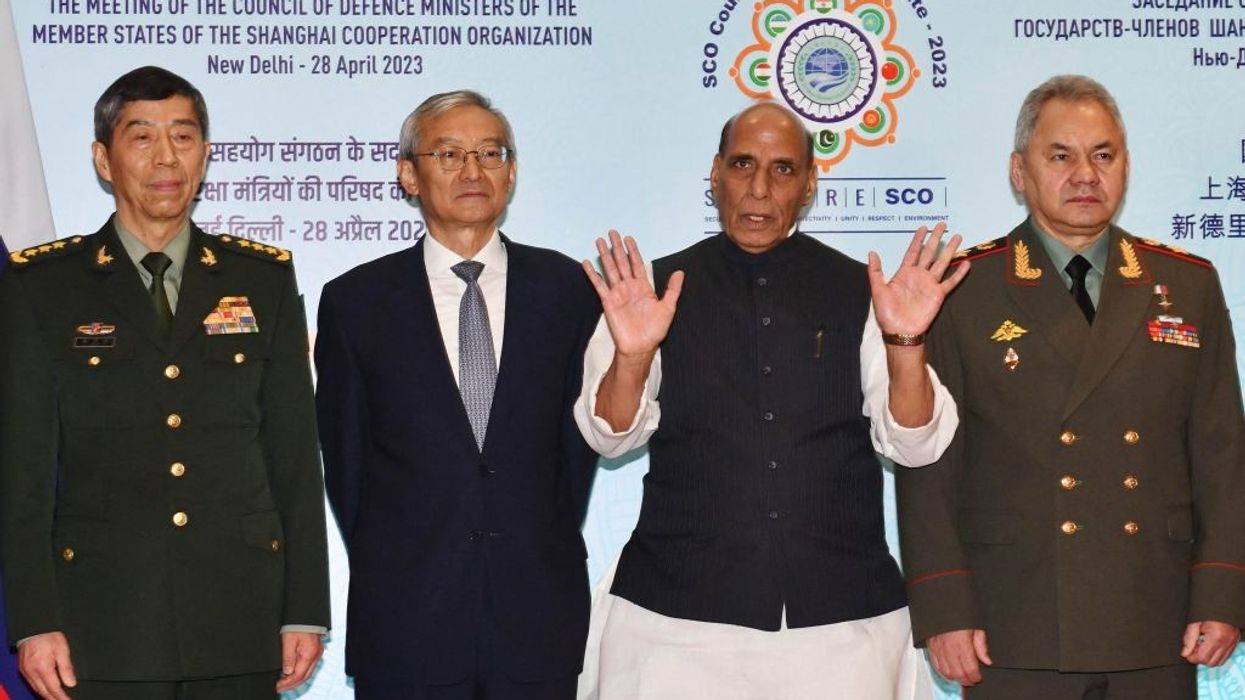

Indian defence minister Rajnath Singh has told his Chinese counterpart that the military forces present on their disputed Himalayan border are harming their relationship and that withdrawal of troops is necessary to maintain 'peace and tranquility'.
Tensions between the two nations have been high since a violent conflict at a high altitude that resulted in the death of 20 Indian and at least four Chinese soldiers in June 2020.
Despite 18 rounds of negotiations between high-ranking military officials from both countries, tens of thousands of soldiers from both sides are still stationed along the border.
Singh held talks with General Li Shangfu on Thursday (27) ahead of a meeting of defence ministers from the Shanghai Cooperation Organisation (SCO), which India is chairing this year.
The Indian defence minister stated New Delhi's position "categorically", a statement from his ministry said.
"He reiterated that violation of existing agreements has eroded the entire basis of bilateral relations and disengagement at the border will logically be followed with de-escalation," it said.
India is wary of its northern neighbour's growing military assertiveness and disputes over their 3,500-kilometre (2,200-mile) frontier are a perennial source of tension.
China claims all of India's northeastern state of Arunachal Pradesh, considering it part of Tibet, and the two fought a border war in 1962.
Beijing and New Delhi have regularly accused each other of trying to seize territory along their unofficial divide, known as the Line of Actual Control.
The clash in 2020 along the western border dividing Tibet from the Indian state of Ladakh led to a sharp deterioration in relations, with both sides sending major reinforcements to the area.
Li said in a statement published online Friday that the situation on the border was "stable".
"We hope that both sides can work together to continuously enhance mutual trust," the statement said.
India holds the rotating presidency of the SCO, a forum established in 2001 that also includes Russia and Pakistan, among others, rivalling Western institutions.
Singh also held a bilateral meeting with Russian defence minister Sergei Shoigu on Friday that affirmed the "unique, long-lasting and time-tested relationship" between their countries, an Indian statement said.
India's security ties with Russia have put it in an awkward diplomatic position in the wake of Moscow's invasion of Ukraine.
Friday's (28) meeting "expressed satisfaction over the continued trust and mutual respect between the two countries, particularly in defence and reiterated their commitment towards strengthening the partnership", the Indian statement said.
(AFP)