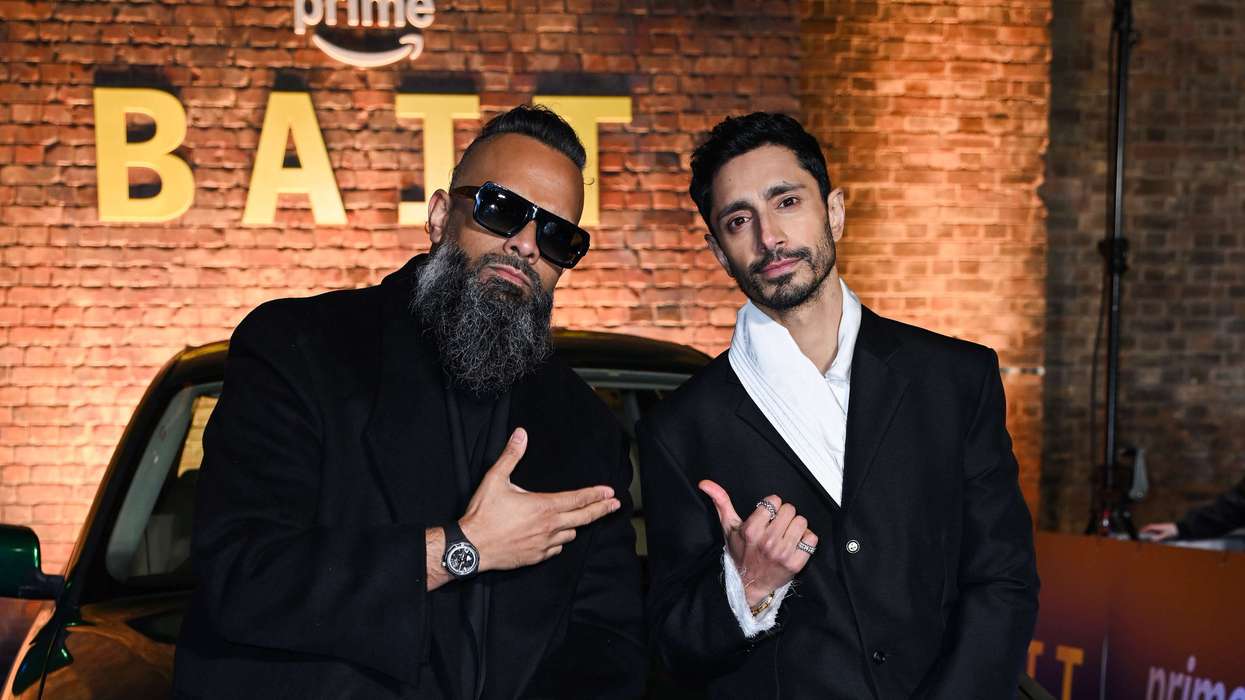

ACTOR and comedian Guz Khan said he and Riz Ahmed “took versions of how we talk to each other, joke with each other, treat each other as friends and brothers in real life” for their new show, Bait.
The six-part series, being shown on Amazon Prime, centres on what happens when an out of work actor (Ahmed) auditions for the role of James Bond.
Ahmed plays Shah Latif, a London-based south Asian actor, while Khan plays his cousin, Zulfi, an Uber driver. The cast also includes Sheeba Chadha as Latif’s mother, Sajid Husain as his father, as well as Aasiya Shah, Ritu Arya, Maxine Peak, Rafe Spall, Soni Razdan, Himesh Patel and Patrick Stewart.
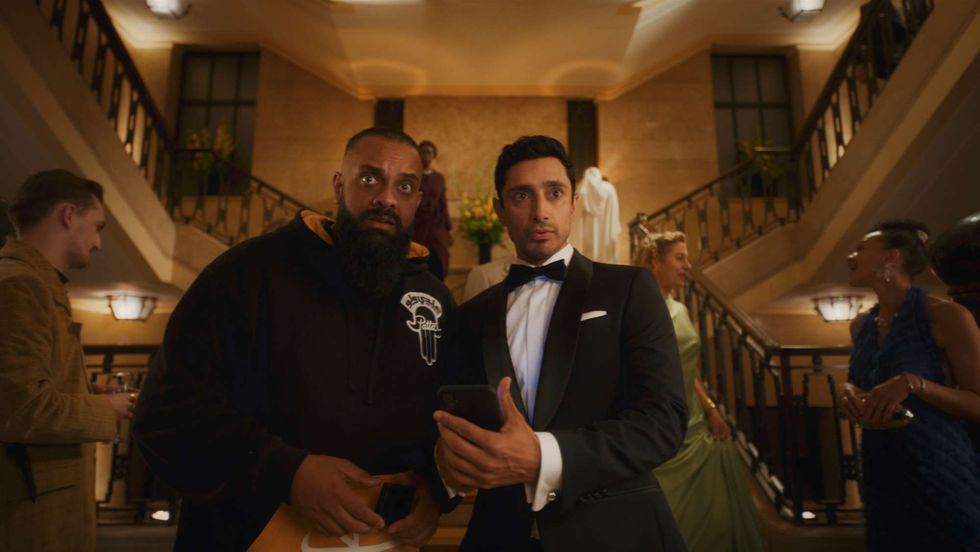 A still from Bait.Amazon MGM Studios
In an interview with Eastern Eye last month, Khan said, “I’d love to tell you that we had to spend hours and hours working on this relationship, lekin (but) me and Riz are good friends in real life.
“So we kind of took versions of how we talk to each other, joke with each other, treat each other as friends and brothers in real life, and brought that to screen. “(Director) Bassam Tariq really helped us hone what Zulfi and Shah should be like.”
Khan, who has known Ahmed for more than a decade, added, “When you come to a project, sometimes you worry about how’s this chemistry going to play out? But that’s one thing we never worried about.
“We knew that given just a short period of time, we could build a real friendship and a true brotherhood. Because most true brotherhoods in real life, it’s never, ‘I love you, you love me’. It’s got competition, it’s got little sprinkles of jealousy. It’s got points where people are competing, massively with each other.
“But there’s an undertone of love and care and worry and so, we hope people really enjoy it.”
Since its premiere at the end of March, Bait has been well received by critics and audiences alike, with its sardonic look at the life of an actor’s life over four days, intersecting with the south Asian immigrant experience in the UK, fame and the publicity machine – all seen through interpersonal relationships.
Khan recalled how Ahmed (who had been working on it for a few years) pitched the show to him. “It was something that was so unique, that I hadn’t heard, in terms of the scale he was going for, especially from a comedy.
“I’m just so happy, having now come to a point where people have seen it, it’s out in the world. People are enjoying it.
“And, not that we care too much about what reviewers say in that sense, because sometimes it’s positive, sometimes negative, everybody seems to really appreciate how much it has going for it.”
At the premiere of the show in London in March, Ahmed explained how the show (previously titled Quarterlife) came to be called Bait.
“I kept having to explain to the American team on the show that one of my favourite British slang words is bait… for being blatant and attention seeking. That’s what Shah is. Bait online means trolling someone.
“Bayt and Bayit/Beit means “home” in Arabic and Hebrew means home. In Urdu, it means loyalty or allegiance.
“And, of course, we see more and more as the show goes on, it means something used as part of a trap.”
Online trolling is one of the themes Bait touches upon, when Ahmed’s character is in the race to be the next Bond, with abusers focusing on his south Asian ethnicity.
Khan told Eastern Eye, “The show explores things that Shah is going through as a lead character, and Riz has dealt with it from a very early point of his career.
“I started 10 years ago. Riz has been doing this for two decades… from early 2000, post 9/11, all of the pressures that come with that. He went through a lot, and he’s explained a lot to me, which is incredible to see… what it would have been like being one of the only British Pakistani performers, British Pakistani Muslim performers.
“I tend to get ‘baited’ – to go with the title the show – a lot. I tend to express the way I feel, whether it be on my social media platforms, and tell people what I do think of them, if they’ve got something to say… they are trying to get a reaction out of you. But I also feel that authenticity is what people connect with.
“In a world where people are hiding behind a public version of themselves, I think Riz is a very astute guy. He kind of sees me as a person who speaks my mind. Sometimes that’s for the good, sometimes that’s for the very much worse, when I’ve been sacked from another job.
“Everybody has to navigate their own journey This show really showcases that.”
Bait’s writers include Ahmed as well as Indian Americans Prashanth Venkataramanujam, Azam Mahmood and Dipika Guha. British Asian writer Nikesh Shukla, whose collection of essays, The Good Immigrant (2016), featured one by Ahmed, also receives a consulting producer credit on Bait.
Khan said, “Our British Asian experience is very different, for example, to the desi American experience. These diasporas are very different. And I feel like the more stories that are told, the better.
“I’m biased; I think we have the best sense of humour here in Britain… our sense of humour translates really well across the world. So hopefully people look forward to it. Hopefully this show allows a whole new genre of young creatives in this country and beyond to say, ‘Yo, we’ve got a voice’.
“I hope people enjoy Bait as the experience that it is. It’s unlike any other comedy or drama you might have seen. It’s Riz Ahmed’s own hybrid of these things; Bait epitomises his skill set. So I hope people enjoy it.”
Bait is streaming on Amazon Prime