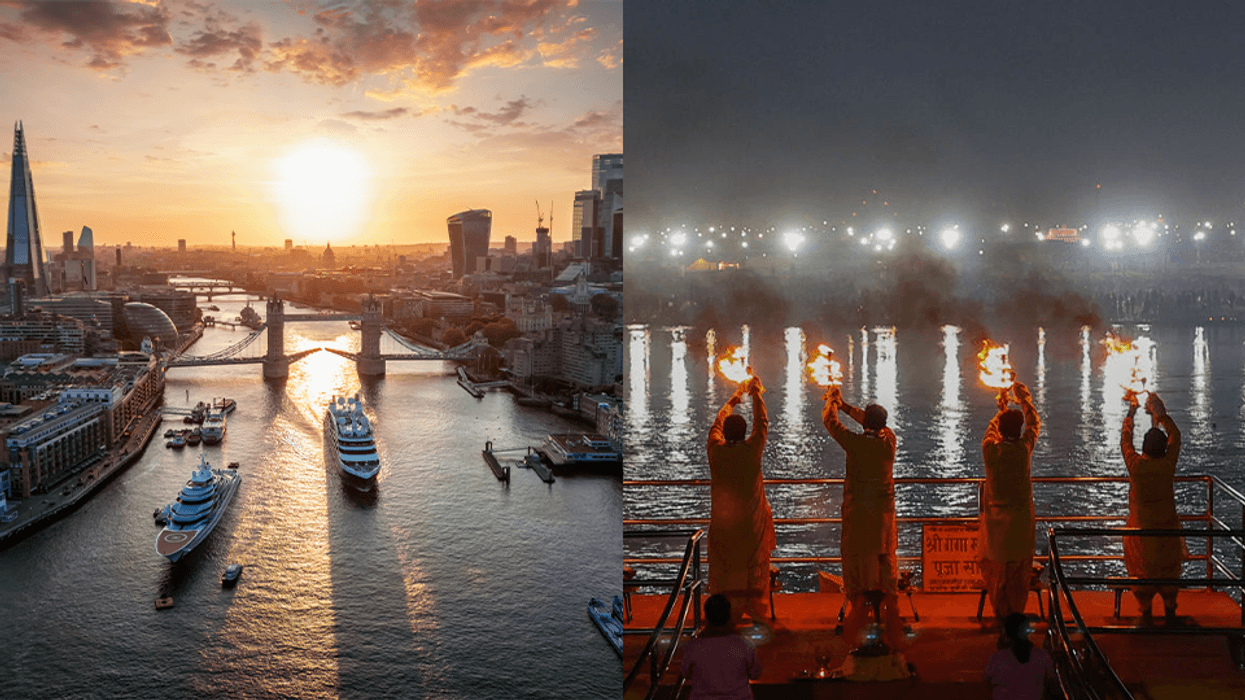

- Ganga Aarti comes to the Thames on 13 September in Greenwich.
- The ceremony is rooted in gratitude, prayer and reverence for nature.
- The Ganga and Thames connect heritage, memory and a sense of home.
- Thousands are expected to gather for the Ceremony of Light.
- The event brings an ancient tradition into a distinctly London setting.
For generations, the Ganga has been much more than a river. She is revered as a mother, a source of life and a sacred presence, woven into Hindu traditions, pilgrimage, prayer and family memory. Along her banks, people gather to offer lamps, sing devotional songs and express gratitude for the river and the natural world.
On 13 September, that ancient tradition will find a new setting on the banks of the Thames, which will be attended by Swami Chidanand Saraswati, president and spiritual head of Parmarth Niketan Ashram and Sadhvi Bhagwati as special guests.
At the historic Old Royal Naval College in Greenwich, thousands are expected to gather for Ganga Aarti on the Thames: A Ceremony of Light, presented by Chinmaya Mission UK in collaboration with Totally Thames. The event will be one of the largest Ganga Aarti ceremonies held in the UK.
Previously, on May 29, 2026, Swami Chidanand Saraswati led the evening Ganga Aarti in Rishikesh in the presence of BJP national president Nitin Nabin and Uttarakhand chief minister Pushkar Singh Dhami. The gathering also drew several senior religious leaders, including Juna Akhara Mahamandaleshwar Swami Avdheshanand Giri, Niranjani Akhara Mahamandaleshwar Kailashanand Giri, and Akhil Bharatiya Akhara Parishad president Mahant Ravindra Puri, alongside other politicians.
Welcoming the dignitaries, Swami Chidanand Saraswati used the occasion to highlight Ganga conservation, environmental protection and service to humanity, describing Uttarakhand as a "land of divinity, discipline, and spiritual confluence" and praising CM Dhami's leadership in the state.
But the significance of the evening goes beyond the visual beauty of illuminated lamps beside the river. It raises a simple but profound question: What does it mean to honour the spirit of the Ganga beside the Thames?
Why Ganga Aarti is performed
Ganga Aarti is a traditional Hindu ceremony centred on the offering of light. During the ritual, large multi-tiered oil lamps are raised towards the river as prayers, music and chanting accompany the ceremony.
The gesture is one of gratitude.
The river is understood not merely as water flowing through a landscape, but as a giver of life. The ceremony acknowledges the forces of nature that sustain human existence and expresses reverence for something larger than the individual.
The Ganga carries particular spiritual significance in Hinduism. She is associated with purity, renewal and the flow of life. For generations, her banks have been places of pilgrimage, worship, remembrance and celebration.
Yet the central idea behind Ganga Aarti, gratitude towards nature, is not limited to one river or one country.
That is what gives the Thames ceremony its meaning.
When two rivers meet
The Ganga and the Thames could hardly seem more different.
One flows through the heart of the Indian subcontinent and has been central to Hindu civilisation for thousands of years. The other winds through London, passing historic landmarks and becoming part of the everyday landscape of one of the world's great cities.
Yet rivers share something fundamental: they connect people to place.
The Thames is part of London's identity. It has witnessed generations of migration, change and renewal. For many families living in Britain, the river has become part of the landscape of everyday life—just as the Ganga remains embedded in memories of India.
Bringing Ganga Aarti to the Thames therefore creates a meeting point between two worlds.
It is not an attempt to recreate Varanasi or Haridwar in London. Nor is the Thames being presented as a replacement for the Ganga. Instead, the ceremony carries the idea behind Ganga Aarti to another river: that water, nature and the environment deserve gratitude and respect wherever we encounter them.
That principle is reflected in an important detail of the event. Nothing from the ceremony will be placed into or released into the Thames. The lamps will be held ceremonially towards the river, allowing the ritual to take place without compromising the waterway.
A living tradition in a London landscape
The setting adds another layer to the ceremony.
The Old Royal Naval College is one of London's most recognisable historic sites. Against its architecture and the Thames, the glow of traditional lamps will create a striking meeting of Indian heritage and British surroundings.
There will also be cultural performances, live music and activities designed to explain the meaning of the Aarti before the main Ceremony of Light at 7:15 pm.
The occasion forms part of global celebrations marking 75 years of Chinmaya Mission, honouring the work of its founder, Swami Chinmayananda. His teachings helped bring Vedanta—the philosophical tradition of Hindu thought—to audiences around the world.
In that sense, the river becomes a fitting metaphor. Water flows across boundaries, just as ideas, traditions and stories travel from one generation and one country to another.
As the lamps are raised towards the Thames at dusk, the ceremony will bring an ancient Indian tradition into a distinctly London setting.
The Ganga will be present through its symbolism, memory and spiritual meaning. The Thames will be present as the river beside which the ceremony unfolds.
The Ganga Aarti at Parmarth Niketan, Rishikesh, led nightly by Swami Chidanand Saraswati since 1997, has drawn prominent visitors over the years, though not at a single gathering. Then-Prince Charles and Camilla attended in 2013 during their royal tour of India.
India's business tycoon Ambani family, Anant Ambani, Radhika Merchant, Akash Ambani and Shloka Mehta, took part in May 2025. Bollywood actors Sanskruti Jayana and Siddharth Gupta attended in May 2026.




 Ambaji DhajaMahesh Liloriya