
How did an ordinary Indian boy, born into a Parsi family in Zanzibar and brought up at school in Bombay, become a global superstar?
Farrokh Bulsara’s transformation into Freddie Mercury, singer, songwriter and frontman of the rock band Queen, is told in a new exhibition at the V&A in London.
Freddie Mercury: Splendid Things, being held to celebrate the showman’s 80th birth anniversary, has tried to reflect his career through seven of his outfits.
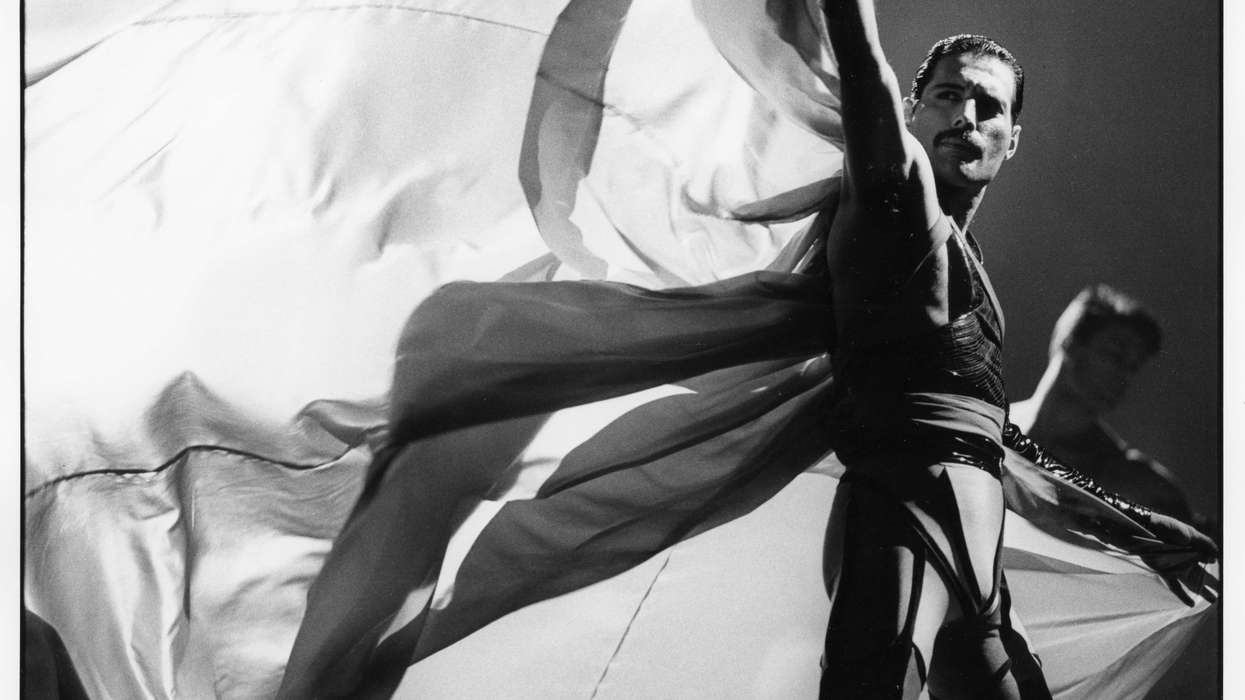
 Freddie Mercury in the Made in Heaven music videoSimon Fowler © Mercury Songs Ltd
They are scattered across the V&A as though in a treasure hunt which visitors can follow free of charge.
To be sure, he was flamboyant but the exhibition shows there was also a thoughtful, contemplative side to his personality.
Farrokh Bulsara was born on 5 September 1946 to Indian parents in Stone Town in the British protectorate of Zanzibar (now part of Tanzania), in East Africa. He died on 24 November 1991 at the age of 45 at his home, Garden Lodge, in Kensington. In accordance with his wishes, he was given a Zoroastrian funeral.
The seven outfits are on loan from Mary Austin, his former fiancée, close friend and confidante of 20 years. The trail inside the V&A has been developed with her cooperation.
Kate Bailey, senior curator of theatre and performance at the V&A, summed up: “We are thrilled to display Freddie’s most iconic costumes at the V&A, celebrating one of greatest performers and songwriters of all time. Reflecting his love of ‘splendid things’ and his passion for art, design and fashion, Freddie is very much at home in the V&A galleries. Each stop on the trail speaks to a different side of his multi-disciplinary creativity, inviting visitors to see these remarkable costumes up close, and to consider the artistic and cultural impact of Freddie’s life and work.”
Before the exhibition opened to the public last Thursday (22), she took journalists on a tour of the exhibition.
She began by saying: “I’m going to take you on the Freddie Mercury: Splendid Things trail, which is a celebration marking 80 years since Freddie's birth. We’re showcasing the iconic looks, seven that are on loan from Mary Austin, selected from across Freddie’s career, which speak to his interdisciplinary creativity, and we hope that contextualising Freddie in the V&A in this way in the galleries allows visitors to see these iconic costumes up close, but also to consider the cultural impact of his legacy and his art.”
She went on: “It’s playful, it’s cheeky, it’s a bit mischievous, but at the same time, there’s a seriousness to Freddie’s artistic interests and sensibilities that we play to through the positioning of these costumes, from Victorian paintings through to Greek gods. It’s been created with a theatre design team: Tom Piper, who’s a theatre designer, works in exhibitions but also on the stage; Lucy Record, who’s a lighting designer; and Gareth Fry, who’s a sound designer.
“So together with our mix of curatorial teams, we’ve staged Freddie in a very unique way in the V&A, alongside a special, unique reimagining of Bohemian Rhapsody, which you will see in our Tapestry Gallery. So, really, from a curatorial point of view, it’s been listening to Freddie’s voice, his words, his life, seeing these costumes, but considering the charisma, the flamboyance, but also the personal side of Freddie, and the incredible archives of photography and film that really helped us contextualise Freddie in these spaces at the V&A.
“We’re in the heart of Kensington, so I like to think of the V&A being like an epicentre of Freddie’s creativity. So whether it’s from Biba to Kensington Market to his home at Garden Lodge, to Imperial College, we’re at hub of many routes that Freddie would have passed through.”
She said: “So before I take you on the trail, I just want to have a moment to remember Freddie before being this global megastar. So Farrokh Bulsara was born on the 5th of September 1946 in Zanzibar, to Parsi Zoroastrian parents. His early school days in India saw initial explorations of his talent, taking piano lessons, joining the first band, and adopting the Freddie moniker. The story then of the family moving to the UK and fleeing the violent unrest of the Zanzibar Revolution feels important to remember here at the V&A. Also, his roots as a student of arts and design at Ealing College, where he would experiment with his style and meet Mary Austin, who would become his fiancée, lifelong friend, and confidant,
“But also, just remembering that moment of South Kensington Exhibition Road alchemy of the band coming together with the performances and the rehearsals at Imperial College, that coming together of science and art. So, from Zanzibar to the biggest stages on earth, join me on this trail, surrounded by many splendid things, to celebrate one of the world’s most beloved performers and songwriters.
“And I guess something that’s been echoing in my head as I’ve been creating the trail, are Freddie words that ‘you can do what you want with my music, but don’t make me boring’.”
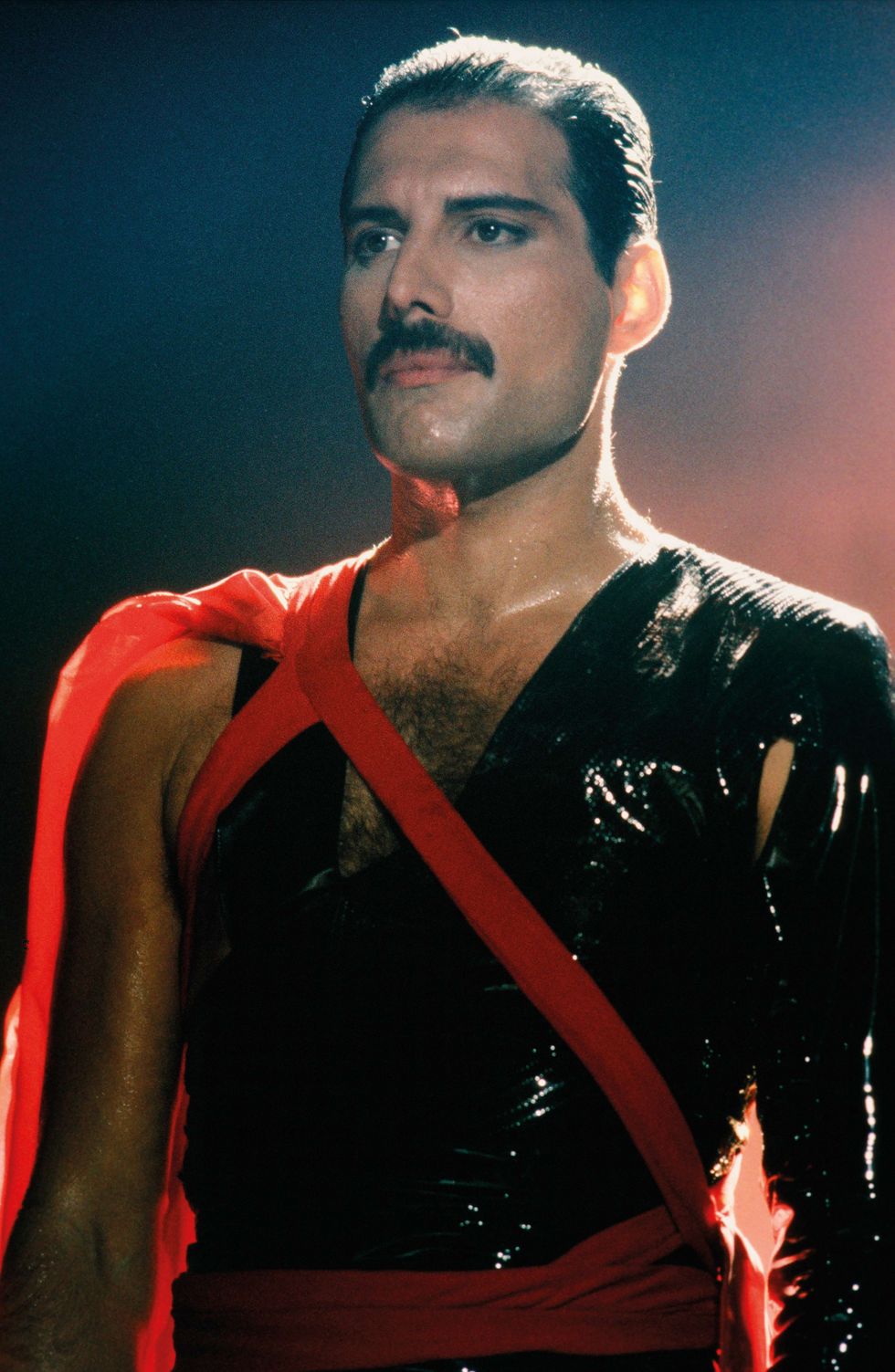
First stop was the paintings gallery featuring a monochrome two-piece worn by Mercury at an early Queen show at Imperial College.
The outfit was close to paintings by John Constable and J W M Turner.
Bailey pointed out “the William Blake painting behind you. There’s also a (Sir Edward) Burne-Jones piano and a (Dante Gabriel) Rossetti. It really speaks to the wider artistic inspirations of Freddie, but in itself, it’s a wonderful glam costume. This look reflects Freddie’s early experimentation with stage wear, identity and image making.”
Next stop was the Tapestry Room which displayed the white Mercury Wing catsuit and bolero ensemble from 1975, inspired by the Gods, Mercury and Hermes.
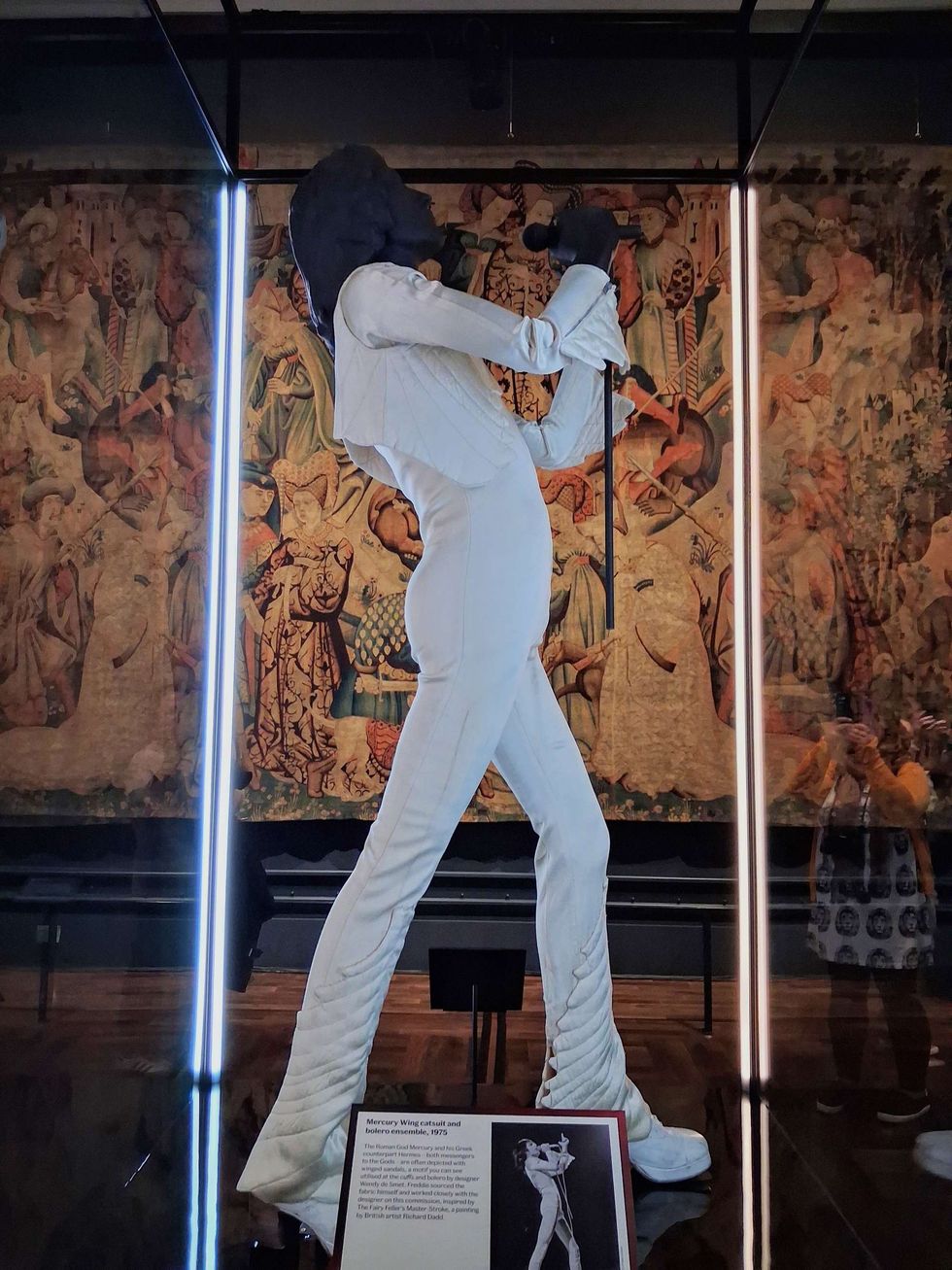 Mercury Wing Catsuit and bolero ensemble (1975)Amit Roy
Mercury handed over the Lycra fabric to the designer Wendy de Smet and worked closely with her.
Next to it was the “Black Spine suit” or the “Black Queen suit”, also from 1975, with the designer, who was present, looking on.
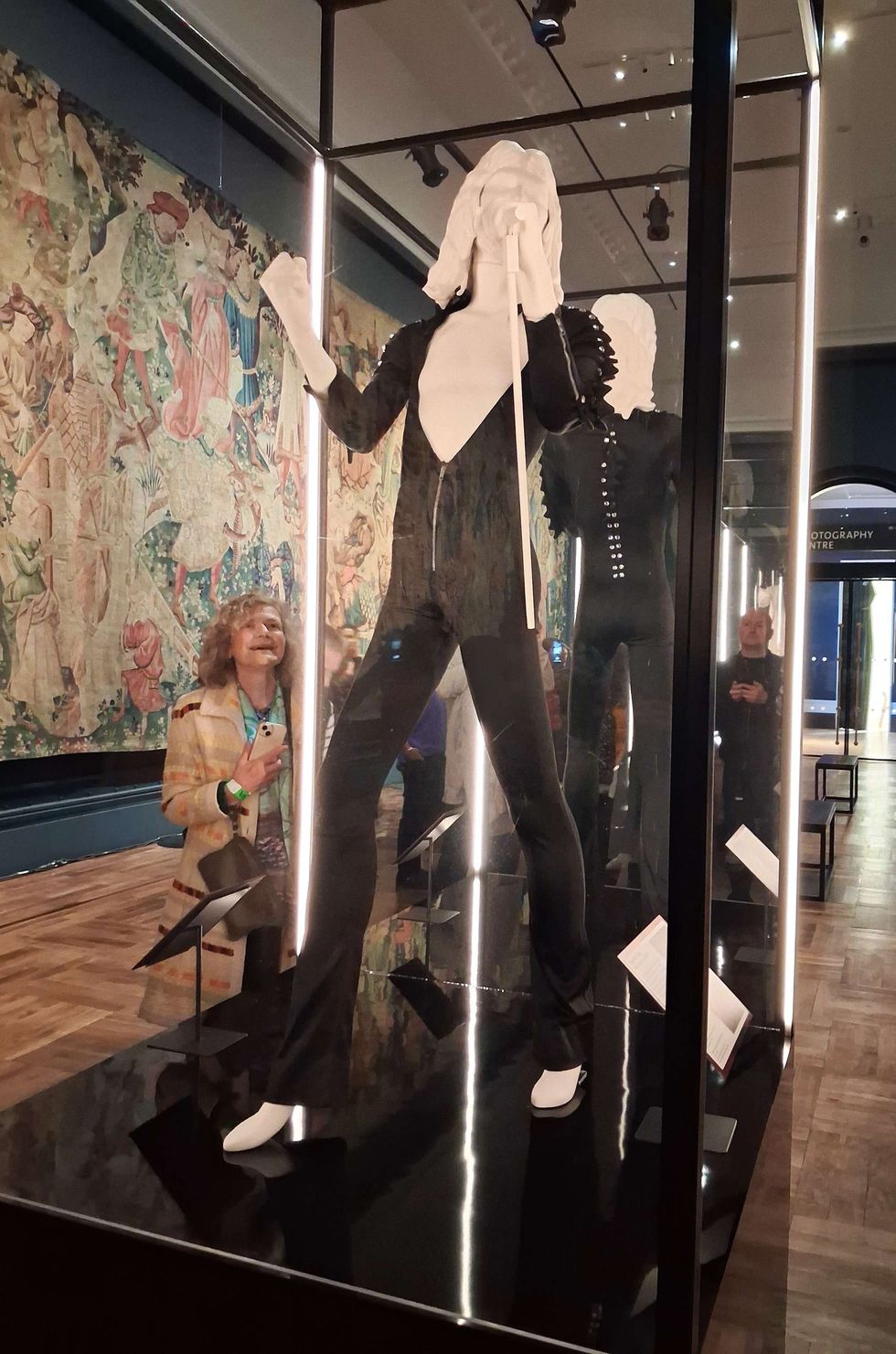 Designer Wendy de Smet with the spine suit or the Black Queen suit from 1975 Amit Roy
Bailey said: “We have a very unique reimagining of Bohemian Rhapsody. So this display of costumes from Night of the Opera and Bohemian Rhapsody is presented in our galleries, which have really, really important mediaeval and Renaissance works, which speak to Freddie’s love of textiles and storytelling. When you’re in the space and looking at the masterpieces created by Wendy and listening to the music, the scenes that surround you are good and evil. There’s triumph over fate and death at the end.
“Creating a masterpiece is a unique spatial audio remix created with Gareth Fry and Sony and the Queen band to convey a magical sonic journey through the song alongside the costumes. It’s six minutes, the whole song. It’s going to get very loud. We’ve pushed the decibel levels as loud as you can go in the gallery.”
Mercury worked closely with the designer, who said the singer was inspired by Richard Dadd’s painting, The Fairy Feller’s Master-Stroke, which was done while the artist was incarcerated in the state criminal lunatic asylum of Bethlem Royal Hospital, where he was confined after he murdered his father in 1843.
Wendy de Smet told Eastern Eye: “He just gave me the fabrics and said, ‘I’ve got this idea. I’m inspired by Richard Dadd’s painting. I want to look like these creatures and fairies, good and evil.’ He stuck on all the jewels in the embellishment. He said he wanted to be able to move around, jump round. The fabric was Lycra. I was quite nervous when I made the costumes that he might split them because during the fittings he wanted them tighter. So I had to stitch the seams really loads of times.
“Looking back 50 years later, I can’t believe I made those when I was 23 with a little toddler in tow. We worked really well together because we understood each other.”
She laughed as she remembered: “He used to come on at the end, and sing, ‘God Save the Queen’. He was so brazen.”
Bailey moved on to the third stop on the tour by a large window at the end of the Leighton Corridor, where the Made in Heaven music video costume, designed by Diana Moseley, from 1985 was silhouetted in the autumn sunshine.
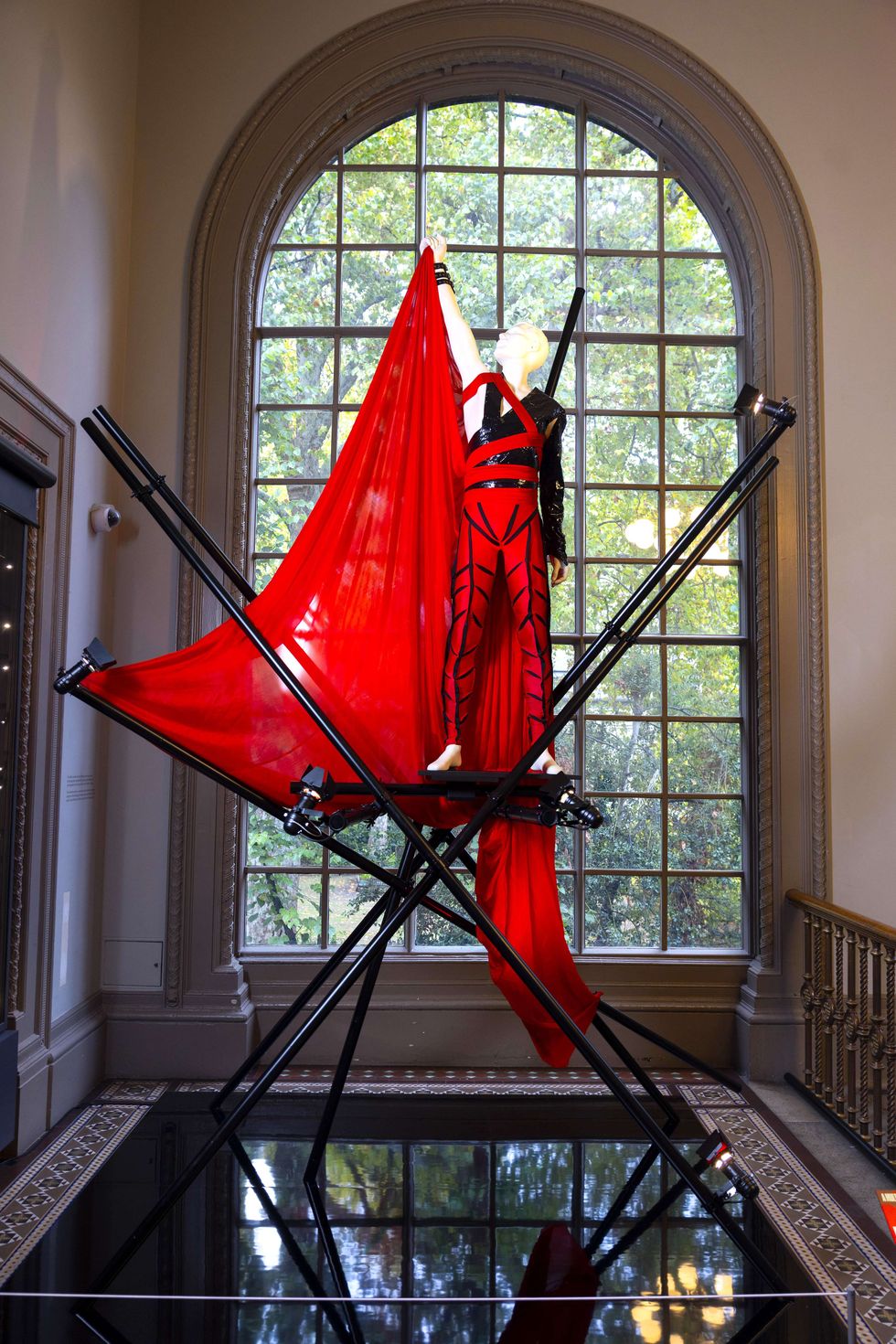 Made in Heaven music video costume (1985) David Parry/V&A
She commented: “We’re here looking at Freddie as a real lover of all performance disciplines. His love of ballet, of opera, which leads him to work with Diana Mosley to create this incredible costume. She created an extra 40 for all the ballet dancers on the set.
“We’ve staged it in an installation that responds to the music video, Dante’s Inferno and the Divine Comedy, and the Rite of Spring, all those great influences on Freddie. The costume is remarkable. We were delighted that it was in such fantastic condition. It speaks to him as being at the cusp of the music video world, his sense of image making that you see early on in the first Queen costumes, but really magnified here to superhero level, I think, is exciting. Mary Austin was here last night and remembered going frequently to the Royal Opera
House to see Montserrat (Caballé, a world-famous Spanish operatic soprano whom Freddie admired and with whom he later collaborated).”
The fourth stop in the Japanese room featured a jacket from the early 1970s and a kimono, both from Mercury’s private wardrobe. He had an appreciation for Japanese culture and design even before the band first visited the country in 1975. He acquired a great many kimonos during his visits, some of which were worn on stage.
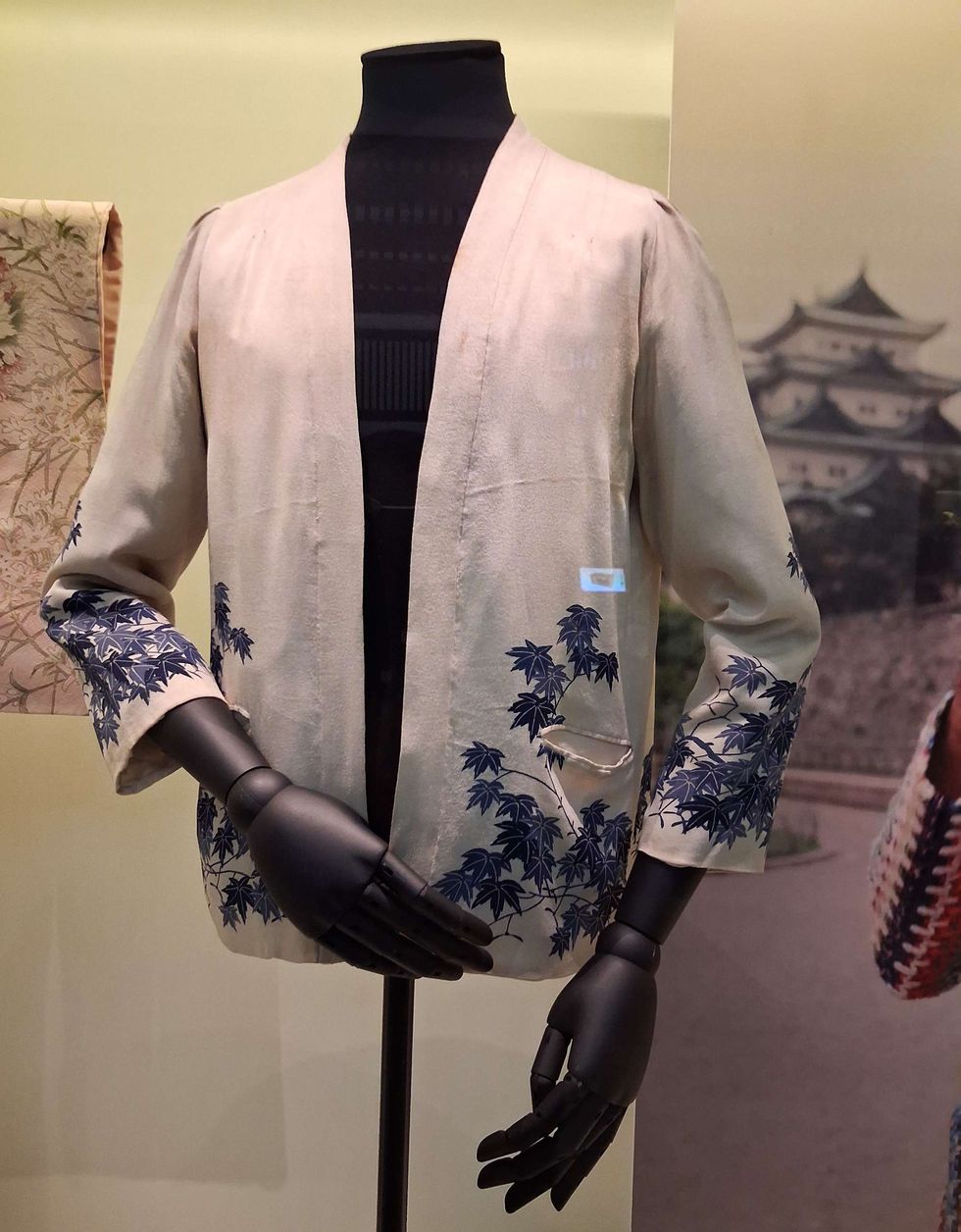 Japanese jacket (early 1970s)Amit Roy
“By Freddie’s late teens, he’d actually lived in three different continents, and already travelled the world, and got a massive passion already by the ’70s for Japanese art and culture,” said Bailey. “Initially, we thought that his Japanese interest had begun from performing there in ’75, but actually his love of Japan started far before that. And what we see here is the kimono jacket, which is likely to have been brought at Kensington Market.
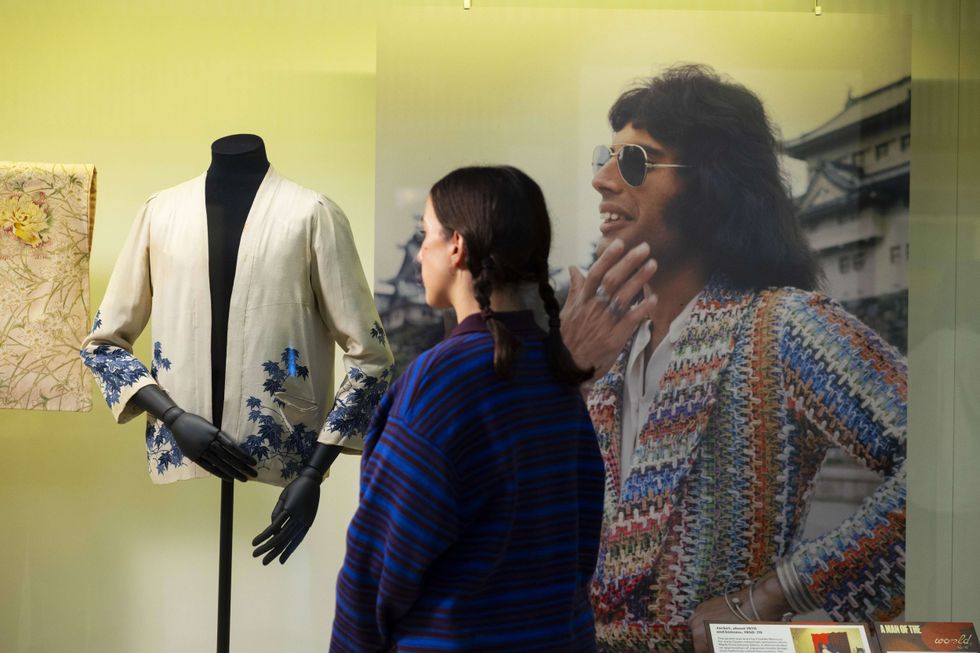 Japanese jacket (early 1970s) and kimono (1950-70) David Parry/ V&A
“That’s Freddie's kimono – he had an extensive collection of kimonos – and that’s something which he probably got from Kensington Market. We have a really significant collection of Japanese art, and Freddie’s collection was extensive as well. He had collections of woodblock prints, of lacquer, of objects that really speak to many things in this space. If you were to be at Garden Lodge, you would see his lacquer boxes or the woodblock art. Freddie Mercury deeply loved Japanese culture, art, and people”
This inspired him to write and record the song La Japonaise for his 1988 collaborative album Barcelona with Montserrat Caballé.
The fifth stop featured the Flash Gordon ensemble and half mic from 1980, from Queen’s soundtrack album created for the film of the same name. The ensemble is shown on a balcony originating from the Palazzo Pola in Treviso, Italy.
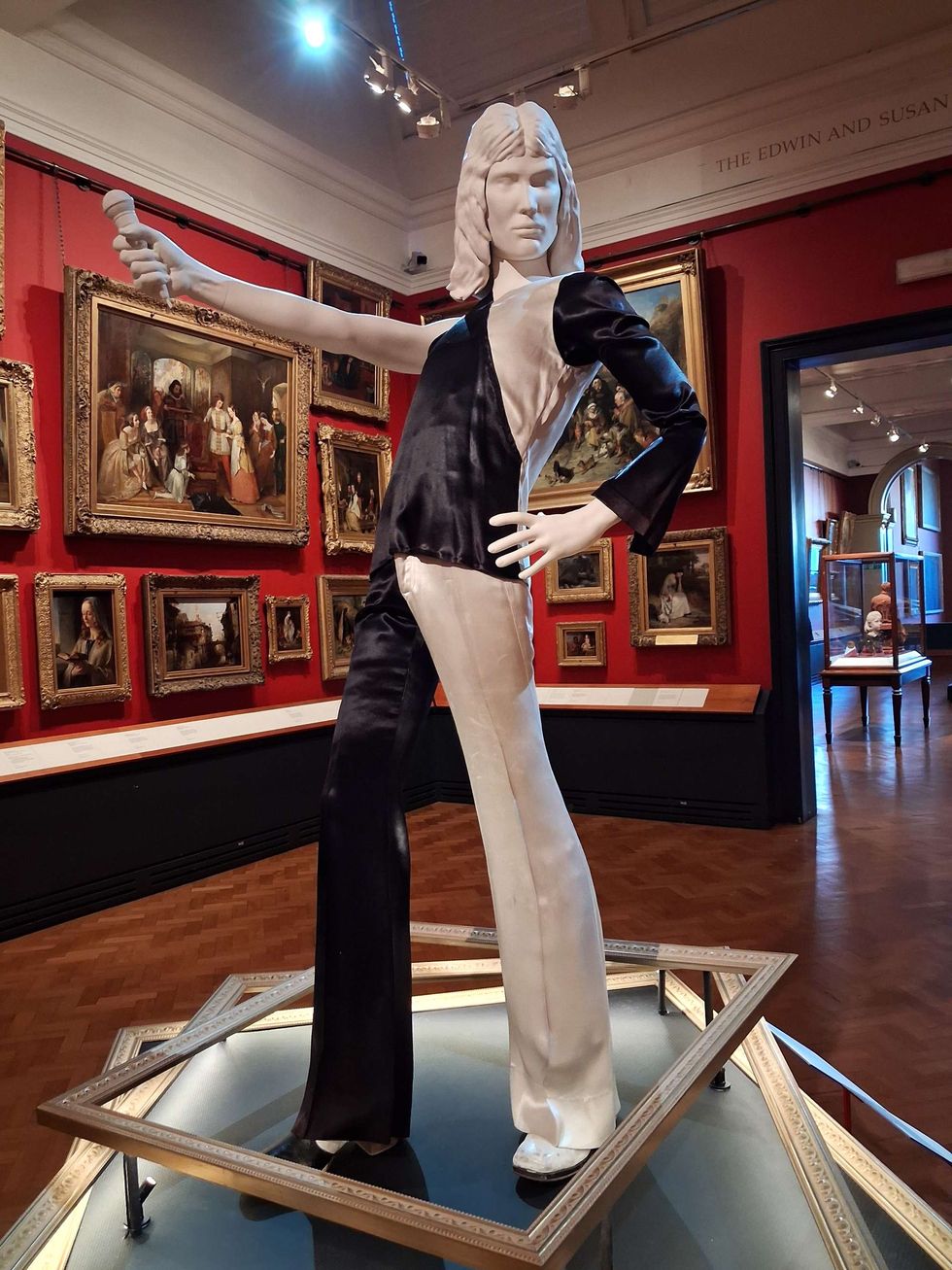 Ensemble worn for Imperial College gig in 1973Amit Roy
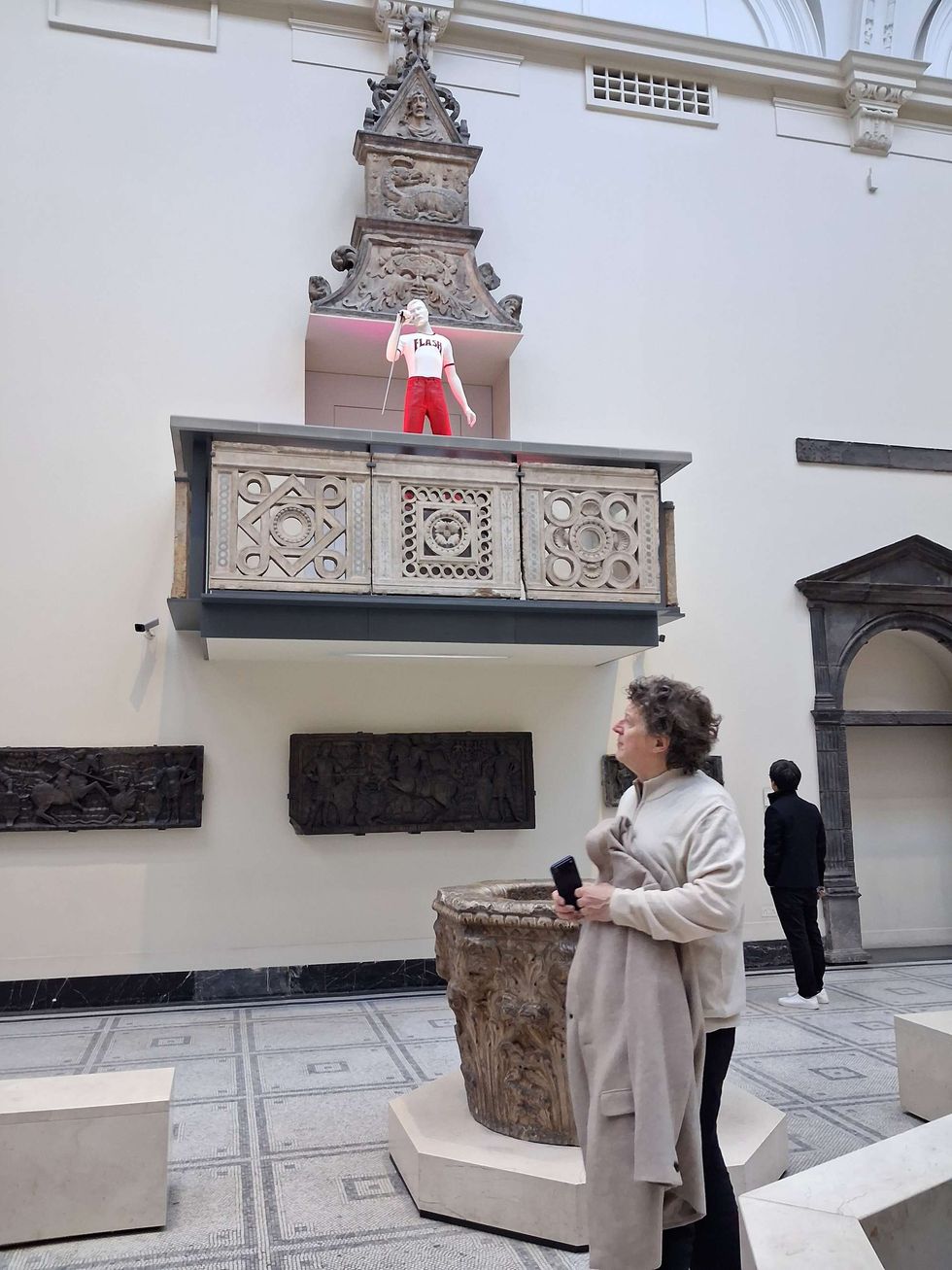 Flash ensemble and half mic (Flash Gordon 1980)Amit Roy
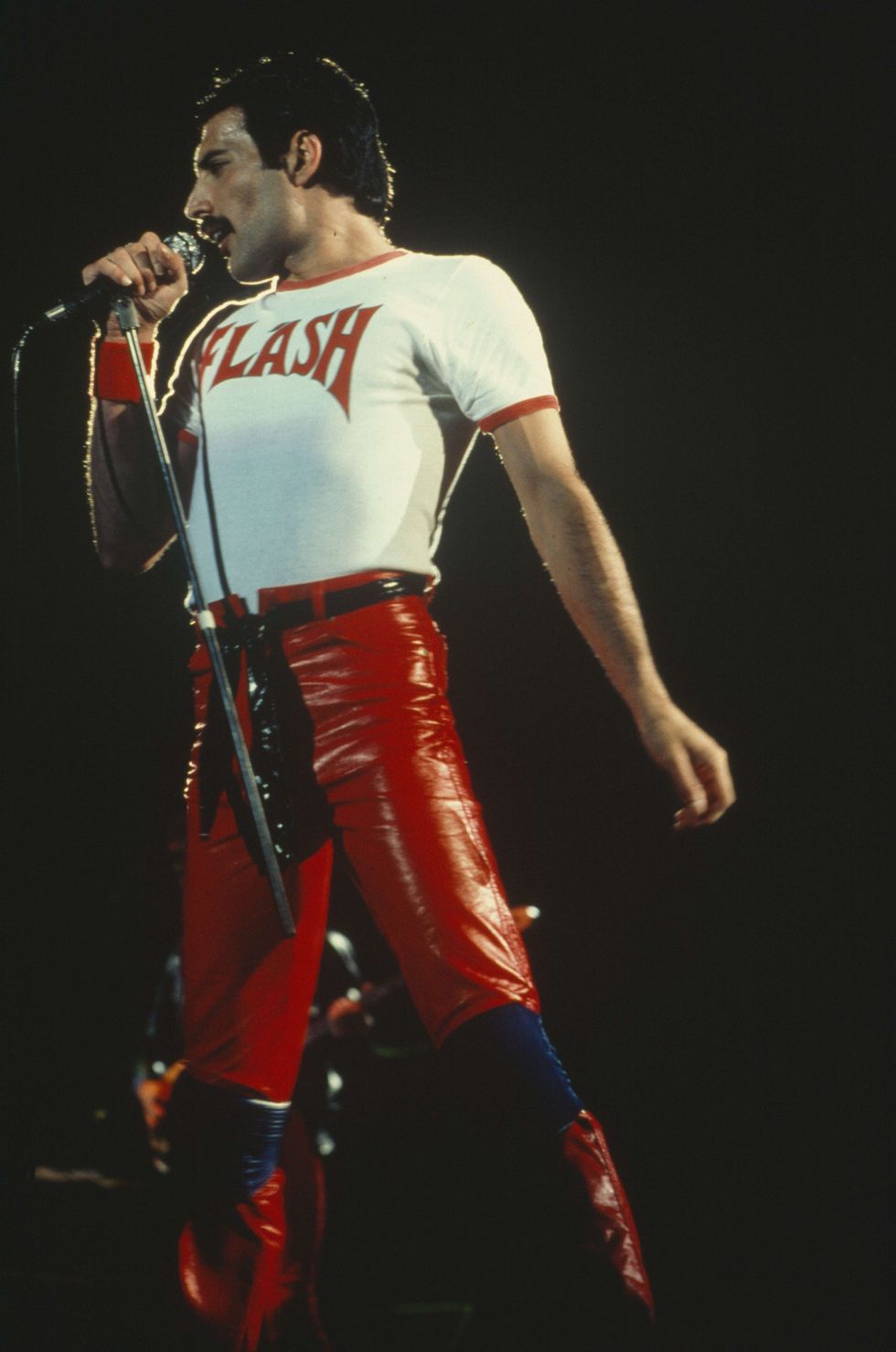 Freddie Mercury performs wearing a 'Flash' t-shirt at Sports Arena in San Diego, California, United States, on 5th July 1980David TanShinko Music/Getty Images
“This splendid balcony was intended to show the kind of flamboyance of families in Italy at the time,” said Bailey. “We’re here thinking of Freddie as the showman.”
The final stop featured the regal cloak and crown ensemble for the Magic Tour of 1986. “He had commissioned the pieces from Diana Moseley, and was expressly looking for a costume that would finish off the shows in grandiose fashion and encapsulate his theatricality and humour. It was worn on his last performance in Knebworth Park in Stevenage.”
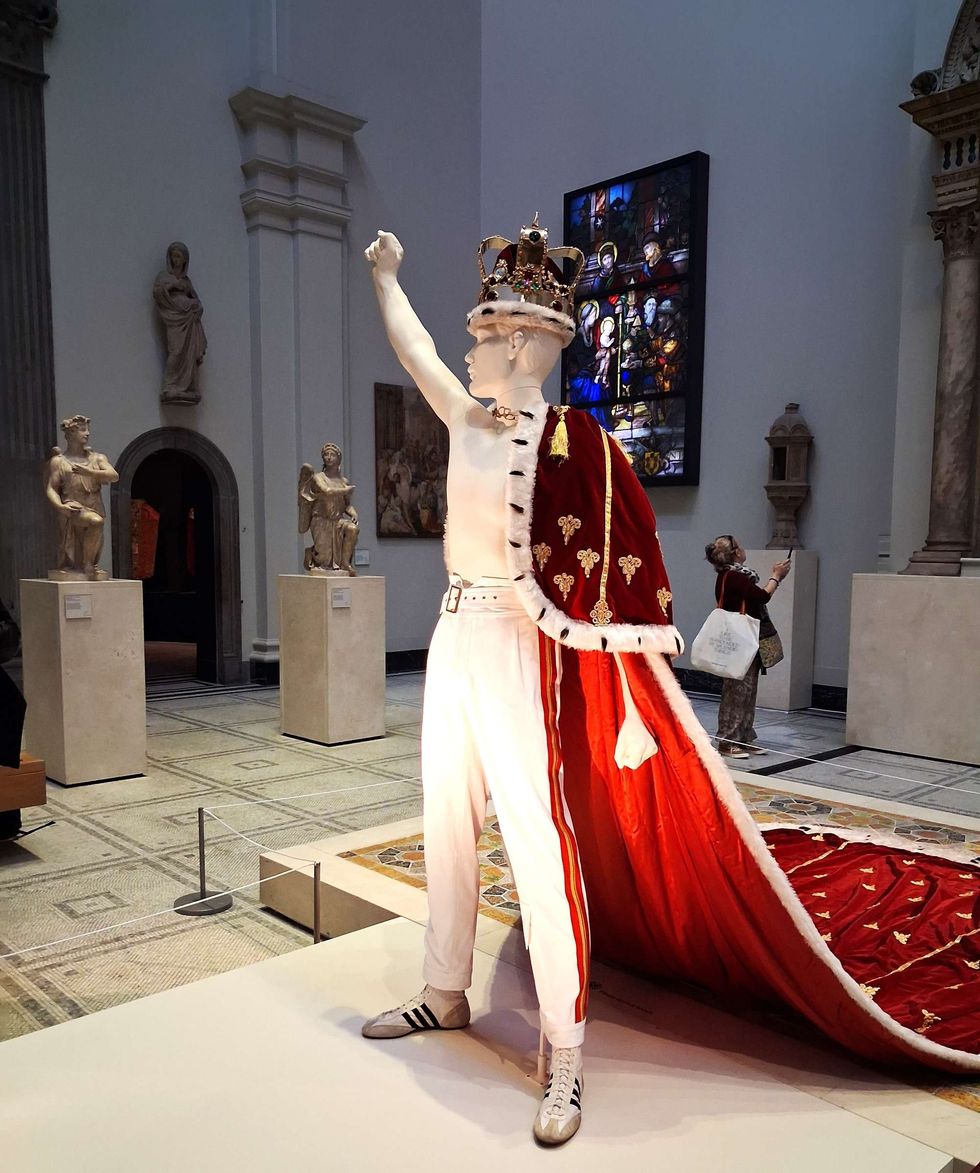 Cloal and crown ensembleAmit Roy
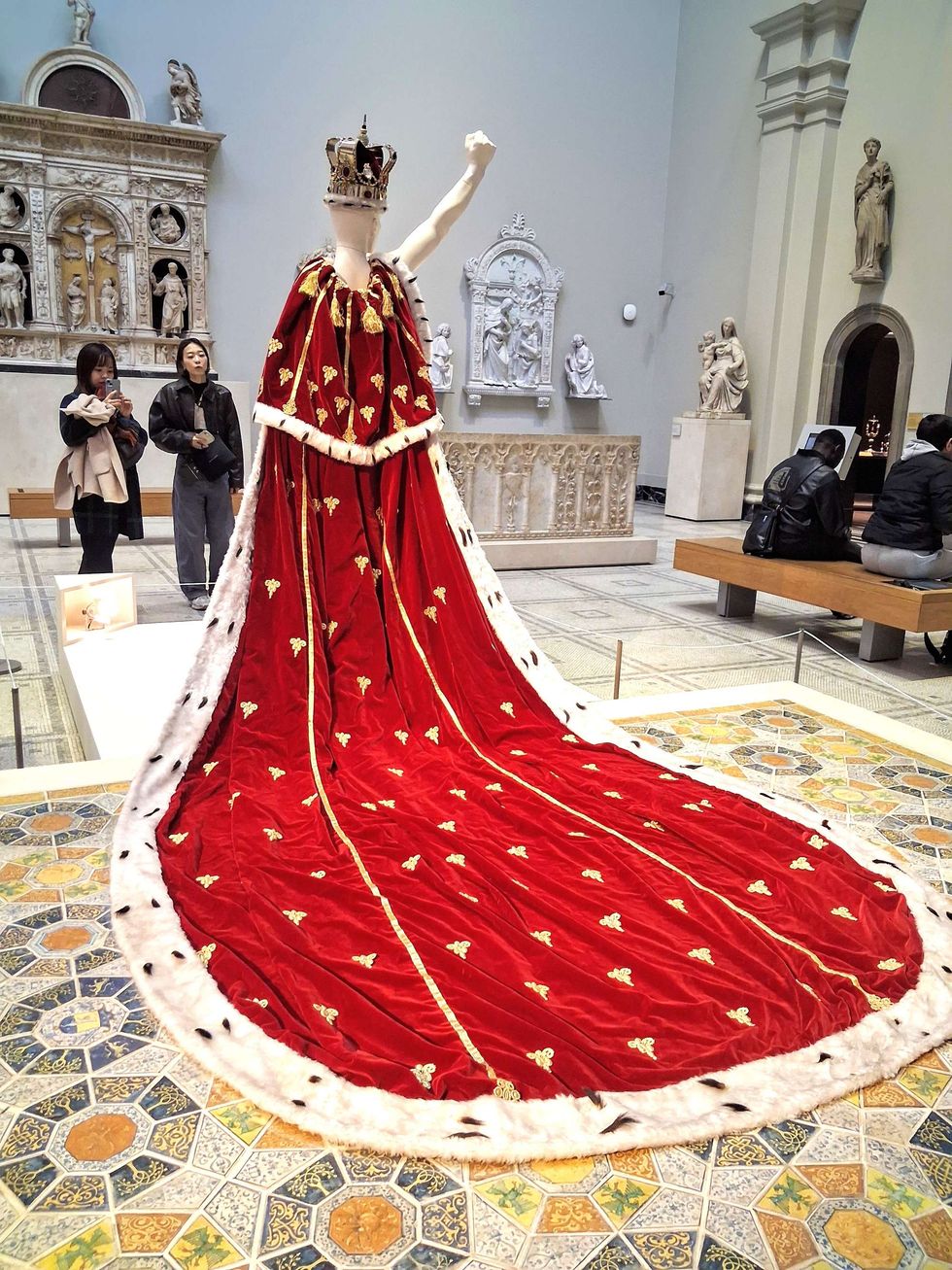 Cloak and crown ensemble (1986)Amit Roy
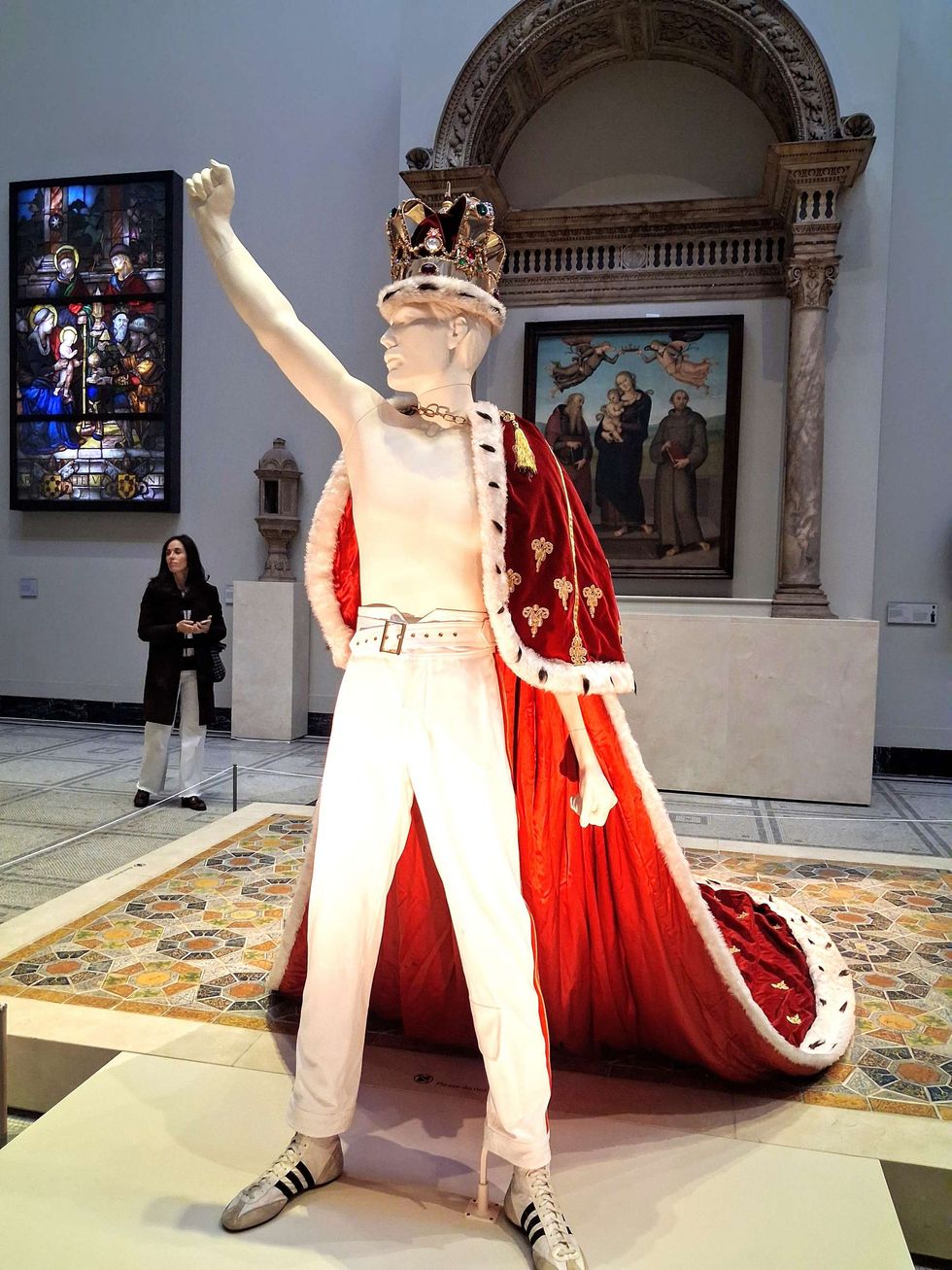 Cloak and crown ensemble (1986)Amit Roy
Bailey recalled something Freddie had said: “If I’m dead and I want to be buried with all my treasures, like Tutankhamun, I’ll do it. If I want a pyramid in Kensington, and I can afford it, I’ll have it. Wouldn’t that be fab?”
He had also said: “I won’t be a rock star. I will be a legend.”
Mary Austin is quoted in the book, Freddie Mercury: A Life in Lyrics, published by HarperCollins, in which she said that the striking costumes were an integral and carefully considered part of the singer’s stage persona: “As the records became more successful and the response grew stronger, his confidence deepened and his performance settled. What I saw now was an artist continuously developing while the seed of who he was stayed intact. The clothes were part of that exploration. Freddie understood early on that he wasn’t just wearing clothes; he was providing an image to match the scale of the space and the vastness of the crowd. He was there to entertain, and everything about what he wore fed into that.”
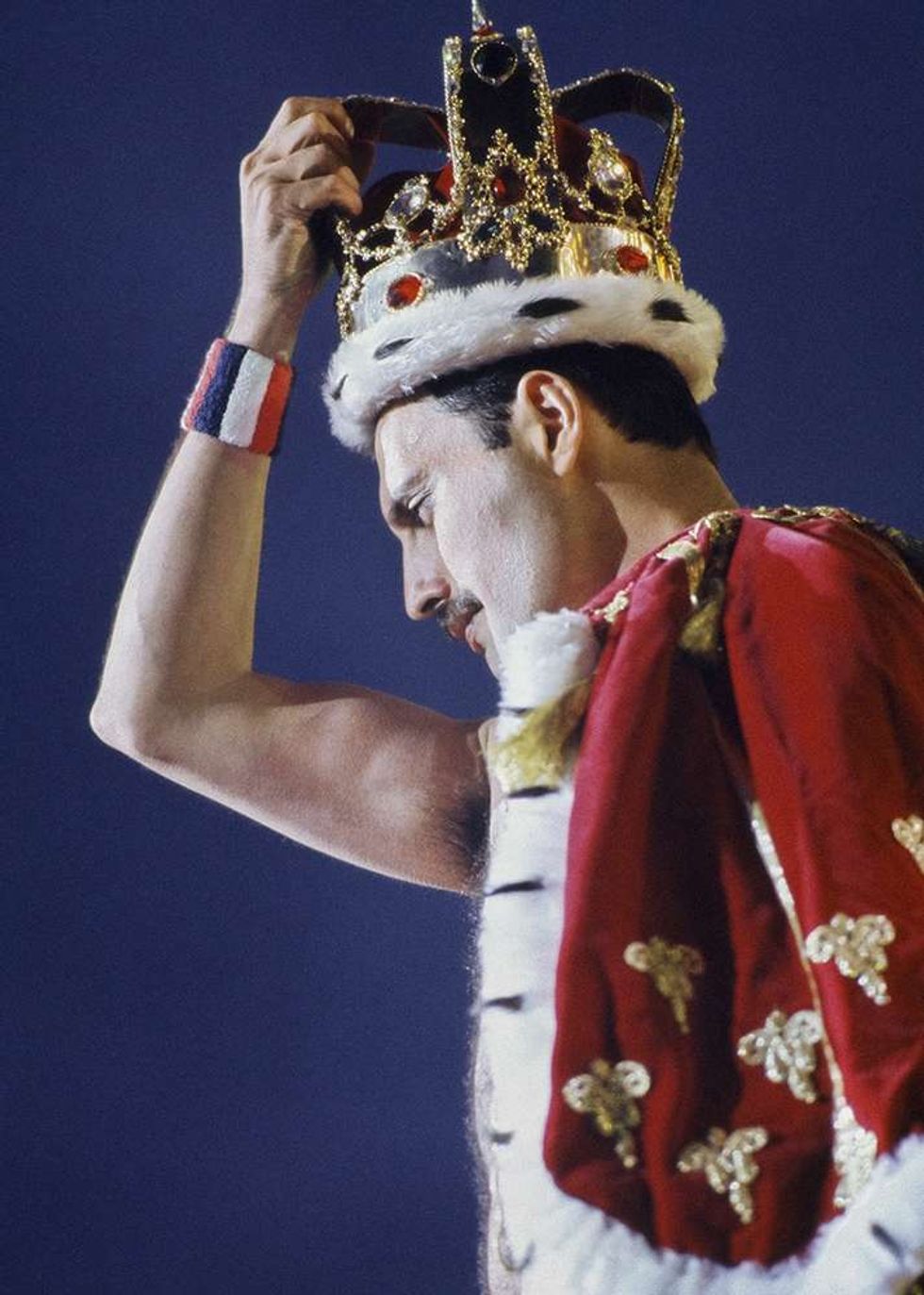 Freddie Mercury, Magic Tour (1986) Denis O’Regan
She added: “As we celebrate Freddie’s legacy in what would have been his 80th year, the clothes and costumes to be displayed at the V&A tell a hugely important part of his story both on and off the stage. Never mere accoutrements, his costumes and clothes were essential to his performances, creative vision, and wider self-expression, carefully designed to create a lasting visual and emotional impact that has reached across the generations and still reverberates today.”
Records show the young Farrokh Bulsara and his sister Kashmira grew up in the old Bombay when his parents moved to India from Zanzibar. In 1954, at the age of eight, Farrokh was sent to study at St Peter’s School, a boys’ boarding school in Panchgani near Bombay. It was here he started being called “Freddie”, a name that he either adopted or was used by fellow pupils.
At the age of 12, he formed a school band, the Hectics, and covered rock and roll artists such as Cliff Richard and Little Richard.
He also attended St Mary’s School in Bombay before moving back to Zanzibar where his parents had returned. But the following year, riots and revolution forced the family to flee to England where they took a small house at 22 Gladstone Avenue, Feltham, Middlesex, not far from Heathrow. The property now has a blue plaque erected by English Heritage in honour of Mercury.
Freddie Mercury: Splendid Things can be seen free of charge at the V&A until Sunday, 17 January 2027