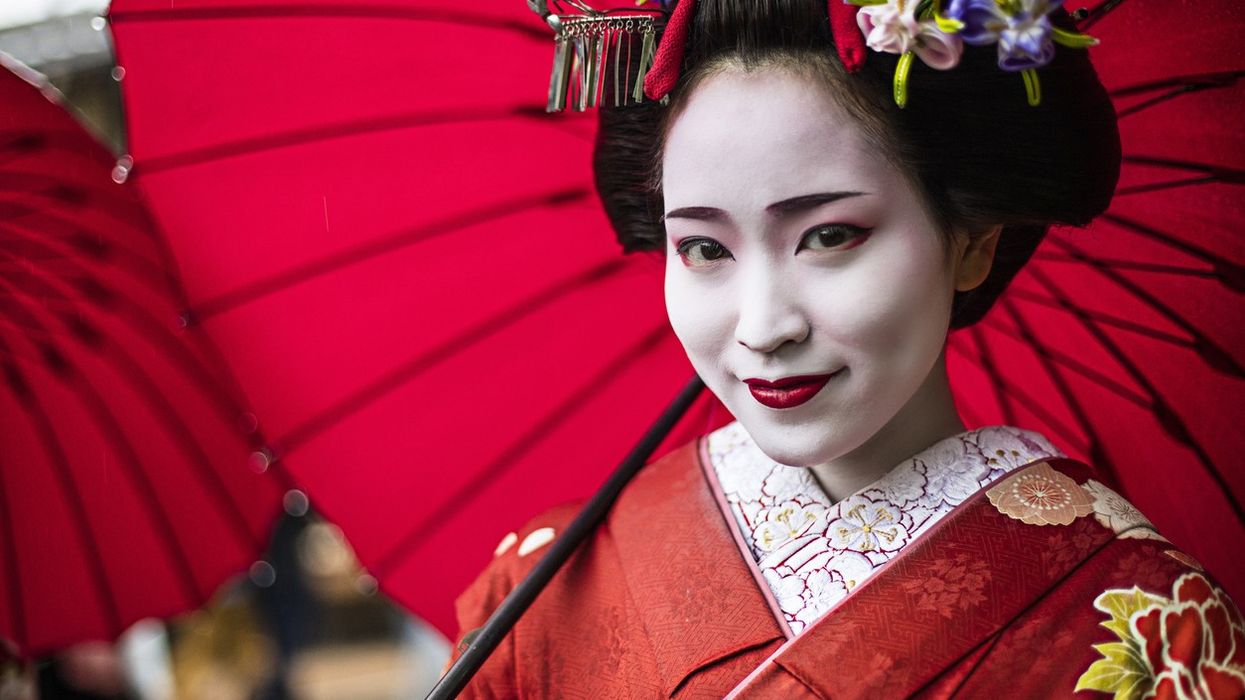

The Edinburgh Fringe Festival has been urged to introduce new guidelines after Asians claimed they were subjected to 'publicly-licenced racism' during a show, according to reports.
Campaign group, British East and South East Asians working in the Theatre and Screen industry (BEATS) demands new guidelines be introduced next year following the Tea Ceremony play, in which a white male actor appears as a geisha, a Japanese hostess trained to entertain men.
In the play, a white male actor, Marios Ioannou, appears as a geisha. The group claimed that the show is 'extremely triggering and traumatic' to those who 'bear historical weight' of historical abuses, media reports said.
The BEATS said that guidelines would prevent 'publicly licensed racism on stage'.
The statement from BEATS said: "We have no wish to see a sanitised and conservative fringe. The problem is, though, that with outdated racist performance tropes, a sanitised and conservative fringe is exactly what we get."
Meanwhile, the show’s producer has rejected any accusations of racism and Ioannou, a Cypriot performer, termed the claims as 'unfair'.
“I am in contact with the Japanese people who worked on this performance, because they did work on it and they didn’t believe it was inappropriate. We are working on an answer from all of us," the actor was quoted as saying by The Telegraph.
“It is a very big discussion about cultural appropriation in art, and we are happy to open up a dialogue. But I was surprised this was not spoken about while we were there, only after we left, which is not very nice. There will be another staging of the Tea Ceremony in London, so it would be good to sort things out before that. We were not racist, so it was a very unnecessary comment.”
The Tea Ceremony play sees the geisha begin to question her role as a servant and entertainer. It leads the audience on a journey of modern-day abuse, child labour, human trafficking, torture and slavery, and the high price we pay for our joy and greed, reports said.
The latest event happened just weeks after the Fringe cancelled the show of comedian Jerry Sadowitz due to 'homophobic, misogynistic and racist' allegations.
Recently, another Edinburgh Fringe show, Shannon Matthews: The Musical, was also stooped into controversy.
Dark comedy group K*** and the Gang have sold out their four-week run of 'Shannon Matthews: The Musical'. The performance was based on the true story of the faked abduction of nine-year-old Shannon Matthews, who was reported missing in 2008.
One of the most outspoken critics included Dewsbury's Tory MP Mark Eastwood, who helped in the search for missing Shannon in 2008, and local Labour councillor Mussarat Pervaiz who blasted the show's trivialisation as 'disgusting'.
Dewsbury West Councillor Ammar Anwar said the musical is 'bang out of order' and 'should have never been allowed'.
Nine-year-old Shannon was the victim of a faked kidnapping by her mother Karen Matthews in 2008, who drugged, tied up and hid her own daughter as she plotted to pocket a £50,000 reward.






 Curator Emma Slocombe with ikat robes and arabachi coats in the Peter the Great Room in Blickling Hall Amit Roy
 View of the entrance to Blickling Hall on a rainy autumn dayAmit Roy
 Kente cloth from Ghana in the Long Gallery in Blickling Hall
 Decoration in the Great Hall at Blickling Hall Amit Roy
 Palampore fragment made in coastal south-east India in the Brown Room in Blickling Hall Amit Roy
 Bed valance dating from early 1700s in the Italian Print Room at Blickling Hall Amit Roy
 Indian inspired fabric draped on sofas in the South Drawing Room in Blickling Hall Amit Roy
 Indian inspired fabric draped on sofas in the South Drawing Room with Indian carpet in Blickling Hall Amit Roy
 Karun Thakar has picked out the geometric patterns in the bookcase and the Kente cloth in the Long Gallery in Blickling Hall Amit Roy
 Large tapestry depicting Peter the Great defeating the Swedish army at the Battle of Poltava in 1709 Amit Roy
 ikat robes and arabachi coats in the Peter the Great Room in Blickling Hall Amit Roy
 Baghs and kanthas made by women provide contrast to the men only portraits in the Great Hall at Blickling Hall Amit Roy
 Baghs and kanthas in the entrance Great Hall at Blickling Hall Amit Roy
 Baghs and Kanthas in the Great Hall in harmony with stained glass window at Blickling Hall Amit Roy
 Kimonos reflect Japanese influence in Upper Ante Room in Blickling Hall Amit Roy
 Kimono in Upper Ante Room in Blickling Hall
 A view of the Palace and fort at Agra shows romantic side of India Amit Roy
 Blickling Hall Amit Roy
 Table carpet, European 1670-1680 Amit Roy
 Unfinished 17th century Italian embroidery in the Print Room at Blickling Hall Amit Roy
 Picture of Kashmir shows a romantic view of India Amit Roy
 A panel of Ashburnham bed hangings made in Gujarat for sale in Europe in the Brown Room in Blickling Hall Amit Roy
 Colcha made in the 1600s by women in Bengal for the Portuguese market in the Long Gallery at Blickling Hall Amit Roy




