
Highlights:
- Police say there is no real “Cat in the Hat killer”.
- Viral images and videos have been generated or staged.
- Fake police statements have added to the confusion.
- The trend has caused genuine fear among some teenagers.
- Authorities are urging people to verify social media claims.
A giant, sinister-looking Cat in the Hat wandering through British streets in the middle of the night sounds like the beginning of an unusually bizarre horror film.
But over the past few days, videos claiming to show the Dr Seuss character stalking homes and neighbourhoods have spread rapidly across TikTok and Instagram, leaving some teenagers genuinely frightened.
The reality, however, is considerably less terrifying: there is no evidence of a real-life “Cat in the Hat killer”.
Police forces in the UK and Ireland have moved to reassure the public that the viral footage is fake, with artificial intelligence, people wearing costumes and social media users adding their own locations and captions helping the story snowball.
So, where did the ‘Cat in the Hat’ scare come from?
The trend initially gained traction around Ireland, particularly in Limerick and Wexford.
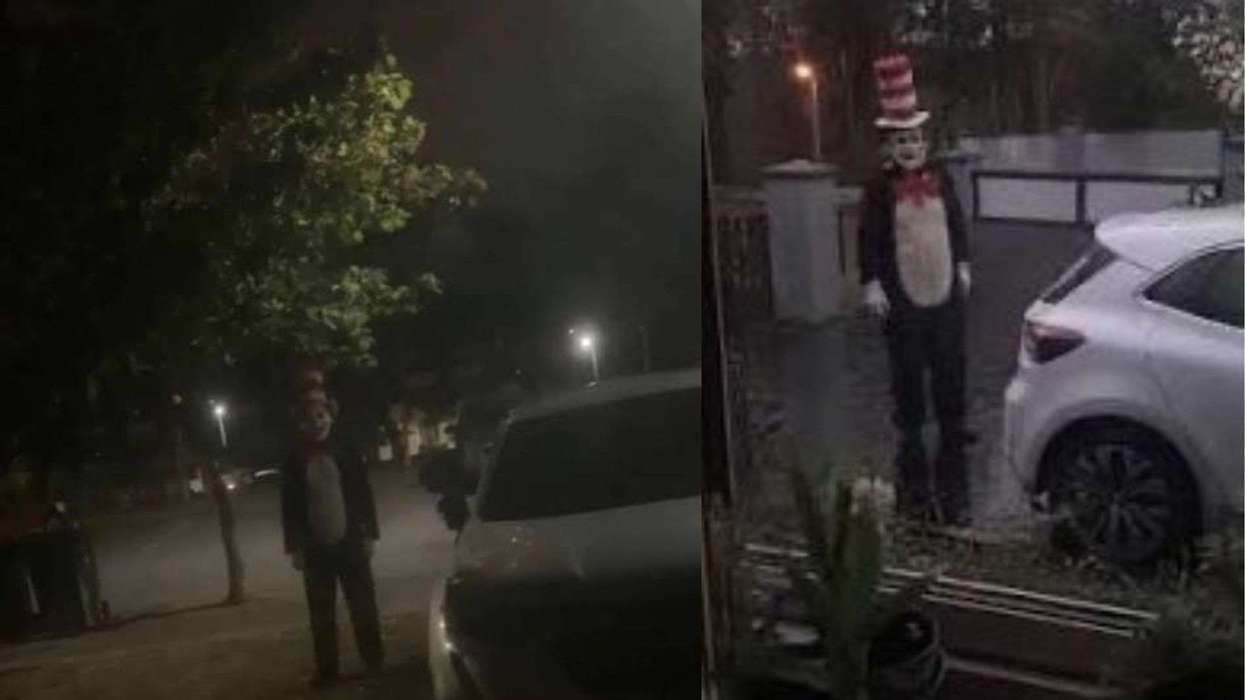
Videos appeared to show a life-sized version of the famous black-and-white feline wearing his unmistakable red-and-white striped hat. In some clips, the figure appeared to walk through streets or linger outside houses after dark.
The footage looked deliberately unsettling, shaky, poorly lit and filmed as though it had been captured by a doorbell camera.
But Wexford police were quick to explain that the images were generated using AI.
Authorities even joked that the Cat in the Hat was not hiding in local neighbourhoods.
The problem was that the clarification did little to stop the posts spreading.
As the trend moved online, users began adding British locations to similar clips. Claims involving areas across the UK appeared, creating the impression that the character was travelling from one town to another.
One particularly convincing fake police statement claimed that officers were investigating a “suspicious figure” dressed as the Cat in the Hat in the Meadowhall area of Sheffield.
There was one major problem: “Yorkshire Police” does not exist.
South Yorkshire Police subsequently confirmed that it had received no reports of such a sighting.
Its message to social media users was clear: “Please don't believe everything you read on social media.”
Why are people actually getting frightened?
For many users, the trend is simply ridiculous internet humour.
TikTok feeds are now filled with people dancing in Cat in the Hat costumes, joking about supposed sightings and creating increasingly absurd scenarios.
But not everyone is laughing.
The BBC spoke to teenagers who said the videos had genuinely frightened them, particularly when they encountered the posts late at night.
One teenager described becoming so alarmed during a sleepover that she wanted to go home after watching Cat in the Hat videos at 3am.
Another young person said the character had been frightening since childhood and that seeing apparently realistic footage made it feel as though the childhood figure had “come to life”.
There have also been claims of supposed meetings with the character, including invitations encouraging young people to go into woods at night.
Those claims are particularly concerning because, even when a viral character is fictional, real people can use the fear surrounding it to lure or frighten others.
Parents and young people therefore have good reason to treat invitations to meet strangers at night as a genuine safety issue, regardless of whether the original story is fake.
The real-life costume behind the viral nightmare
There is another surprising piece to the story.
The original Cat in the Hat costume worn by Mike Myers in the 2003 film adaptation has recently become part of the internet conversation after footage and photographs of the ageing costume circulated online.
The costume is being offered through Propstore as part of an auction featuring film and television memorabilia. It is expected to fetch between $12,000 and $24,000 (£9,000-£17,500 approximately).
An X post about the costume attracted millions of views, with commenters describing its worn and damaged appearance as unsettling.
That may have helped provide fresh material for the online trend.
From there, the phenomenon appears to have evolved into a mixture of genuine film memorabilia, people wearing costumes, AI-generated imagery, fake police announcements and users deliberately creating frightening stories around familiar locations.
The result is an internet mystery that can look remarkably convincing if viewed without context.
The trend also echoes the “killer clown” scare of 2016, when rumours and sightings of threatening clowns spread across several countries.
The important difference today is the speed and sophistication with which AI-generated images and videos can make fictional events appear real.
For anyone encountering a frightening Cat in the Hat post, the advice from police is straightforward: stop, check the source and look for confirmation from an official police account before sharing it.
The Cat in the Hat may be having a very strange moment online, but there is currently no evidence of a serial killer in the costume roaming British streets.
What is real is the power of a convincing fake to turn a joke into genuine fear — particularly when millions of people are watching, sharing and adding to the story.